Showing posts with label Ohio State Buckeyes. Show all posts

Thursday, January 23, 2014

Oregon’s integral role in the history of the grandaddy of them all

Oregon’s integral role in the history of the grandaddy of them all 

 
Originally posted on December 28th, 2011 
 
On New Years Day in 1890 the first Rose Parade was held in downtown Pasadena, CA; devised as a way to entice people from the east coast to purchase real estate in Southern California, an effort to convince those with deep pockets to escape the cold winter weather for sunny Southern California.
“In New York, people are buried in snow, here our flowers are blooming and our oranges are about to bear,” announced Professor Charles Holder, a noted author and sportsman who had moved out west in 1885 from New York. “Let’s hold a festival to tell the world about our paradise.”

Following the parade were various festive events.  In the first few years a communal picnic was held with contests such as foot races and tug-of-war battles highlighting the post-parade afternoon.  Once there was even a race between an elephant and a camel, with the elephant declared the victor.   But by 1902 it was decided that a college football game should be held to punctuate the annual Tournament of Roses festivities, matching the best teams of the east and the west.
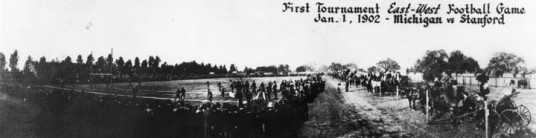

The very first East-West Game (later coined 'The Rose Bowl' was played in 1902 
Tournament Park was determined to be the location for that first game, dubbed the East-West Game, pitting the University of Michigan Wolverines (10-0) vs. the Stanford Indians (3-1-2).  Michigan had been nicknamed “the point-a-minute gang,” having racked up a season total of 550 points to zero, led by legendary coach Fielding Yost, who had been Stanford’s coach the year prior.  Almost 8,000 spectators packed the grandstands for the game following the Rose Parade, though they didn’t get to witness a complete battle as Stanford quit in the 3rdquarter, with the score already 49-0.


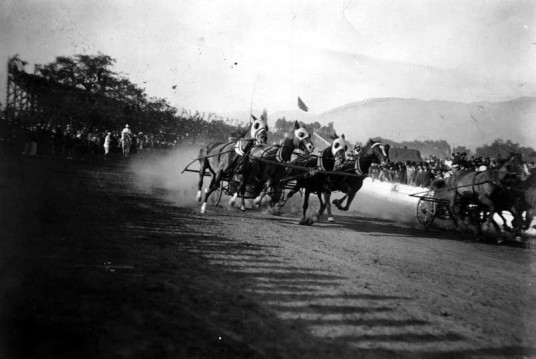
Roman Chariot Races held at Tournament Park in 1908 

Perhaps embarrassed over the lopsided affair, or the premature ending to the game, the East-West Game would not be held the next year, or the next, or the next.  In fact, 14 years would pass before a college football game would be held again in Pasadena as part of the Tournament of Roses slate of events.  During those non-football years the game was replaced with other events, such as ostrich races, polo, and Roman chariot races (which had become all the rage in the wake of the release of the book ‘Ben Hur’).

By 1916 the Great War was raging in Europe, and while the United States had remained out of the conflict, the sinking of the Lusitania in 1915 and amped-up anti-German rhetoric signaled the inevitability that America would someday join the fight.  In anticipation of that, many young men were joining the military, and military bases began fielding teams playing against collegiate squads.  When it was decided to hold another East-West Game in Tournament Park, it was (6-0) Washington Agricultural College (now known as Washington State) defeating the (5-3-1) Brown University Bruins, 14-0.  Brown was invited to play after Syracuse refused to travel cross-country again for a game, having already played Oregon Agricultural College (now Oregon State University) earlier that year.

The 2nd East-West game was held in 1916, Brown vs. Washington Agricultural College (WSU)

Despite the WAC (WSU) victory, eastern teams were considered vastly superior to football teams out west, so it was no surprise that in the third East-West Game The Penn Quakers were considered a huge favorite over the Oregon Webfoots.

Oregon even being able to physically attend the game was a difficult task.  The Oregon Webfoots had finished their season 6-0-1, with a tie against Washington, a team that had not lost a game since 1907.  Oregon was chosen to represent the brand new Pacific Coast Conference (formed in 1915).  Oregon had a larger margin of victory than Washington in their mutual opponent, California, even though Washington had actually played and beaten California twice that year, leaving Washington with one more victory tallied than Oregon.  It also helped that Eugene was closer to Pasadena than Seattle, lessening the travel expenses to reach Pasadena, still the cost associated with representing the PCC was hefty.
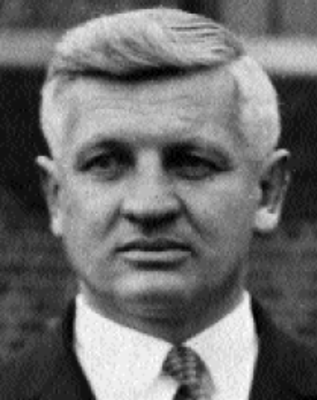

Oregon Coach/Athletic Director Hugo Bezdek 

Oregon coach Hugo Bezdek had been a man of many talents, also coaching the baseball and basketball teams while acting as the first Athletic Director at Oregon and a professor of “Outdoor Athletics.”  From 1917-1919 he also was the manager of the Pittsburgh Pirates, traveling by train between Pittsburgh and Eugene to cover his dual duties.  It was Bezdek’s second tenure in Eugene, he had coached the football team in 1906 first, before returning in 1913 after time spent with the University of Arkansas, where he coined the team nickname “Razorbacks.”  Years later after a lengthy stint at Penn State he would coach the Cleveland Browns, becoming the only person in history to coach both a major league baseball and national football league team.

Bezdek’s salary was covered by both the University of Oregon and  the student body, in fact 2/3′s came from the students (imagine the students covering the cost of Chip Kelly’s ample salary today).  Bezdeck was an innovator, a free thinker, the Chip Kelly equivalent of the early 20th century.

Oregon was one of the first teams to openly embrace the forward pass, in spite of rules existing at the time penalizing teams for incomplete throws.  Bezdek implemented odd new formations, training regimens and meals for players, and other techniques that were well beyond their years.  In later years Oregon would be among the first to utilize pre-snap motion in the 1940s, proving that Oregon has clearly been an innovator in the game of football throughout the decades, not just recently in this renaissance era of the Chip Kelly spread and flashy Nike uniforms.

In order to be able to fund the cost of an additional month’s salary for Coach Bezdek and paying for the team to travel to Pasadena, the student body sold the student-owned campus bookstore.  It was worth it to the students and the Eugene community for a chance for the University of Oregon to play in what was at the time the only college football postseason game in the country, and only the third time such a game would occur at that.  Bezdek was stripped of his roles as baseball and basketball coach so as to focus solely on football and the difficult task of shutting up the national pundits who claimed that no west coast team could compete with the might of the east.


Former Penn quarterback Bert Bell, as NFL commissioner, meets with President Harry S. Truman 

The (7-2-1) Penn Quakers featured three All-Americans, including future NFL commissioner Bert Bell (whose father was the Pennsylvania Attorney General), yet Penn had not been the first choice for the game, Harvard and Yale had both initially declined.  Despite being third choice, Pennsylvania had been a powerhouse and innovator as well in the early days of college football; declared the national champions in 1894, 1895, 1897, and 1904.  Penn was credited with creating the quarterback kick (a precursor to the forward pass), the delayed pass, and the place-kick from scrimmage i.e. field goal.  Among the legends who had played for Penn were John Heisman and John Outland, for which two of the most prestigious awards in collegiate sports are named after, along with years later Chuck Bednarik (1947-49), considered the greatest Penn Quaker of all-time.

Penn coach George H. Brooke had quit suddenly the previous season, replaced by Bob Folwell for the 1917 campaign, who had previously coached for Lafayette College (1909-11) and Washington & Jefferson College (1912-15).  Folwell, bolstered by the barrage of media already declaring Penn the victor before the game was even played, invited coaches to come see his team practice.  Among them was Amos Alonzo Stagg, legendary coach of the University of Chicago, later nicknamed ‘the grand old man of football’ for all of his feats (he was part of the initial class elected into the Football Hall of Fame).  Hugo Bezdek had played fullback for Coach Stagg at Chicago, and Stagg had been the one to recommend to the University of Oregon that they hire Bezdek back in 1906 for his first stint in Eugene.

At Bezdek’s request, Stagg compiled a scouting report of the Penn team and provided it to Bezdek in advance of the East-West Game matchup.  Again Folwell showed his cards with his team in Pasadena preparing to take on the Webfoots, inviting Bezdek to attend Penn’s final practice before the East-West Game a day before the game was to commence.  Coach Bezdek happily accepted the offer to attend, took notes, and decided to implement into his own gameplan the trick pass play that Penn demonstrated for Bezdek in practice to him as he and Folwell exchanged pointers (imagine Chip Kelly inviting an opposing coach to come watch the team practice inside the Moshovsky Center the day before a game and go over Chip’s gameplan in detail with them).

Folwell and Penn’s overconfidence would become their folly, as Oregon came ready to play on January 1st, 1917.  The Webfoots were led by three pairs of brothers, John & Jack Beckett, Leo & Robert Malarkey (Leo’s son Donald Malarkey would gain fame for being portrayed in the HBO series Band of Brothers as a member of the 101st airborne during WWII), and quarterback Charles “Shy” Huntington & Hollis Huntington.  Shy was Oregon’s first All-American, a standout at quarterback as well as a quality kicker and defensive back.  The Huntington duo, and the rest of the Webfoots led by Bezdek would have plenty in store for the Penn Quakers, and college football would never quite be the same again thereafter.

Of course going into the game Coach Hugo Bezdek, ever the strategist, played up the David vs. Goliath matchup to the media perfectly.  “I’ve got only overgrown high school boys, while Penn can field a varsity of big university strength, we haven’t a chance,” he said.  “We are going to put a team on the field that won’t be licked and consequently can’t be licked,” Folwell meanwhile boasted to the press.
 
The 1917 EAST-WEST GAME (3rd Rose  Bowl)
 
Anticipating a larger crowd than usual, the city had built temporary grandstands to house the 25,000 fans that packed the sidelines at Tournament Park for the Oregon-Penn game, culminating the annual Tournament of Roses event.  Meanwhile back in Eugene, the Heilig Theater (located where the Hult Center now stands) was packed to the rafters with folks watching a simulated football field on stage being updated with the assistance of a telegraph and megaphone announcing each play as they were relayed over the wire.
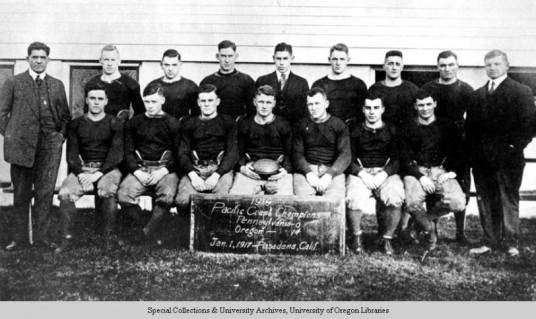

Pacific Coast Conference Champions, the 1916 Oregon Webfoots 
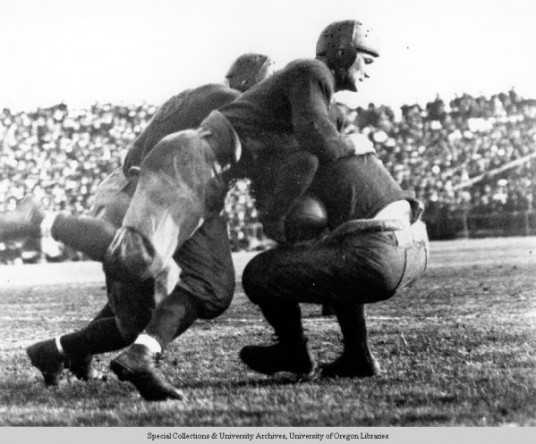
On the field it was a defensive struggle, with Shy Huntington shining.  In an era when teams rarely threw the ball, Huntington intercepted three passes on the day, and would have had a fourth pick but it was called back on a penalty.  Even with the turnovers, it was Penn who first threatened to score, moving the ball to Oregon’s 4-yard line after recovering their own blocked kick followed by a 20-yard run by Penn quarterback Bert Bell setting up the Quakers in scoring range.  The Quakers would be stymied though, as Bell was sacked forcing a field goal attempt that sailed wide.  It remained a scoreless tie at halftime.


Shy Huntington brings down a Penn player in the 1917 Rose Bowl 

The defensive stop was just what the Ducks needed to turn the tide.  Howard Angus, a writer for the Los Angeles Times, noted the following: “The Webfoots defense were steadied as if someone had given them a shot of hop. A big grin spread over their faces that never was erased. From then on Oregon was unbeatable.”

In the third quarter, Oregon finally broke the game open.  Utilizing the same trick pass play that Penn Coach Bob Folwell had invited Coach Bezdek to witness the day prior, Shy Huntington connected with Lloyd Tegart for a 15 yard touchdown.  Shy knocked in the extra point to give the Webfoots a 7-0 lead over the much-favored and clearly frustrated Penn Quakers.

“Imagine what we thought and said when Oregon scored its first touchdown on our own play,” said Bert Bell to reporters after the game, as quoted in the Los Angeles Times.
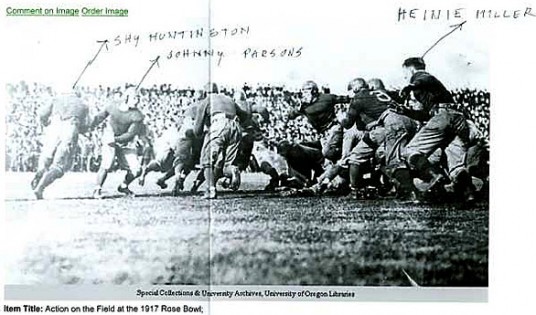

Shy Huntington and Johnny Parsons in action vs. Penn in the 1917 Rose Bowl 

The battle continued, highlighted by Huntington’s great defensive play and John Beckett’s tremendous job in the trenches controlling the line of scrimmage.  In 1953 when MVPs of the Rose Bowl were first assessed, Beckett was retroactively awarded the MVP of the 1917 East-West Game (3rd Rose Bowl).  With each defensive stop the Oregon Webfoots’ confidence grew.  Penn’s much ballyhooed passing attack was stopped in its tracks by Shy Huntington’s interception hat trick, held to only 32 passing yards on the day while Oregon racked up 131 through the air, while Beckett was leading the push up front to allow for the Oregon ground game to grind it out.

In the 4th quarter, the Webfoots broke through again.  A 40-yard run by Johnny Parsons set up Oregon at the 1-yard line, where Shy Huntington ran it in for the second touchdown.  Huntington added the extra point, making it 14-0.
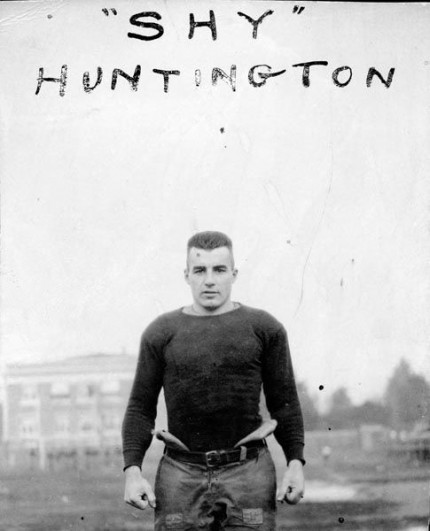

Charles "Shy" Huntington, quarterback/kicker/safety and later coach at Oregon 

Taunts emanated from the Oregon team, “Are the city boys getting tired? Came west to teach us football, did you?” (source: Los Angeles Times) in the wake of the stunning score, while back in Eugene it was jubilation as the score was announced inside the Heilig Theater.  The score would stay, Oregon had shut out their opponent for the fifth game in a row to end the season, stunning the Penn Quakers in a 14-0 upset victory in the East-West Game at Tournament Park, the third Rose Bowl.  Fittingly the game ended with Huntington intercepting a Pennsylvania pass at the end of a long 79-yard drive, and the Webfoots ran out the remainder of the clock to seal the victory.

Oregon had barely outgained Penn, with the Webfoots totaling 242 yards of offense to Penn’s 230, but it was the staunch defensive effort that Oregon displayed that made the game feel like a rout.
Completely bewildered, Coach Folwell said after the game, “We ran into a batch of football that was a cross between a zip of forked lightning and the roll of a fast freight.” 

Folwell would not be the last to grossly underestimate the University of Oregon’s abilities and will to fight against superior talent.

Harry A. Williams of the LA Times joyfully wrote after the game, “west coast teams would lick the stuffing out of every eastern team which ventures far enough away from home to make the discovery that all the football in the world is not bounded on the west by the Mississippi River.”  That sentiment may have been proven by the game outcome at the time, yet as we all know the now infamous ‘east coast bias’ still rings very true nearly a hundred years later.
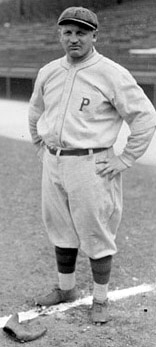
 

Hugo Bezdek, as manager of the Pittsburgh Pirates
 
Three months later the United States officially entered The Great War, and campuses across the country drastically changed, including the University of Oregon.  So many young men enlisted or were drafted that the following season Oregon could barely field enough bodies to practice much less play, while military bases sported their own teams comprised of former collegiate superstars.  Bezdek meanwhile had a big change as well, as he was hired to be the manager of the Pittsburgh Pirates and commuted between Pennsylvania and Oregon.  The Huntington brothers entered the military along with the vast majority of the male student body at Oregon to serve their country in the call to arms.

However, an odd twist of fate would keep Oregon’s ties close to the Rose Bowl during America’s involvement in World War I in 1917 and 1918.  After the 1917 baseball season ended, Hugo Bezdek was asked by the United States Marine Corps to become the football coach for a USMC team, the Mare Island Marines of California.  The team just happened to feature two new enlistees that Bezdek was particularly familiar with, Hollis Huntington and John Beckett, Bezdek’s former stars at the University of Oregon.

The Mare Island Marines of California finished the year 5-0, and with the nation caught up in patriotic fervor it was decided that for the 1918 East-West Game (Rose Bowl) two military teams would be featured.  Sure enough, Bezdek’s Mare Island Marines were asked to play against the Camp Lewis Army team (5-1-1) from American Lake, WA.
 
BEZDEK, BECKETT & HUNTINGTON RETURN DURING WAR TIME
 

Crowd shot from the 1918 East-West Game, Mare Island vs. Camp Lewis 

It was an odd but familiar site as the former coach and former players accompanied the rest of the Mare Island USMC team to Pasadena, CA and Tournament Park, the field where exactly a year prior Bezdek had tutored Beckett, Hollis and his brother Shy to a victory over Penn.  President Woodrow Wilson had personally approved the two military teams playing each other in the East-West Game, with the vast majority of America’s premier football players already overseas in the trenches of the European western front or preparing to leave shortly.

The fact that a war was raging overseas hung a dark cloud over the game, while jubilant and patriotic in nature there was also a sense that this game was just a temporary respite before the young men fighting on the field would soon be instead fighting in the trenches of the war to end all wars, with most scheduled to go overseas within weeks of the game’s completion.
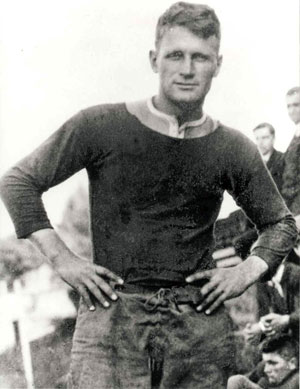

John Beckett played in two East-West Games, for Oregon (1917) and Mare Island (1918) 

“This would be the last battle that we would fight in the name of sports,” said John Beckett to reporters prior to the game.

There was no scoring in the first quarter, but in the 2nd quarter Bezdek’s boys from Mare Island got on the board thanks to a 31-yard drop-kick field goal to take the lead 3-0.  The Army team responded with a 6-yard touchdown run by E.L. Romney, the primary weapon in Camp Lewis’ arsenal, taking the lead 7-3.

It would prove to be Camp Lewis’ only bright spot on the day, as the Webfoot trio now in military garb were simply too powerful.  The first half finished with Mare Island quarterback Jap Brown running in for a 5-yard touchdown, though the extra point attempt failed, leaving the score 9-7.

In the fourth quarter Mare Island would extend their lead, scoring with a 1-yard touchdown plunge by Hollis Huntington, and finishing off the game with a 33-yard field goal to defeat Camp Lewis 19-7.  It was Mare Island of California Military Base going down in the record books as the victor, but it might as well have been the University of Oregon credited with being back-to-back champions with Beckett and Huntington being such integral parts of the game while being coached by Bezdek.  Hollis Huntington would be retroactively named the game’s MVP when the award started being given out in 1953, making the Mare Island teammates Huntington and Beckett the owners of two of the first four MVP titles.

Indeed Beckett’s pre-game prediction held true, while Bezdek returned to his coaching duties for both the Pittsburgh Pirates and the University of Oregon, the men who played in the 1918 East-West Game later known as the Rose Bowl would mostly go overseas to fight for their country.
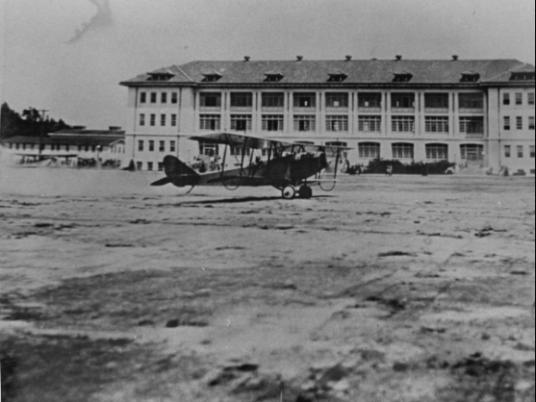

The parade grounds of Mare Island during WWI, near Vallejo, CA 

Armistice Day, the day the war officially ended, was November 11th, 1918, though some sporadic fighting continued on into 1919. There was still a great deal of post-war work to be done by the military with the wounds of the conflict still fresh, while the world simultaneously was losing millions of lives to a global influenza pandemic.   Once again, for the 1919 game it was military teams squaring off against each other.  This time it was a US Navy team (Great Lakes Naval Training Station) defeating the USMC team (once again represented by Mare Island of California), 17-0.

However, this was not the same Mare Island team, none of the same players were there, as they had all been shipped out for the war.  Not even Hugo Bezdek returned, instead William H. Dietz coached Mare Island in 1919.  The US Navy team was led by fullback George Halas, named MVP of the game, who later known as “Papa Bear” became an NFL Hall of Famer for his time as head coach of the Chicago Bears.
The US Navy Team defeated the USMC team in the 1919 game 

As for Hugo Bezdek, the strain of coaching at Oregon, and running a major league baseball team in Pittsburgh, and coaching the Mare Island team was too much of a strain.  By 1918 he had enough of cross-country travel and wrote a letter to the University of Oregon from his home in Chicago, IL.  “I am in too nervous a condition and unable to think or concentrate.”  With that, Hugo Bezdek’s days leading the Oregon Ducks were over.

However, Bezdek’s time at the Rose Bowl was not.  Choosing to find a position a bit closer to home that wouldn’t involve quite as much cross-country rail travel, Bezdek took the job as the new football coach at Penn State University, where he stayed from 1918 to 1936 as both coach and athletic director.  During his time at Penn State he turned the program into a national powerhouse, a stature it retains today despite the recent sex scandal that has rocked Penn State to its foundations.

Bezdek led Penn State to two undefeated seasons, and a trip to the Rose Bowl in 1923 (a 14-3 loss to USC), the inaugural game in the newly built Rose Bowl stadium, the construction of which had begun in 1921 when the city of Pasadena realized that the annual football game was becoming larger than what Tournament Park could hold.
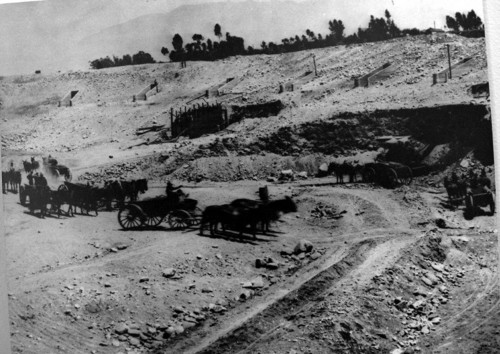
Construction of the Rose Bowl began in 1921, completed in time for the 1923 game 

The 1923 game in the new stadium would also mark the first time that the ‘East-West Championship Game’ as it had become known would thereafter be referred to as ‘The Rose Bowl,’ the first official college football bowl game.  Bezdek at Penn State resumed his multi-sport ways, coaching the Penn State basketball and baseball teams as well.

Hugo Bezdek remains the only person to have coached three different teams in the Rose Bowl, with a record of 2-1.  He also remains the only person to coach a major league baseball team and national football league team, and was elected to the College Football Hall of Fame in 1954.
 
1920 ROSE BOWL: THE HUNTINGTON’S RETURN
 
While Bezdek’s departure from the Oregon program was difficult, it also was somewhat of a relief as his hefty salary had become a strain on the University and student body, who had to flip the majority of the bill.  The question remained though, who would replace the genius who had turned Oregon into a west coast powerhouse?

With the war now over and the country settling back into a somewhat-normal routine, it seemed a natural fit that Oregon’s first All-American and the hero of the 1917 Rose Bowl would return home the conquering hero, Charles “Shy” Huntington.  While Bezdek’s ominous shadow was a large one to overcome, Huntington went about his work as both new football coach and also baseball coach for the University of Oregon.  Huntington would remain at the helm for six seasons, leading Oregon to a 26-12-6 record, finishing 4-2 in 1918 his first year, 2nd best in the Pacific Coast Conference.
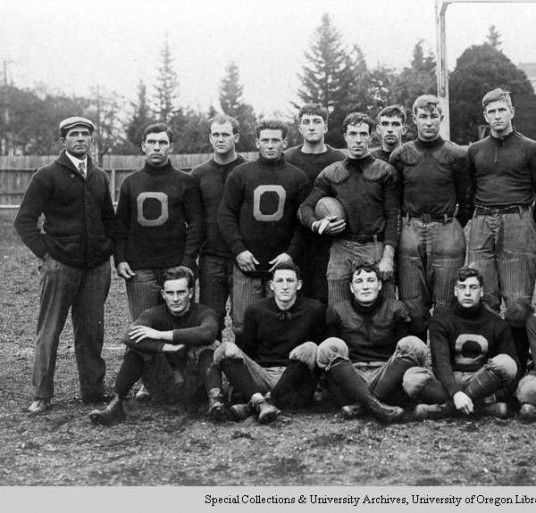
Oregon's 1919 team, led by coach Shy Huntington (far left) 

In 1919 with the boys returning from overseas, Huntington’s team was bolstered by the return of a familiar face to the University of Oregon, his brother Hollis.  There were a few other returning players from the 1918 team, and just like in 1916 the Webfoots were led in part by multiple pairs of brothers; Francis & Vince Jacobberger, Earl & Keith Leslie, and Bill & W.H. Steers.  Also rounding out the roster was Neil Morfitt, the grandfather of Neil Everett (Morfitt), the ESPN sportscaster and Oregon alumnus who often includes Oregon references in his nightly sports highlights on Sportscenter.

Oregon also had a proud new gem of a stadium to demonstrate their dominance, as the newly built Hayward Field replaced Kincaid Field to house Oregon’s athletics, though bigger games were often played in Portland at Multnomah Stadium to accommodate the larger crowds expected.
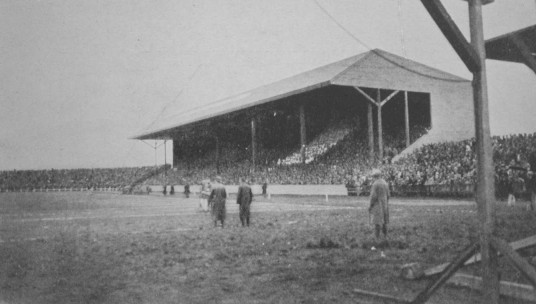
Hayward Field 

Huntington’s team started the 1919 campaign out well, defeating MAAC, Idaho (a game in which Huntington scored 4 TDs), and Washington all in convincing fashion.  But a 7-0 loss to Washington Agricultural College (WSU) was a disappointing shocker, in part due to a series of crushing injuries suffered the week prior vs. UW.  Oregon would finish the year defeating their rival, Oregon Agricultural College (Oregon State University today), and MAAC once more for a 5-1 record, tying with Washington as Pacific Coast Conference co-champions.

During the game against rival OAC (OSU), a ceremony had been held officially naming the new structure Hayward Field after track coach and trainer Bill Hayward (who coached at Oregon from 1903-1947).  However, nobody notified him of the honor being bestowed upon him, and he was not present for the event, busily tending to his duties as team trainer back in the locker room at the time.  He found out of the honor the next day while reading the newspaper recap of the game.

Behind the scenes there was grumbling about Huntington not being cut out for the coaching job, and an effort was made to entice Bezdek to return to Oregon.  Huntington’s teams were winning, but not in the same dominating fashion that Bezdek’s Webfoots had been known for, and a longing eye was cast eastward to the success Bezdek was having with his new team, the Penn State Nittany Lions.  Bezdek declined the offer, he would remain at Penn State and Huntington like it or not would stay as Oregon’s coach.

Despite a tie at the top of the conference, once again it was Oregon selected to participate in the Tournament East-West Football Game over Washington for the January 1st, 1920 affair.  This time east coast powerhouse Harvard would be the foe, the eventual national champions (a title that it shared with Illinois).  Harvard was undefeated, with a tie to Princeton their only blemish.
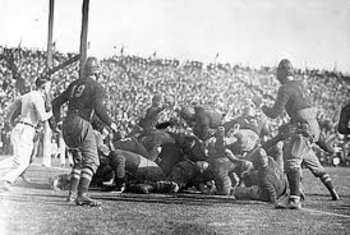
The 1920 Rose Bowl, Harvard vs. Oregon 

With older brother Charles “Shy” Huntington as coach and younger brother Hollis leading the way as star fullback, the Webfoots seemed a solid foe, yet once again east coast bias raised its ugly head.  The faces may have been familiar from the 1916 shocking defeat of Penn, but Harvard was the pride of the east coast and once more the media overwhelmingly chose the east coast team as the clear favorite.  No matter to the Huntington’s, they had been through all of this before, Hollis especially having played not only in the 1917 game but the 1918 matchup as well while a member of Mare Island.

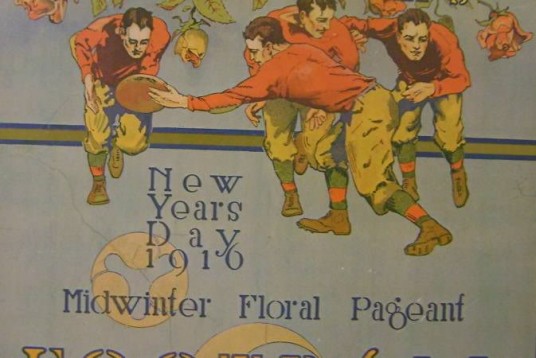
Program from the 1920 Rose Bowl, Harvard vs. Oregon 

The game would have special distinction for Hollis Huntington, as the only player in history to participate in three East-West (Rose Bowl) games, and the only one to ever do so for two different teams.

The game began exactly as the previous ones had, with no scoring in the first quarter as each side fought to achieve supremacy over the opponent.  And just like in 1917 and with Mare Island in 1918, it was the Webfoots striking first.

The scoring began in the 2nd quarter when quarterback Bill Steers nailed a 25-yard drop kick to take a 3-0 lead.  Oregon was moving the ball well, but once the Webfoots got within scoring range the big Harvard Crimson defense would stiffen, stifling their attack.  Hollis Huntington was scorching the Crimson defenders, he would finish the day with 122 yards on 29 carries, but the endzone eluded Hollis and the Webfoots.

Harvard responded with one long drive in the 2nd quarter following Steers’ dropkick, resulting in a touchdown, a 13-yard run by Fred Church.  Harvard took the lead 7-3, and on this day it would prove to be enough.  It wasn’t without great effort by Huntington’s Webfoots, but yardage churned up in the middle of the field couldn’t result in points at each end against the Harvard defense.
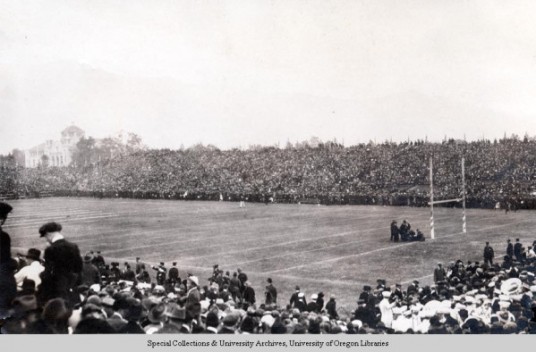
Additional grandstands were built at Tournament Park for the large crowd to witness the Oregon-Harvard game 

Late in the 2nd quarter Oregon did manage to score again, on a 30-yard drop kick by diminutive backup quarterback C.R. “Skeet” Manerud, who weighed in at barely 128 pounds, making the score 7-6.  The remainder of the game was a repetitive affair, Oregon would stop Harvard only to storm down the field, but couldn’t convert on kick attempts.  Three times Oregon’s attempts to take the lead resulted in a kick either missed or blocked.

Harvard was barely clinging to a 7-6 lead while clearly getting outplayed by Oregon.  As the game wore on, Skeet Manerud again had a chance to take the lead, but his kicked sailed barely a foot wide of the goal posts.  It was so close in fact that the scoreboard operator deemed it good, temporarily giving Oregon a 9-7 lead, but the referees overruled it and took the points off the board.  Despite Oregon’s overwhelmingly dominant performance, the game would end with no points scored in the 2nd half, and an agonizing 7-6 loss to Harvard.
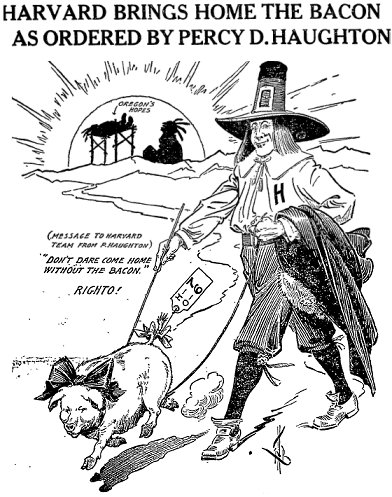

The Harvard Crimson barely escaped the East-West game vs. Oregon with a 7-6 victory 

Despite the loss, Oregon was clearly the better team that day, and in the papers they were coined “The Team That Outplayed Harvard.”  The bitter loss only increased the behind-the-scenes awkwardness as Oregon officials continued to believe they could lure Bezdek back to Eugene to take over for his protégé Shy Huntington.  This futile pursuit of Bezdek continued intermittently for several years.
 
While Huntington’s teams continued to win, never losing more than two games in a season, Oregon officials pestered Bezdek to leave Penn State and come back to Eugene.  At one point Bezdek did make a cross-country trip to visit his old school, where he was welcome by a crowd of nearly 2,000 hailing him as a hero, honoring him during a ceremony where Huntington was awkwardly prodded to address the crowd and state “He is the best coach in the United States and I hope that Oregon may hope someday to have Hugo Bezdek come back.”

By the 1923 season, Shy Huntington had enough of the unwelcome attitude.  In his letter of resignation he wrote, “Each year my teams have been with me, but the alumni have not.  They have demanded a high-priced coach, and not for a moment does it appear to have entered their heads that a hometown boy might possibly be a good coach.”  In the wake of Huntington’s resignation, Oregon officials again tried to bring Bezdek back to Eugene, again he declined.


Hugo Bezdek chose to stay a Nittany Lion despite Oregon's repeated attempts to bring him back to Eugene
 
OREGON’S GLORY DAYS END IN THE POST-HUNTINGTON/BEZDEK ERA
 
With the last traces of the Huntington’s no longer a part of the program, Oregon’s glory days were officially over.  The Pacific Coast Conference had been dissolved, and Oregon had not been invited to be a part of the newly formed “Big 3” conference.  Hayward Field had been expanded to house a larger crowd, but the days of Oregon’s dominance on a national level would not return for some time.
Meanwhile in Pasadena the popularity of the annual Rose Parade was blooming, and the Tournament East-West Football Game had given way to an official re-naming to the Rose Bowl by 1923, with the construction of their new jewel of a stadium built on the former grounds of Tournament Park.  Originally a horseshoe design, the Rose Bowl would years later be fully enclosed as a bowl and expanded several times to its current capacity.
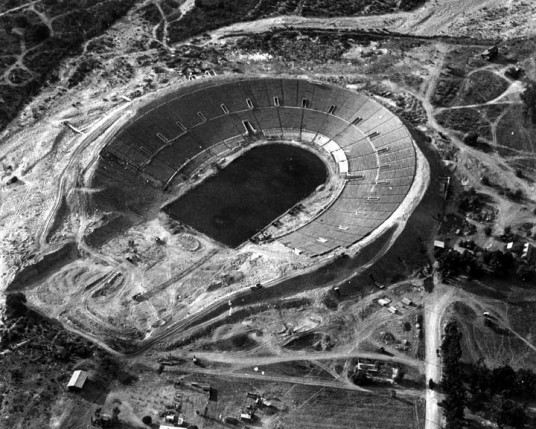

The original horseshoe design of the Rose Bowl 
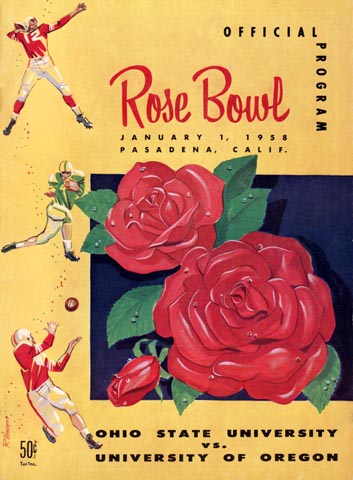
Other bowl games eventually appeared as college football rose in nationwide popularity, but the Rose Bowl is appropriately deemed “the granddaddy of them all,” the oldest and most prominent bowl game in the country.  It still is played on new years day every year following the Tournament of Roses Parade held in Pasadena, unless new years falls on a Sunday in which case the events are delayed until the 2nd.  There was a brief time during World War II that the game was moved out east, fearing that the stadium could fall under Japanese attack, but the Rose Bowl remains the grand old gem of stadiums, host of the granddaddy of them all, the annual Rose Bowl game.


The 1958 Rose Bowl was Oregon's first return to the game since 1920 

Oregon’s participation in the Rose Bowl would not be nearly as prominent as it was in establishing the game’s foothold as the East-West Game.  The Ducks as they were now known would not return to the Rose Bowl until the 1957 season, losing 10-7 in the 1958 game to #1 ranked and national champion Ohio State, a game where once again the heavily favored east coast team was vastly outplayed on the field by the scrappy Ducks.

As Ohio State fans celebrated the victory, Oregon coach Len Casanova was carried off the field on the shoulders of his players in triumph regardless of what the scoreboard read, Oregon again even in defeat shocking the football world and opening the eyes of everyone that west coast teams could compete toe-to-toe with the big boys east of the Mississippi.
 
It would be another 37 years before Oregon would return, facing off against the Penn State program that years earlier their former coach and hero Hugo Bezdek had spent decades building into a national power.  It was a welcome return for Oregon to the granddaddy, but one that would again end in frustration despite a valiant effort, as Oregon squandered multiple scoring opportunities and lost to the Penn State Nittany Lions 38-20.
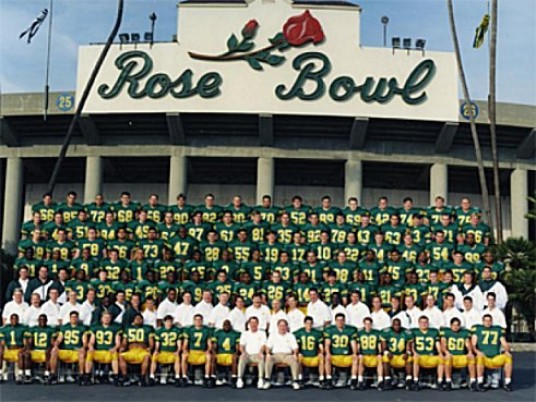

The 1994 Oregon Ducks returned to the Rose Bowl for the first time in 37 years 
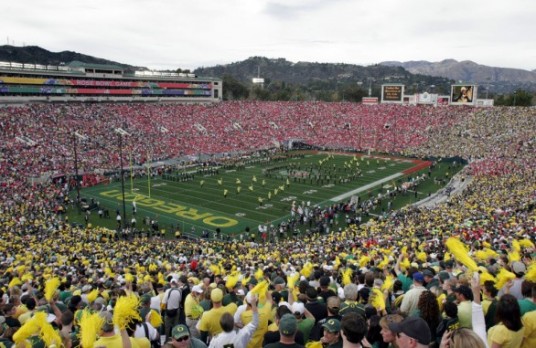
The 2009 season for Oregon started off with an embarrassing loss, but was followed by a remarkable winning streak that ended with a brilliant victory over Oregon State to seal the Pac-10 conference title and Oregon’s chance to once more play in the bowl game that the school had helped make famous back in Huntington & Bezdek’s era.  Again, Oregon would come out on the short end, losing to Ohio State 26-17 in the 2010 Rose Bowl.


The 2010 Rose Bowl, Oregon vs. Ohio State 

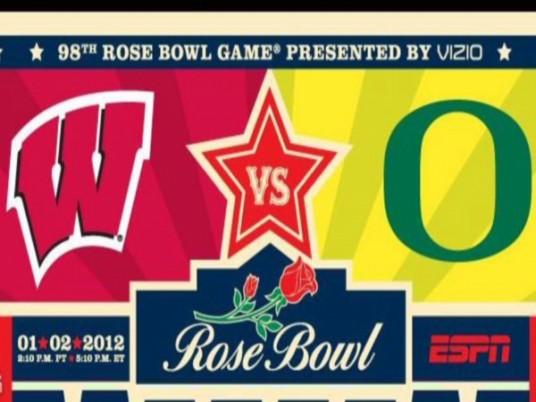
Now, in less than a week Oregon again returns to the Rose Bowl, the granddaddy of them all, Oregon vs. Wisconsin.  Oregon is 1-4 in games played in the event, having outplayed their opponents in 1920 and 1958 but suffering the loss nonetheless.  Perhaps distant memories of the Huntington brothers, the Beckett duo, and the legendary coach Hugo Bezdek that helped establish Oregon as the focal point of the success of the grand old event can lead the Ducks to victory one last time, after all sixth time’s the charm I hear.  As Bezdek and the Huntington’s proved in those early years of the game, all they need is a chance for Oregon to prove their worth.

An interesting sub-text exists with Oregon’s first Rose Bowl, and the opponent of their next one.  1916 was the first season that Oregon used their fight song, “Our Mighty Oregon,” coincidentally the first year they played in the Rose Bowl.  Now less than a week away before their next Rose Bowl, Oregon is playing the team whose song they borrowed prior to 1916.  Indeed, before that 1916 season when Oregon’s prominence in college football began, Oregon used a variation of the fight song “On Wisconsin” during events, with the lyrics slightly changed, as the official school song.
 

1958 Rose Bowl: a recipe for overachievement repeated 37 years later

 1958 Rose Bowl: a recipe for overachievement repeated 37 years later

Originally published on FishDuck.com on September 7th, 2011
 
 
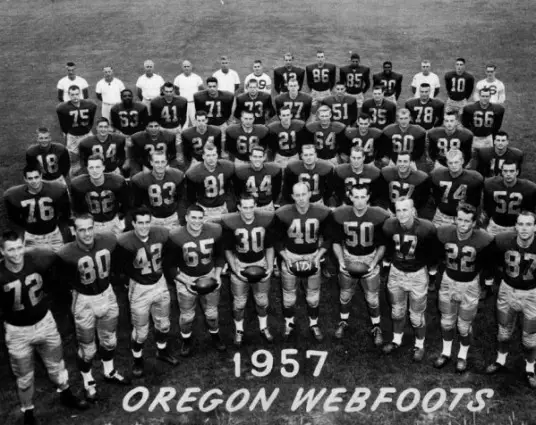
The 1957 Oregon Webfoots were an unlikely conference champion, the scrappy ugly ducklings that overachieved proving the nation to not underestimate Oregon.  Decades later, Oregon would have an encore of this in eerily similar circumstance and comparable results, but the country would never again take Oregon lightly thereafter.

The 1957 Oregon Webfoots overachieved and earned national respect for their play in the 1958 Rose Bowl. Photo Courtesy: Special Collections & University Archives: University of Oregon Libraries
 
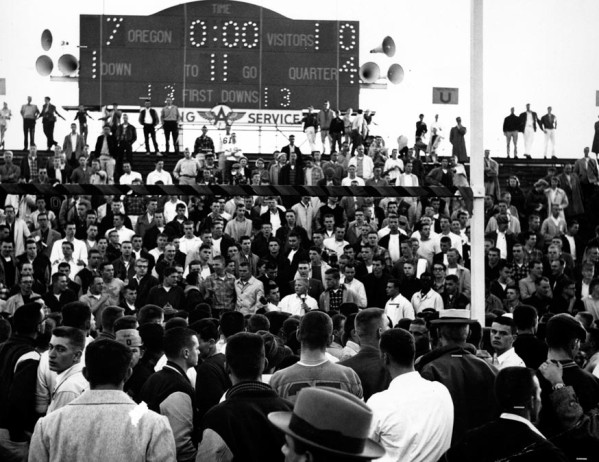
The Pacific Coast Conference was owned by the state of Oregon that year, though few expected it, with both Oregon and OSU having only one loss each on the year going into the Civil War.  However, Oregon had already clinched the right to represent the PCC in the Rose Bowl over Oregon State thanks to the previous week’s victory over USC because at the time there was a “no repeat” clause, which left Beaver fans grumbling when OSU defeated Oregon in the 1957 Civil War 10-7, yet it was Oregon that was Pasadena-bound.

The game, in typical Civil War fashion, was not without great controversy, as Oregon halfback Jim Shanley dove for a touchdown as time expired, but the referees ruled that he had fumbled just prior to crossing the line.  Despite Oregon State claiming the PCC title, the Ducks headed south for winter for their first trip to the Rose Bowl since 1920.


Despite losing the Civil War, Oregon received the invite to the 1958 Rose Bowl because of the PCC's 'No-Repeat" clause. Photo Courtesy: Special Collections & University Archives: University of Oregon Libraries
 
37 years later, another Oregon Ducks team in 1994 would improbably fight their way through the Pac-10 conference schedule, finding themselves conference champions playing in the Rose Bowl following the blueprint set in 1957, led by a coaching staff that included defensive line coach Joe Schaffeld, who had played for the Ducks in the game in ’57.

It hadn’t been easy getting to the Rose Bowl in 1957 or 1994, nearly every game was a close battle with some odd circumstances coming down to the wire.  In 1957 in the second week of the season Oregon had led Pittsburgh 3-0 until the final 20 seconds when quarterback/cornerback Jack Crabtree gave up a long touchdown pass over the top that resulted in a heartbreaking 6-3 loss.  37 years later, an embarrassing blowout loss to Hawaii got Oregon’s season off to a very rough start.  For both the 1957 and 1994 Oregon teams, their ugly starts gave little confidence that either would play any factor in the conference standings that season.

In 1957 against Washington State, a dog ran onto the field just as WSU was about to kick the game-winning field goal, distracting the kicker just enough to miss wide resulting in a 14-13 Oregon victory.
 
Big wins over UCLA, San Jose State, and Cal were balanced out with a string of close nail-biters against Idaho, Pittsburgh, Stanford Washington, USC, and OSU.  Oregon was winning its games, but it wasn’t aesthetically pleasing, more of a blue collar by-any-means-necessary approach scrapping and clawing out tough victories.

The team was led by quarterback Jack Crabtree, brother of Tom Crabtree, who had been the quarterback at Oregon the previous two seasons.


Oregon head coach Len Casanova, assistant coach John McKay, and Oregon QB Jack Crabtree. Photo Courtesy: Special Collections & University Archives: University of Oregon Libraries
 
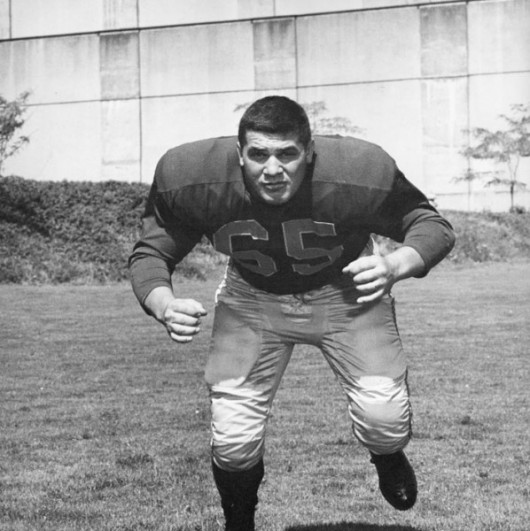
Crabtree had a wealth of running backs to give the ball to, including speedy fullback Jack Morris, who would go on to a 4-year career in the NFL, the elusive Willie West, and Jim Shanley, who finished the year with 693 yards making him the all-time career leader in rushing yards at Oregon.  Shanley along with guard Harry Mondale were both named to the All-Coast Conference team, but much like in 1994 when Oregon would next return to the Rose Bowl, few had anticipated that this underdog group of also-rans had any legitimate shot to compete alongside the powerhouses of the day USC, UCLA, Washington, and Oregon State.


Harry Mondale was one of two All-Conference players for Oregon in 1957, but he was injured on the third play of the 1958 Rose Bowl, making Oregon's task to compete with the Buckeyes that much harder. Photo Courtesy: Special Collections & University Archives: University of Oregon Libraries
 
The task was thought to be impossible, to simply hang with the top-ranked Ohio State Buckeyes in the Rose Bowl.  Almost nobody thought Oregon had any chance whatsoever to win.  Yet Oregon’s run to the roses had been impressive and had moments that turned heads, including Oregon’s 21-0 shutout victory over UCLA and a 16-7 victory over USC where fullback Jack Morris had run for 212 yards.
 
Ohio State was ranked #1 in the coaches poll and #2 in the AP poll behind Auburn, though the Tigers were on probation due to recruiting violations and ineligible to participate in post-season play.  The Buckeyes, stacked with a roster of All-Americans and future NFL hall of famers, were widely considered the top team in the nation.

Oregon may have been lacking in superstars, but it was a collective effort struggling to earn victories through sheer will that came to define the 1957 Webfoots, a blueprint that also defined Oregon in the coming decades, particularly the 1994 team that followed in the 1957 team’s footsteps to face a team in Penn State that  most agreed should have been national champions.

In fact the parallels between the 1957 Oregon team and 1994 team are stunning.  Both were led by impressive coaching legends that define Oregon’s proud past, Len Casanova and Rich Brooks.  Both started off the season with tough out-of-conference losses and were not expected to compete for the league title.  Both teams lacked superstar names or great size/speed/athleticism that was thought to be able to consistently compete with the best teams in the nation.  It had been 38 years since Oregon played in the Rose Bowl when the 1957 team made it, for the 1994 team it was 37 years.  In 1957 Oregon faced a Big-10 coaching legend in Woody Hayes, in 1994 it was the only Big-10 coach who could surpass the immense shadow of Hayes’ legacy, Joe Paterno.


The Oregon Ducks team in 1994 was the first to return to the Rose Bowl since the 1957-58 Oregon Webfoots
 
What they may have lacked in stature on the surface, both the 1957 and 1994 Oregon teams made up for by perfecting the art of football synergy, working together to overcome their flaws to defeat teams thought far superior that year to improbably make a run to the Rose Bowl.  The 1957 team was the first Oregon squad that defeated all four California schools in a single-season, the 1994 team didn’t play UCLA but defeated the other three.  This straight sweep of all California schools would not be accomplished again by an Oregon team until the perfect 12-0 regular season Oregon had in 2010 on its way to the national championship game.

The 1957 team featured a string of unlikely victories over highly ranked opponents like USC and UCLA to propel Oregon to the Rose Bowl.  The same could be said 37 years later, when Oregon’s 1994 team defeated USC, Washington, and Arizona in games where it seemed unfathomable that the Ducks could defeat such powerful teams.
 
 
The 1957 co-national champion Ohio State Buckeyes boasted a stacked roster of All-Americans including Jim Marshall, Joe Cannavino, and Dick Lebeau.  1994 Penn State was led by multiple All-Americans and NFL stars, including Kerry Collins, Kyle Brady, Bobby Engram, and the #1 overall NFL draft pick Ki-jana Carter.

In both 1957 and 1994 it was considered a laughable David vs. Goliath matchup, no self-respecting sports writer in the country giving Oregon any legitimate shot…why should they?  In 1957 Oregon had made it to the Rose Bowl over Oregon State because of a no repeat-clause, not because they were the best team in the conference as decided on the field, and in 1994 it was thought a fluke that Oregon was there, while Penn State was consensus #1 in the country for much of the season.
The common thread among news stories of the day in 1957 was that this would be the most mismatched game in the 44-year history of the Rose Bowl, and that Oregon didn’t even deserve to be on the same field as the Buckeyes.
 

The 1958 Rose Bowl was considered one of the biggest mismatches in the game's history, but the game played out much differently from expectations
 
Len Casanova’s team didn’t look the part of a great football team, nicknamed “The Ugly Ducklings.”  What Oregon lacked in overall talent, they made up for in competitiveness and grit.  Never underestimate the motivation of a defiant group being told they shouldn’t even show up or they will be laughed out of the building.


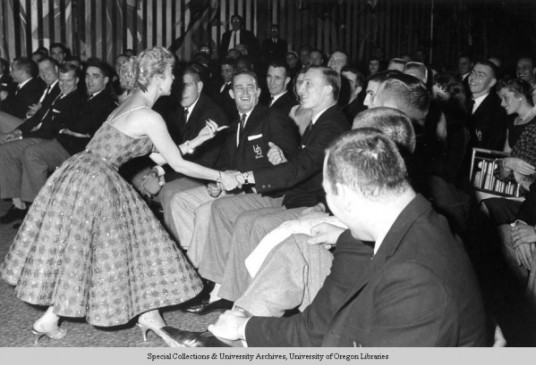
WR Ron Stover says it's HB Jim Shanley that she wants, at an event in Hollywood before the 1958 Rose Bowl. Photo Courtesy: Special Collections & University Archives: University of Oregon Libraries
 
Oregon had two foes to overcome in the game, Ohio State and the media.  They had a new determination, win or lose they wanted to make the papers look bad.  While Ohio State may not have considered Oregon much of a foe, they and the doubters found out quickly that they were in for a battle on January 1st, 1958 at the Rose Bowl in Pasadena, CA.


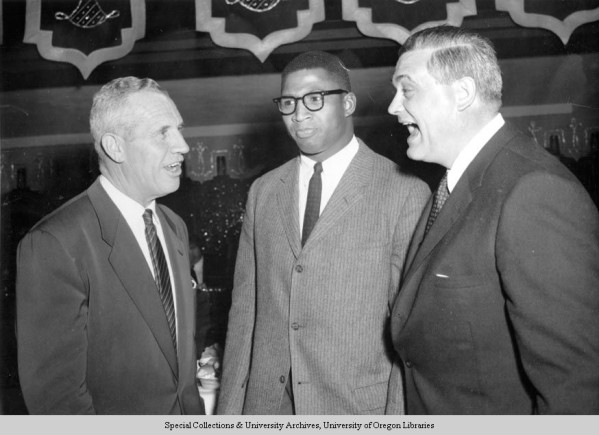
Oregon coach Len Casanova, Ohio State guard Aurelius Thomas, and OSU coach Woody Hayes at an event before the 1958 Rose Bowl. Photo Courtesy: Special Collections & University Archives: University of Oregon Libraries
 
Legends of broadcasting were there that day to cover the game, Keith Jackson covering the radio broadcast while Mel Allen and Chick Hearn handled the television duties for the national television audience.  While trying to stay as impartial as possible, even they couldn’t help but subtly predict a slaughter.  Ohio State was favored in the game by 19, many thought it should have been more than that.

Oregon showed up surprisingly early for the game, making their way out onto the field nearly two hours before they were scheduled to go through warm-ups, grossly miscalculating the amount of traffic that would be encountered due to the annual Parade of Roses in Pasadena.


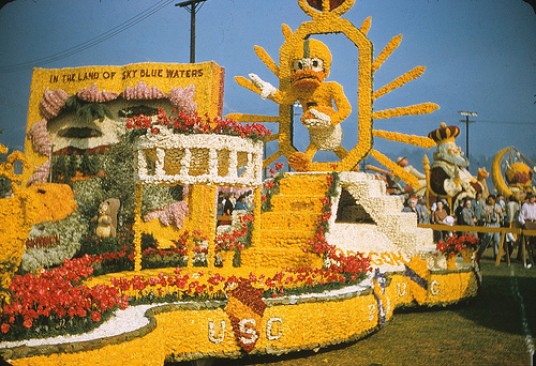
Oregon's float at the annual Parade of Roses on new years day in 1958 before the Rose Bowl 


Ohio State's float at the Parade of Roses before the 1958 Rose Bowl
 
Not quite sure what to do, Head Coach Len Casanova told his assistant coaches to take their respective position groups and go relax them, tell some jokes or stories for a while to occupy time.  By the time the team returned to the dressing room for pregame preparations, Casanova recognized how loose and ready his team was and asked for simply one thing, “Make me proud today.”

It started as many expected, with Ohio State slowly marching 79 yards for a touchdown to take the lead 7-0, despite solid defense by Oregon it appeared like it would be a long day, the first of many scores for Ohio State that were predicted to follow.
 
It didn’t help any that Oregon team captain Norm Chapman wasn’t playing, suffering a broken leg vs. Washington State earlier in the year.  On the third play of the opening drive things got worse, as Oregon’s All-Conference guard Harry Mondale was injured, forcing backup Joe Schaffeld into the lineup.  Schaffeld would hold the line admirably against OSU all game, and years later would become a mainstay at the university of Oregon as the Ducks’ defensive line coach, including the 1994 season when Oregon next returned to the Rose Bowl.

What happened next though in the 1958 Rose Bowl shocked everyone, except those clad in green & yellow.  Ohio State’s predictably traditional Big-10 style 3-yards-and-a-cloud-of-dust offense slowly ground out small chunks of yards at a time, but Oregon was all over the field.  Halfback option passes, deceptive quarterback fake jump pass draws, option plays, even a triple reverse pass had Oregon marching up and down the field.
 
 
Meanwhile Oregon’s defense, while missing Chapman and Mondale, were stout at stacking the line and putting plenty of pressure on OSU QB Francis Kremblas.
 
 
It was a fluke game from many respects.  Oregon was dominating the stats, but turnovers kept Ohio State in the game.  Oregon’s defense was solid, holding Ohio State’s superstars of the game to short yardage all day except for a couple broken tackles resulting in big gains.
 
But turnovers took their toll. Despite the yards being racked up, two interceptions by Joe Cannavino and two fumbles stacked the odds further against them. Oregon was winning at the line of scrimmage and with their wide-open playbook, but four turnovers is difficult to overcome regardless of the opponent, three of these turnovers coming in field goal range.


Oregon had a chance to score on one of the strangest fluke plays in the history of the Rose Bowl, when a pitch to halfback Willie West, who then tried to throw, was deflected by an Ohio State lineman into the hands of Oregon offensive lineman Tom Keele, who had been knocked to the ground and was just standing back up to find the ball suddenly in his hands…immediately Keele started sprinting into the open field with only one Ohio State defender between Keele and the endzone, unfortunately in his panic Keele ran directly towards the defender and only managed to pick up a first down.
 
The score was tied 7-7 at halftime, stunning the audience in the stands and those watching on TV, thanks to a touchdown run by Oregon halfback Jim Shanley.
 
Nobody expected Oregon to hang with the national champions, but Oregon’s defense had been extremely impressive and the offense with their innovative playbook had OSU on their toes.  OSU drove close to a touchdown, but the Ducks held on a 4th down as QB/safety Jack Crabtree leaped over a receiver to bat the ball down.
 
Each team had split short touchdown runs, but it was Oregon the far more impressive team racking up tons of yards on long plays while Ohio State slowly ground out gains in short bursts with an occasional big run or play-action pass. The Ducks were playing loose, above and beyond what anyone had predicted.

In the 2nd half Oregon had a chance to take the lead with a field goal attempted from the 24 yard line, but Jack Crabtree’s kick unfortunately sailed just wide.  In the 4th quarter Ohio State from the exact same spot on the field did successfully hit a field goal, making the score 10-7.
 
 
Oregon continued to roll up and down the field but failed to execute once within scoring range.  Ohio State sitting on 10-7 lead had played ball control, trying to bleed off the clock. However a 4th down stop by Oregon’s defense gave one more chance to tie or win it.
 
With seconds left in the game Oregon had a chance to win, as wide receiver Ron Stover had a long pass completion putting the Ducks in range to at least tie it with a field goal or go for the victory, but Stover was stripped of the ball as he was going to the ground and fumbled.
 
Stover had 10 catches in the game, but his final one closed the door on Oregon’s chances.  Ohio State ran out the clock, winning the Rose Bowl 10-7.
 
However, the final score didn’t tell the whole story.  Just like 37 years later with the 1994 Oregon football team, just getting there was as much of a victory than the final score, and the valiant efforts of the scrappy Oregon Ducks shocked the world.

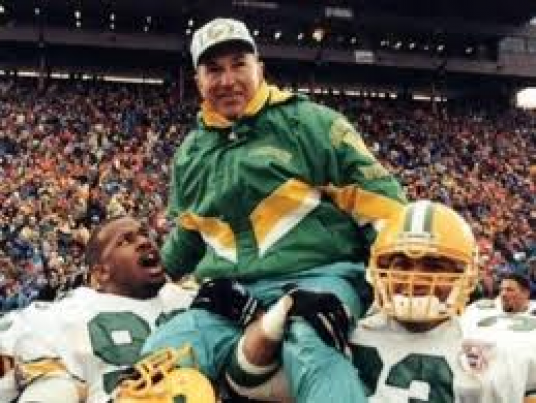
It was Ohio State winning the game on the scoreboard, but Oregon Head Coach Len Casanova was the one being carried off the field by his players in celebration.
 
This would be repeated in the 1995 Rose Bowl, as coach Rich Brooks was carried off in celebration for Oregon’s efforts to end a magical season despite losing to Penn State 38-24.


Oregon coach Rich Brooks would be carried off the field by his players in his last two games as Oregon's coach, against Oregon State (pictured here) and in the 1995 Rose Bowl.
 
Following the 1958 Rose Bowl, Oregon quarterback Jack Crabtree in a losing effort was named the game MVP, something that again would be repeated by Oregon in 1995 when quarterback Danny O’Neil set a Rose Bowl record with 456 passing yards and was named co-game MVP desspite losing 38-24.

Regardless of the final scores in the 1958 and 1995 Rose Bowl games, both teams turned heads.  Little Oregon had competed with the big boys and completely out-shined their favored opponents in every way on the field, yet unfortunately bad luck kept them from winning on the scoreboard as well.  What they had failed to earn in the trophy case, the Oregon Ducks earned ten-fold in national respect.
Following the 1958 Rose Bowl the writers who had done everything they could to humiliate Oregon in the press took notice and admitted they were wrong, Oregon had earned the right to compete with anybody.
Ohio State players congratulated Oregon for the way they played, the decidedly larger Ohio State fan base in attendance cheered the Oregon team as they departed the field.  Oregon may not have won on the scoreboard, but the Webfoots were victorious in every other way imaginable that day.  Most importantly of all, despite the 10-7 loss, the 1957-58 Oregon Ducks had indeed done everything that coach Casanova had asked of them, they had made him proud.

37 years later after the final seconds of the 1995 Rose Bowl ticked away, and with Len Casanova looking on Oregon Head Coach Brooks would utter similar words in defeat…never was he more proud of a team.

Following the 1958 Rose Bowl Len Casanova remained head coach for years, and eventually became an administrator and mentor for the Oregon Ducks athletic program for decades.  He would oversee the construction of new facilities, support the many years under Coach Rich Brooks when it seemed like Oregon has sunk to its lowest point, and be there to show support when Oregon arose from the ashes like a phoenix.  The Casanova Center built in 1990 was a launching point, with baby steps being accomplished each season building up the program.

But while hard times for years followed after Oregon’s loss to Ohio State in the 1958 Rose Bowl, the loss in the 1995 Rose Bowl was a turning point for the program. 

The team followed it up with a 10-2 season and trip to the Cotton Bowl, while with Casanova’s assistance Oregon began expanding and improving its facilities.  The Moshofsky Center was built within a few years, Autzen Stadium was expanded, other facilities were added, and suddenly Oregon winning was not a fluke, it was a tradition.

The success Oregon experiences today is built upon the shoulders of those who struggled for decades with minimal facilities and underdog players who achieved in spite of the naysayers.  The 1957 Oregon team epitomized the spirit that defined what it means to be a Duck, an ideology mimicked again in 1994 and every year thereafter.