Showing posts with label Rich Brooks. Show all posts

Thursday, January 23, 2014

The forgotten season: When Injuries and Bad Luck Derailed High Hopes

The forgotten season: When Injuries and Bad Luck Derailed High Hopes 

 
Originally posted on FishDuck.com on May 7th, 2012
 
 
It was a year with such high promise, raised expectations from two consecutive bowl appearances, and a roster stacked with NFL-caliber talent. By the end of the 1991 Oregon football season it was a year better left forgotten by many, one riddled with injuries and disappointment, a time when the harsh reality emerged that the program still had some growing pains before officially arriving.

Bill Musgrave had shattered every passing record at Oregon during his career (86-90), replacing him proved difficult 

As fans there are certain years that can be recalled for the initial promise of excellence, leading only to eternal questions of ‘what-if’ had injuries or bad circumstance not occurred. What if Stanford hadn’t blocked two punts in 2001, would Oregon have won the national championship? What if Reuben Droughns’ leg not broken in 1998, the Ducks looked invincible prior to big #22’s leg buckling along the sideline. What if Dennis Dixon’s knee ligament hadn’t torn on the wretched crabgrass of Arizona Stadium in 2007, would the Casanova Center today hold a Heisman Trophy and national championship?

All of these are valid questions for both fans and the former players who experienced it first-hand to ponder, but years before these painful memories, 1991 defined the tragic circumstance of a promising season shattered.

There was reason for great optimism following the 1990 season, the Oregon Ducks had just narrowly lost the Freedom Bowl by an inch after winning the Independence Bowl vs. Tulsa the year prior.

Many of the players that had led Oregon to those bowl games were gone to the NFL: Derek Loville, Latin Berry, Tony Hargain, and arguably the greatest player in Oregon history-Bill Musgrave.
Yet while the Ducks had to decide who would replace the Musgrave legacy, the defense had seven players in the rotation who would go on to make NFL rosters, and the offense featured future pros like Ronnie Harris and Jeff Thomason, leaving high expectations for the next season.  It was unknown exactly who would play quarterback, but despite a definitive signal caller there was no hesitation from fans to expect that the 1991 Oregon Ducks should again be bowl bound. The talent was there, all that was left was to prove it on the field.

“Going into fall camp and daily doubles, I was looking around thinking ‘Wow we’ve got some great people!‘” said Tony Koker, a backup linebacker to start the season who would see extensive playing time as the season progressed. “Sean Burwell had just come off a darn good season, we had Jeff Thomason and Ronnie Harris on offense, and talent all over the defense.”

All eyes were on who would replace Bill Musgrave, who had broken every passing record at the University of Oregon, and drafted by the 49ers following the 1990 Freedom Bowl loss. A five-player battle would take place for the job in fall camp—Danny O’Neil, Kyle Crowston, Michigan transfer Doug Musgrave (Bill’s younger brother), JC transfer Brett Salisbury, and local product Bob Brothers, who had played some in years prior but coaches thought would be better utilized as a wide receiver.
“It was pretty exciting,” Kyle Crowston remembers of the quarterback competition. “We were all chomping at the bit to see if we could get the job, we all had a shot at it.”

Brett Salisbury was among those tasked with trying to replace Bill Musgrave 

As camp developed, the competition remained fierce though it appeared that Danny O’Neil, who spent the 1990 season as Musgrave’s backup, had a slight edge in camp while Salisbury recovered from hernia surgery.

“I had backed up Ty Detmer at BYU, who was probably the best quarterback I had ever seen in the clutch,” Brett Salisbury recalls. “He (Detmer) had won the Heisman Trophy the year I was at Palomar Junior College, so the competition against a bunch of young guys (at Oregon) didn’t play a role in my mind when I made my recruiting trip. I could see Danny was separating himself from those guys, but didn’t worry much until fall camp. Unfortunately I didn’t get much of a chance to prove myself because of a ruptured hernia early on. I was getting snaps with the first team and at that time I simply wanted to be an asset, not a liability.”

Salisbury’s injury setback proved an omen for how the season would progress, a team with a lot of talent but riddled with medical problems, never getting a chance to get fully comfortable.

The season started off well, hosting a Washington State team led by a young Drew Bledsoe, the Ducks stomped the Cougars 40-14. O’Neil in his first start for Oregon was a little sporadic at times, but the quality talent on the defense and hard-running of tailback Sean Burwell more than compensated for the inexperience at quarterback.
 
However the game took its toll, as multiple starters couldn’t finish the game suffering injuries. There would be more to follow.

Week 2 Oregon traveled to Texas Tech, a team featuring a behemoth of a running back in Bam Morris, who would become a star in the NFL with Pittsburgh and Kansas City before drug issues landed him in jail. Again the Ducks rolled, defeating the Red Raiders 28-13, but it proved a pyrrhic victory at best as more starters, particularly along the defensive line, went down.

Then reality struck. With the Ducks 2-0, a trip to Utah seemed like a sure win, setting them well on the path to a third consecutive bowl game. But the youth showed, and injuries lingered. Out were many along the starting defensive front seven, as well as starting tailback Sean Burwell. The defense played well, and special teams came through with a blocked punt; but two first quarter turnovers proved too much to overcome, as Oregon lost a heartbreaker to the Utes 24-17.

While just one loss, it proved devastating, one that a young team never seemed to overcome for the rest of the year.

Now 2-1, Oregon hosted USC at Autzen Stadium.  During the first half Danny O’Neil struck his throwing hand on a helmet, dislocating his thumb. Hiding it from coaches, he continued to play, popping his thumb back into place after each snap. However eventually coaches did notice, and O’Neil’s day was done.

In for O’Neil in the 2nd half stepped Brett Salisbury, now recovered from his hernia, but lacking in enough practice reps to be fully comfortable in Oregon’s pro set rather than the spread system he had run in 1990. Still, Salisbury was a quality talent with a pedigree name (his brother Sean was a quarterback with the Minnesota Vikings at the time), his Palomar JC squad the year prior had led the nation in offense. Salisbury and the Ducks fought hard, but could not gain enough offensive consistency to keep pace with the Trojans, losing 30-14.


Now 2-2, Oregon’s season was suddenly sharply veering off course, with multiple backups thrust into starting roles. The Ducks would get a respite of sorts, as hapless New Mexico State came to town next, with O’Neil feeling healthy enough to return to the starting role. However the thumb injury would be aggravated, this time ending O’Neil’s season.

With O’Neil and Salisbury looking like the solid rotation at QB for the year, Kyle Crowston had asked for a position switch to see the field. “I had been recruited by WSU to play safety, but I wanted to play quarterback so I chose Oregon over an offer to play QB at Hawaii. But with Danny and Brett playing I told coaches to switch me to safety, and I played in the New Mexico State game, but once Danny got hurt I was moved back to quarterback.”

…And then there were four.

Brett Salisbury again took over, and led the Ducks to an easy 29-6 victory over NMSU. But to many of the Ducks the 3-2 mark, multiple starters lost to injuries, and 23-point victory didn’t leave them feeling very good about the season.

“We were disappointed when we only beat New Mexico State 29-6, we thought we should have put 50 on them,” said Tony Koker.  “It was frustrating, we started off 2-0 and then injuries just destroyed us.  It was frustrating as a player, and I can understand how devastating it would be as a fan to have gone through it. Back then it didn’t matter that much to me what everyone was saying back then, but now as a fan I can relate to that a bit more.  There’s always the expectations, and I knew that as a player, and we wanted those expectations because we wanted that success just as much as anyone else. Sometimes when you get into a season like that it’s a snowball effect, one thing just happens after another.”
 
While perhaps unrealistic to expect great things from inexperienced quarterbacks so early, there were heightened expectations (fair or not) due to the success of their siblings. While Salisbury and Musgrave would never admit it as a factor, from the outsider perspective there were high hopes for the two transfer QBs battling for the vacated starting role due in large part to the names adorning the back of their jerseys. The Salisbury name was already familiar to NFL fans with Brett’s brother Sean playing for the Vikings, and the Musgrave name was considered royalty in Eugene. It was difficult not to compare everything that Brett & Doug did to their elder siblings Sean & Bill.

“They were both very talented, Brett and Doug,” said Crowston. “Doug is very smart, he’s a doctor now, and Brett threw a really nice ball. Doug was a student of the game, but trying to live up to Bill’s legend, especially early on his first season, that’s tough to do. You’d have to imagine that the extra pressure was there in the back of their minds even if they didn’t acknowledge it.”

“We as players read just like all the fans do, so when Doug Musgrave’s player profile came out we saw he broke all of Bill’s records in high school and we thought he was going to do great,” Koker remembers.  “But Bill and Doug were totally different people, Bill was fantastic, coolest guy ever. Doug was very introverted, kept to himself, didn’t handle the limelight as well.  Brett was the same way, we read the press and certainly had expectations because of the Salisbury and Musgrave names.
 We’re more realistic though because we’ve been there and we know what it takes, we see the people who glide through and the people who fight hard and find success.  We know that we’ve read these things, but they still had to prove themselves, the records they broke elsewhere don’t translate to our offense and the Pac-10 level, but as teammates there were expectations.”

Salisbury would get the nod initially in the now four-man battle over Musgrave, the fleet-footed scrambler Crowston, and local hero Brothers.

While Salisbury made some plays, the day would prove a disaster, as Oregon’s defense collapsed against the tough running of Cal superstar RB Russell White, and the Duck offense couldn’t find a good rhythm. Sensing a need for a spark and lacking full confidence in their new QB, Oregon coaches pulled Salisbury in favor of Doug Musgrave. Again, only sporadic success would emerge, while Bob Brothers now converted to wide receiver would find some playing time making a few catches at the end of the game.
 
The next week it would be Doug Musgrave getting the very weak vote of confidence to start, as the Ducks headed north to face top-ranked Washington. Despite the daunting task of taking on the #1 team in their house, the Ducks felt the sense of urgency to turn the season around, and what better time than against the hated Huskies? Four key starters were missing on defense, though the secondary was still intact, and Oregon welcomed back on offense fullback Juan Shedrick and tailback Sean Burwell. If the 1991 season was to be salvaged, this would be the day to make their mark.

There had been player-only meetings to address the situation. The defense, led by tremendous talents like Eric Castle and Muhammad Oliver, recognized that it was time to step up and take over with the offense struggling trying to find consistent play from the quarterback rotation.

“As a defense, we tried to really put it on our shoulders,” said Koker. “We weren’t naive to think that we could have all these injuries and changing quarterbacks and it wouldn’t effect things, but we knew we had to get in the driver’s seat and take over games more so to pick up the slack. We had more player-only meetings that year than any time I can recall. It wasn’t about finger-pointing though yes there were frustrations, rather it was trying to figure out what we could do.”


Steve Emtman anchored UW's touted defense, culminating in a national championship in 1991 and #1 overall NFL draft pick 

Washington’s defense was as good as there was in the country, led by #1 overall draft pick Steve Emtman. While the Oregon defense played well, UW gave up no ground with Musgrave at the helm. So again coaches pulled the QB, this time trying to find a spark with Kyle Crowston, who could make plays with his feet as well as with his arm.

“I really wish we could have that Washington game over,” said Crowston of the missed opportunity. “I came in and I thought I was a couple plays away from having a pretty good game against the #1 team in the country, but I made a few stupid plays, and it cost us. We had our chances, but a team like that you can’t give them many opportunities. Part of it was the inexperience, when you don’t have game experience you tend not to make those necessary snap decisions, the game is going so much faster. Ironically, after that Washington game was when I started getting comfortable, the game started slowing down for me, but the next week against Stanford I was sat down in favor of Bob Brothers and I didn’t see action again for the rest of the year.”

Oregon fought hard against the Huskies, the defense forcing several turnovers and keeping one of the most dominant teams in the country to a manageable score. But the Huskies had no fear of the Ducks offensive attack, and stifled their opportunities to make it a game.  Oregon tacked on a late touchdown on a Burwell run, but when the dust settled Washington had trampled the Ducks 29-7.
“The Washington game sticks out to me more than any other,” Koker recalls. “We were really up for that game, it being a rivalry, and we wanted to turn things around, but it just didn’t come together and you could see us struggling, it was a brutal game.”

The remainder of the season was much of the same, coaches grasping at straws trying to find any consistency whatsoever out of their quarterback rotation, while more players fell victim to injuries. By the time the season drew to a close, the Ducks were a shell of the team that looked to hold so much promise against WSU to open the year.

Salisbury, Musgrave, and Brothers (now switched back to QB from WR) would all see action in the remaining games, with little to no offensive consistency, while Crowston could only watch the futility from the bench after starting the Stanford game the next week but proving ineffective. The frustration from coaches was evident, quick to pull a player for the next, leaving the quarterbacks struggling trying to force plays wondering if the hook would come after every 3-and-out if they didn’t do something spectacular.

The Ducks went on a six-game losing streak, never winning another game after NMSU finishing 3-8, the worst finish under Coach Rich Brooks since 1982′s 2-8-1 season. The cumulative points scored over the six-game stretch to close the year was only 58, many of those coming on defensive and special teams scores. But the defense had kept it close, the final four games being lost only by a combined 43 points. The Ducks played tough, but limped to the finish line closing out the season with close losses to Stanford, ASU, UCLA, and OSU.

The Ducks weren’t being blown out, but in every game the inability of the offense to move the chains or put points on the board proved too difficult of a task for the battle-weary defense to overcome every week.

“It was tough on everyone,” Salisbury lamented. “However, I always have the lock and load approach. If one guy goes down, you have to replace him with talent. We couldn’t do that. We didn’t have the depth of the teams today. When Sean Burwell went down, we went to a walk-on tailback who had never played a down of college football at the Division-1 level.  It’s tough to get a rhythm if you continue to change the quarterback. The offense only gels when they know who their leader is.”
Fans had grown to expect a winner, a team of scrappers that would come through in the clutch. 1991 by the wins/losses mark proved a dismal failure, yet amidst the hard lessons were stories of great individual performance and achievement through adversity.

As the season wore on, two starters in particular in the secondary took it upon themselves to carry the team. Safety Eric Castle and cornerback Muhammad Oliver were astounding talents who would go on to lengthy NFL careers. Following the New Mexico State win recognizing the inevitable offensive struggles to come, both players knocked up their level of play to another level to compensate.

The two would have multiple interceptions, score multiple touchdowns, block multiple punts keeping Oregon close in many of the games down the stretch. Against ASU, Oliver’s punt block and return for a TD was one of the top highlights of 1990s, coinciding with a Castle pick-six earlier, the two plays almost single-handedly winning the game for Oregon if the offense had managed to capitalize on some of the turnovers the defense forced against the Sun Devils.

 
“Muhammad and Eric both really shined that year, I don’t know who was faster, both were lightning quick,” Tony Koker remembers fondly of his teammates, particularly Castle, the two close friends (Koker & Castle) having grown up together in Lebanon, OR.  “Those guys stepped up from their positions and did what they had to do to make plays, and when they did get their hands on the ball they had a little extra in them to say ‘I’ve gotta get this to the house because the offense may not be able to do it.’ Those guys were just studs, amongst a defense that had dwindled due to injuries, they took it upon themselves and really shined.”

“Going against that defense every day in practice was a challenge and a great motivator,” Crowston recalls, “We knew how good they were. It boosted our confidence big when were able to drive down the field and score on them in practice.”

“We would see a scout defense in practice and have our way with them, however during a scrimmage guys like Castle would make plays. They were physical and fast and that makes you better,” said Salisbury.

But the great individual play couldn’t quell the losing. Fans were frustrated, coaches and players were too. For a team that returned so many starters of a squad that had gone to back-to-back bowls, losing seasons were no longer acceptable. There had been two bowl trips in a row, and fans were eager for a third. But having to replace a quarterback, was it realistic to expect a bowl game trip for the otherwise stacked roster of talent?

Kyle Crowston isn’t sure if those goals could have been met. “It was probably pushing it with the QB question as to if we could have made it to a bowl game. It doesn’t happen very often, the odds are against a freshman or young QB taking a team to a bowl game. It could have happened if we would have stayed healthy on both sides of the ball, but obviously that didn’t happen.”

“I don’t ever like to think of the woulda-coulda situations,” Brett Salisbury responded. “We did what we did and it didn’t work out. I think it helped the team overall as they proved in the years after though.”

“You want fans to have high expectations of us, we want that as a team because we had those same expectations to perform at our absolute best,” said Tony Koker. “But realistically look at the parts…we had a good O-line, a good running back, good receivers, and a great defense; but it’s tough to win with a first-year starting quarterback, especially after guys get injured.”

These were growing pains years, harsh realities, and tough lessons learned. Yet it was the players who got thrust into the spotlight that would take the memories of the 1991 season and cultivate them into something so special that the program and city of Eugene would be forever altered.

The next season O’Neil took over as the starter once more and led the Ducks to the Independence Bowl. 1993 Oregon managed five wins, though started 3-0 until a devastating loss at Cal took the wind out of the sails. Taking to heart the experience and adversity of the 1991 and 1993 seasons, those young players who had filled the gaps in 1991 for their fallen teammates would go on to the greatest of achievements, the improbable season of 1994 where Oregon defied the odds winning the Pac-10 title earning a trip to the Rose Bowl.

That team, featuring so many young players from the 1991 team, were now seasoned veterans having gone through the toughest adversity imaginable, ready to weather any storm and persevere. Their efforts in 1994, stemming from the experiences of 1991, would be the foundation for where the program is today, now considered a perennial national powerhouse.

“I’m convinced the 1991 season helped the seasons that would follow,” said Salisbury. “When you lose you have two choices: get up or stay down. Everyone I know from that team has gotten back up and led by example. It took the ’91 and ’92 teams to get to the Rose Bowl. It made the program stronger, everyone learned from their mistakes, Danny eventually proved it leading the team to the Rose Bowl.”

Tony Koker agrees with Salisbury’s sentiments. “I always like to think that we in the ’89 – ’94 era set the cornerstone for what the program has now, obviously it has grown so much bigger with the facilities and BCS. The adversity we faced in ’91 led to the success in later years, we felt like we had a senior class with guys like Chad Cota, Danny (O’Neil), Herman (O’Berry) that came in together and grew as people and left a good thing behind for others to build upon. We started this bowl game era and through baby steps built its way up to where the program is now.”

The team in 1991 featured many players who would go on to NFL careers– Tommy Thompson, Ronnie Harris, Jeff Thomason, Romeo Bandison, Matt Brock, Matt LaBounty, Ernest Jones, Muhammad Oliver, Eric Castle, Herman O’Berry, Chad Cota. Salisbury would spend six years playing professional football overseas, and others went on to tremendous success both in football and beyond it after hanging up the jersey for good. What the team may have lacked in victories in 1991, it more than made up for in character. Having experienced the harsh adversity of ’91, there was nothing that these young men couldn’t overcome in life.

“We never gave up, there were frustrating games and situations where people could have done so, but we never stopped fighting,” Koker vehemently stated. “We did not implode as a team, we didn’t implode within ourselves. It’s such a character-builder, it’s humbling, and in the long run that creates success. There were times in ’92 things got bad but we were able to step up and turn it around, and it didn’t take an entire season to do so. We had it built into us already, because we had fought through some of the worst times a team could ever experience. We willed ourselves to be better, we had some misfortune, but we stuck it out and that culminated in the Rose Bowl.”

“Those were some of the best days of my life,” said Crowston. “There were some amazing people, and friends for life, I wouldn’t change it for the world. The whole overall experience, even in a down year, it was such a blessing to be a part of it.”

Having left the UO program after 1992 to finish out his eligibility at Wayne State, Salisbury too watched fondly as the Ducks took the harsh lessons of 1991 and turned them into a positive. “The team was fun to watch from my living room. They had a swagger and mindset about them. It’s what started the new generation of athletes to come to the U of O that would normally have ended up at places like USC. I was part of that group and proud of it.”
 

Brett Salisbury:

Following two years at Oregon, Salisbury transferred to Wayne State in Nebraska for his senior year. He then spent six years playing professionally, became a top male model, and has written two books, including The Transform Diet.
 

Kyle Crowston:
After the 1991 season Kyle Crowston switched to safety permanently at Oregon, backing up his roommate Chad Cota. After his Duck days Kyle spent five years working with another fellow Oregon football alumnus, Dick Winn, at Columbia River Hardwood, and coaching a middle school football team. He returned to school to acquire his masters in education, and has spent 11 years coaching and teaching physical education. As Kyle puts it, “I get paid to play now, it’s fun.”
 

Tony Koker:

Tony Koker played linebacker at Oregon from 1990 – 1994. He is now a proud father of two athletic, competitive girls and enjoys coaching their teams. He can often be found in the stands cheering at many Oregon sports events.  Now in his 16th year with the Wildish Company, he is a piping superintendent who gets to relive his past football glories often, working on the construction crews that have been a part of many projects on the U of O campus in recent years; including the construction of PK Park, the Moshofsky Center, the Autzen Stadium remodel, and the current expansion of the Casanova Center.



Oregon’s integral role in the history of the grandaddy of them all

Oregon’s integral role in the history of the grandaddy of them all 

 
Originally posted on December 28th, 2011 
 
On New Years Day in 1890 the first Rose Parade was held in downtown Pasadena, CA; devised as a way to entice people from the east coast to purchase real estate in Southern California, an effort to convince those with deep pockets to escape the cold winter weather for sunny Southern California.
“In New York, people are buried in snow, here our flowers are blooming and our oranges are about to bear,” announced Professor Charles Holder, a noted author and sportsman who had moved out west in 1885 from New York. “Let’s hold a festival to tell the world about our paradise.”

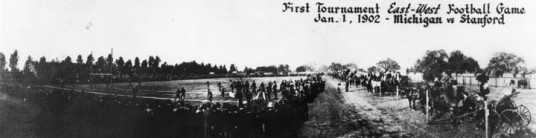
Following the parade were various festive events.  In the first few years a communal picnic was held with contests such as foot races and tug-of-war battles highlighting the post-parade afternoon.  Once there was even a race between an elephant and a camel, with the elephant declared the victor.   But by 1902 it was decided that a college football game should be held to punctuate the annual Tournament of Roses festivities, matching the best teams of the east and the west.


The very first East-West Game (later coined 'The Rose Bowl' was played in 1902 

Tournament Park was determined to be the location for that first game, dubbed the East-West Game, pitting the University of Michigan Wolverines (10-0) vs. the Stanford Indians (3-1-2).  Michigan had been nicknamed “the point-a-minute gang,” having racked up a season total of 550 points to zero, led by legendary coach Fielding Yost, who had been Stanford’s coach the year prior.  Almost 8,000 spectators packed the grandstands for the game following the Rose Parade, though they didn’t get to witness a complete battle as Stanford quit in the 3rdquarter, with the score already 49-0.


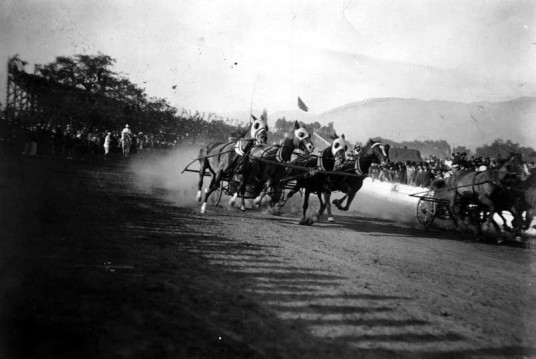
Roman Chariot Races held at Tournament Park in 1908 

Perhaps embarrassed over the lopsided affair, or the premature ending to the game, the East-West Game would not be held the next year, or the next, or the next.  In fact, 14 years would pass before a college football game would be held again in Pasadena as part of the Tournament of Roses slate of events.  During those non-football years the game was replaced with other events, such as ostrich races, polo, and Roman chariot races (which had become all the rage in the wake of the release of the book ‘Ben Hur’).

By 1916 the Great War was raging in Europe, and while the United States had remained out of the conflict, the sinking of the Lusitania in 1915 and amped-up anti-German rhetoric signaled the inevitability that America would someday join the fight.  In anticipation of that, many young men were joining the military, and military bases began fielding teams playing against collegiate squads.  When it was decided to hold another East-West Game in Tournament Park, it was (6-0) Washington Agricultural College (now known as Washington State) defeating the (5-3-1) Brown University Bruins, 14-0.  Brown was invited to play after Syracuse refused to travel cross-country again for a game, having already played Oregon Agricultural College (now Oregon State University) earlier that year.


The 2nd East-West game was held in 1916, Brown vs. Washington Agricultural College (WSU)

Despite the WAC (WSU) victory, eastern teams were considered vastly superior to football teams out west, so it was no surprise that in the third East-West Game The Penn Quakers were considered a huge favorite over the Oregon Webfoots.

Oregon even being able to physically attend the game was a difficult task.  The Oregon Webfoots had finished their season 6-0-1, with a tie against Washington, a team that had not lost a game since 1907.  Oregon was chosen to represent the brand new Pacific Coast Conference (formed in 1915).  Oregon had a larger margin of victory than Washington in their mutual opponent, California, even though Washington had actually played and beaten California twice that year, leaving Washington with one more victory tallied than Oregon.  It also helped that Eugene was closer to Pasadena than Seattle, lessening the travel expenses to reach Pasadena, still the cost associated with representing the PCC was hefty.


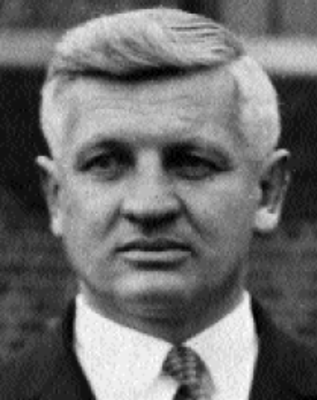
Oregon Coach/Athletic Director Hugo Bezdek 

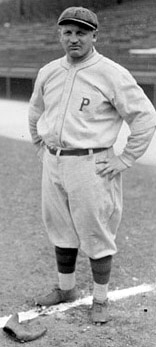
Oregon coach Hugo Bezdek had been a man of many talents, also coaching the baseball and basketball teams while acting as the first Athletic Director at Oregon and a professor of “Outdoor Athletics.”  From 1917-1919 he also was the manager of the Pittsburgh Pirates, traveling by train between Pittsburgh and Eugene to cover his dual duties.  It was Bezdek’s second tenure in Eugene, he had coached the football team in 1906 first, before returning in 1913 after time spent with the University of Arkansas, where he coined the team nickname “Razorbacks.”  Years later after a lengthy stint at Penn State he would coach the Cleveland Browns, becoming the only person in history to coach both a major league baseball and national football league team.

Bezdek’s salary was covered by both the University of Oregon and  the student body, in fact 2/3′s came from the students (imagine the students covering the cost of Chip Kelly’s ample salary today).  Bezdeck was an innovator, a free thinker, the Chip Kelly equivalent of the early 20th century.

Oregon was one of the first teams to openly embrace the forward pass, in spite of rules existing at the time penalizing teams for incomplete throws.  Bezdek implemented odd new formations, training regimens and meals for players, and other techniques that were well beyond their years.  In later years Oregon would be among the first to utilize pre-snap motion in the 1940s, proving that Oregon has clearly been an innovator in the game of football throughout the decades, not just recently in this renaissance era of the Chip Kelly spread and flashy Nike uniforms.

In order to be able to fund the cost of an additional month’s salary for Coach Bezdek and paying for the team to travel to Pasadena, the student body sold the student-owned campus bookstore.  It was worth it to the students and the Eugene community for a chance for the University of Oregon to play in what was at the time the only college football postseason game in the country, and only the third time such a game would occur at that.  Bezdek was stripped of his roles as baseball and basketball coach so as to focus solely on football and the difficult task of shutting up the national pundits who claimed that no west coast team could compete with the might of the east.


Former Penn quarterback Bert Bell, as NFL commissioner, meets with President Harry S. Truman 

The (7-2-1) Penn Quakers featured three All-Americans, including future NFL commissioner Bert Bell (whose father was the Pennsylvania Attorney General), yet Penn had not been the first choice for the game, Harvard and Yale had both initially declined.  Despite being third choice, Pennsylvania had been a powerhouse and innovator as well in the early days of college football; declared the national champions in 1894, 1895, 1897, and 1904.  Penn was credited with creating the quarterback kick (a precursor to the forward pass), the delayed pass, and the place-kick from scrimmage i.e. field goal.  Among the legends who had played for Penn were John Heisman and John Outland, for which two of the most prestigious awards in collegiate sports are named after, along with years later Chuck Bednarik (1947-49), considered the greatest Penn Quaker of all-time.

Penn coach George H. Brooke had quit suddenly the previous season, replaced by Bob Folwell for the 1917 campaign, who had previously coached for Lafayette College (1909-11) and Washington & Jefferson College (1912-15).  Folwell, bolstered by the barrage of media already declaring Penn the victor before the game was even played, invited coaches to come see his team practice.  Among them was Amos Alonzo Stagg, legendary coach of the University of Chicago, later nicknamed ‘the grand old man of football’ for all of his feats (he was part of the initial class elected into the Football Hall of Fame).  Hugo Bezdek had played fullback for Coach Stagg at Chicago, and Stagg had been the one to recommend to the University of Oregon that they hire Bezdek back in 1906 for his first stint in Eugene.

At Bezdek’s request, Stagg compiled a scouting report of the Penn team and provided it to Bezdek in advance of the East-West Game matchup.  Again Folwell showed his cards with his team in Pasadena preparing to take on the Webfoots, inviting Bezdek to attend Penn’s final practice before the East-West Game a day before the game was to commence.  Coach Bezdek happily accepted the offer to attend, took notes, and decided to implement into his own gameplan the trick pass play that Penn demonstrated for Bezdek in practice to him as he and Folwell exchanged pointers (imagine Chip Kelly inviting an opposing coach to come watch the team practice inside the Moshovsky Center the day before a game and go over Chip’s gameplan in detail with them).

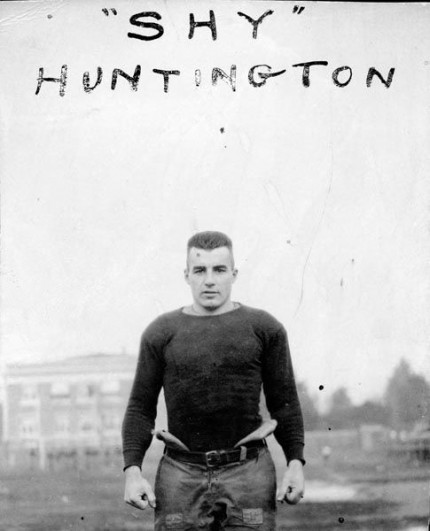
Folwell and Penn’s overconfidence would become their folly, as Oregon came ready to play on January 1st, 1917.  The Webfoots were led by three pairs of brothers, John & Jack Beckett, Leo & Robert Malarkey (Leo’s son Donald Malarkey would gain fame for being portrayed in the HBO series Band of Brothers as a member of the 101st airborne during WWII), and quarterback Charles “Shy” Huntington & Hollis Huntington.  Shy was Oregon’s first All-American, a standout at quarterback as well as a quality kicker and defensive back.  The Huntington duo, and the rest of the Webfoots led by Bezdek would have plenty in store for the Penn Quakers, and college football would never quite be the same again thereafter.

Of course going into the game Coach Hugo Bezdek, ever the strategist, played up the David vs. Goliath matchup to the media perfectly.  “I’ve got only overgrown high school boys, while Penn can field a varsity of big university strength, we haven’t a chance,” he said.  “We are going to put a team on the field that won’t be licked and consequently can’t be licked,” Folwell meanwhile boasted to the press.
 
The 1917 EAST-WEST GAME (3rd Rose  Bowl)
 
Anticipating a larger crowd than usual, the city had built temporary grandstands to house the 25,000 fans that packed the sidelines at Tournament Park for the Oregon-Penn game, culminating the annual Tournament of Roses event.  Meanwhile back in Eugene, the Heilig Theater (located where the Hult Center now stands) was packed to the rafters with folks watching a simulated football field on stage being updated with the assistance of a telegraph and megaphone announcing each play as they were relayed over the wire.


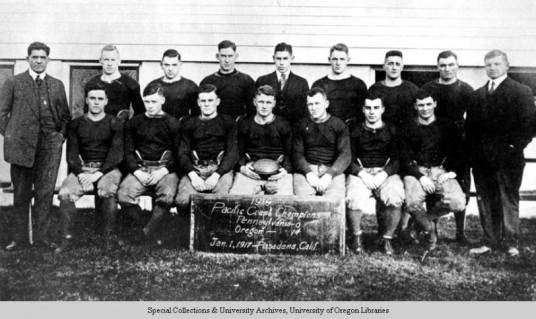
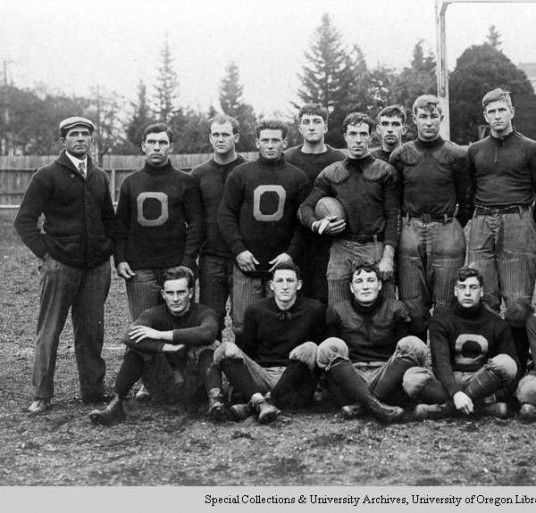
Pacific Coast Conference Champions, the 1916 Oregon Webfoots 

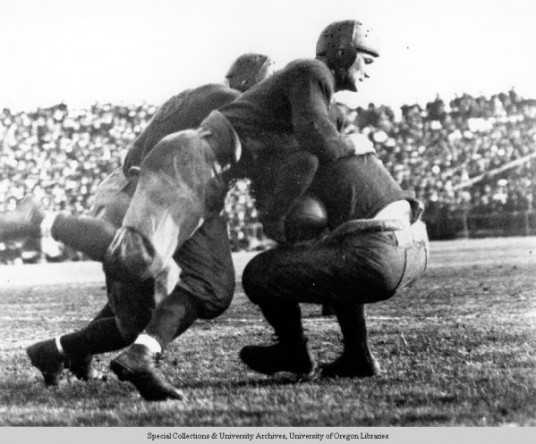
On the field it was a defensive struggle, with Shy Huntington shining.  In an era when teams rarely threw the ball, Huntington intercepted three passes on the day, and would have had a fourth pick but it was called back on a penalty.  Even with the turnovers, it was Penn who first threatened to score, moving the ball to Oregon’s 4-yard line after recovering their own blocked kick followed by a 20-yard run by Penn quarterback Bert Bell setting up the Quakers in scoring range.  The Quakers would be stymied though, as Bell was sacked forcing a field goal attempt that sailed wide.  It remained a scoreless tie at halftime.


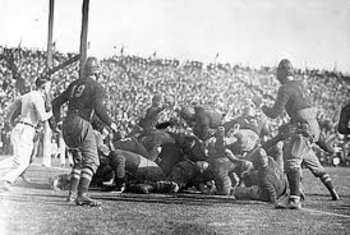
Shy Huntington brings down a Penn player in the 1917 Rose Bowl 

The defensive stop was just what the Ducks needed to turn the tide.  Howard Angus, a writer for the Los Angeles Times, noted the following: “The Webfoots defense were steadied as if someone had given them a shot of hop. A big grin spread over their faces that never was erased. From then on Oregon was unbeatable.”

In the third quarter, Oregon finally broke the game open.  Utilizing the same trick pass play that Penn Coach Bob Folwell had invited Coach Bezdek to witness the day prior, Shy Huntington connected with Lloyd Tegart for a 15 yard touchdown.  Shy knocked in the extra point to give the Webfoots a 7-0 lead over the much-favored and clearly frustrated Penn Quakers.

“Imagine what we thought and said when Oregon scored its first touchdown on our own play,” said Bert Bell to reporters after the game, as quoted in the Los Angeles Times.


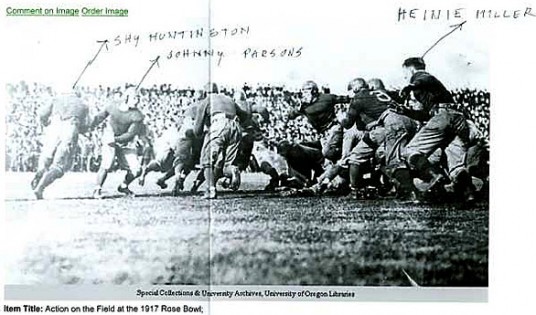
Shy Huntington and Johnny Parsons in action vs. Penn in the 1917 Rose Bowl 

The battle continued, highlighted by Huntington’s great defensive play and John Beckett’s tremendous job in the trenches controlling the line of scrimmage.  In 1953 when MVPs of the Rose Bowl were first assessed, Beckett was retroactively awarded the MVP of the 1917 East-West Game (3rd Rose Bowl).  With each defensive stop the Oregon Webfoots’ confidence grew.  Penn’s much ballyhooed passing attack was stopped in its tracks by Shy Huntington’s interception hat trick, held to only 32 passing yards on the day while Oregon racked up 131 through the air, while Beckett was leading the push up front to allow for the Oregon ground game to grind it out.

In the 4th quarter, the Webfoots broke through again.  A 40-yard run by Johnny Parsons set up Oregon at the 1-yard line, where Shy Huntington ran it in for the second touchdown.  Huntington added the extra point, making it 14-0.


Charles "Shy" Huntington, quarterback/kicker/safety and later coach at Oregon 

Taunts emanated from the Oregon team, “Are the city boys getting tired? Came west to teach us football, did you?” (source: Los Angeles Times) in the wake of the stunning score, while back in Eugene it was jubilation as the score was announced inside the Heilig Theater.  The score would stay, Oregon had shut out their opponent for the fifth game in a row to end the season, stunning the Penn Quakers in a 14-0 upset victory in the East-West Game at Tournament Park, the third Rose Bowl.  Fittingly the game ended with Huntington intercepting a Pennsylvania pass at the end of a long 79-yard drive, and the Webfoots ran out the remainder of the clock to seal the victory.

Oregon had barely outgained Penn, with the Webfoots totaling 242 yards of offense to Penn’s 230, but it was the staunch defensive effort that Oregon displayed that made the game feel like a rout.
Completely bewildered, Coach Folwell said after the game, “We ran into a batch of football that was a cross between a zip of forked lightning and the roll of a fast freight.” 

Folwell would not be the last to grossly underestimate the University of Oregon’s abilities and will to fight against superior talent.

Harry A. Williams of the LA Times joyfully wrote after the game, “west coast teams would lick the stuffing out of every eastern team which ventures far enough away from home to make the discovery that all the football in the world is not bounded on the west by the Mississippi River.”  That sentiment may have been proven by the game outcome at the time, yet as we all know the now infamous ‘east coast bias’ still rings very true nearly a hundred years later.


Hugo Bezdek, as manager of the Pittsburgh Pirates
 
Three months later the United States officially entered The Great War, and campuses across the country drastically changed, including the University of Oregon.  So many young men enlisted or were drafted that the following season Oregon could barely field enough bodies to practice much less play, while military bases sported their own teams comprised of former collegiate superstars.  Bezdek meanwhile had a big change as well, as he was hired to be the manager of the Pittsburgh Pirates and commuted between Pennsylvania and Oregon.  The Huntington brothers entered the military along with the vast majority of the male student body at Oregon to serve their country in the call to arms.

However, an odd twist of fate would keep Oregon’s ties close to the Rose Bowl during America’s involvement in World War I in 1917 and 1918.  After the 1917 baseball season ended, Hugo Bezdek was asked by the United States Marine Corps to become the football coach for a USMC team, the Mare Island Marines of California.  The team just happened to feature two new enlistees that Bezdek was particularly familiar with, Hollis Huntington and John Beckett, Bezdek’s former stars at the University of Oregon.

The Mare Island Marines of California finished the year 5-0, and with the nation caught up in patriotic fervor it was decided that for the 1918 East-West Game (Rose Bowl) two military teams would be featured.  Sure enough, Bezdek’s Mare Island Marines were asked to play against the Camp Lewis Army team (5-1-1) from American Lake, WA.
 
BEZDEK, BECKETT & HUNTINGTON RETURN DURING WAR TIME
 

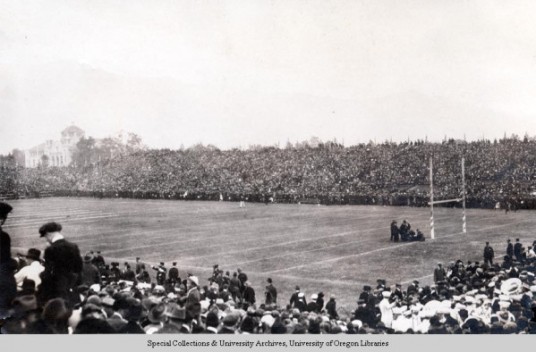
Crowd shot from the 1918 East-West Game, Mare Island vs. Camp Lewis 

It was an odd but familiar site as the former coach and former players accompanied the rest of the Mare Island USMC team to Pasadena, CA and Tournament Park, the field where exactly a year prior Bezdek had tutored Beckett, Hollis and his brother Shy to a victory over Penn.  President Woodrow Wilson had personally approved the two military teams playing each other in the East-West Game, with the vast majority of America’s premier football players already overseas in the trenches of the European western front or preparing to leave shortly.

The fact that a war was raging overseas hung a dark cloud over the game, while jubilant and patriotic in nature there was also a sense that this game was just a temporary respite before the young men fighting on the field would soon be instead fighting in the trenches of the war to end all wars, with most scheduled to go overseas within weeks of the game’s completion.


John Beckett played in two East-West Games, for Oregon (1917) and Mare Island (1918) 

“This would be the last battle that we would fight in the name of sports,” said John Beckett to reporters prior to the game.

There was no scoring in the first quarter, but in the 2nd quarter Bezdek’s boys from Mare Island got on the board thanks to a 31-yard drop-kick field goal to take the lead 3-0.  The Army team responded with a 6-yard touchdown run by E.L. Romney, the primary weapon in Camp Lewis’ arsenal, taking the lead 7-3.

It would prove to be Camp Lewis’ only bright spot on the day, as the Webfoot trio now in military garb were simply too powerful.  The first half finished with Mare Island quarterback Jap Brown running in for a 5-yard touchdown, though the extra point attempt failed, leaving the score 9-7.

In the fourth quarter Mare Island would extend their lead, scoring with a 1-yard touchdown plunge by Hollis Huntington, and finishing off the game with a 33-yard field goal to defeat Camp Lewis 19-7.  It was Mare Island of California Military Base going down in the record books as the victor, but it might as well have been the University of Oregon credited with being back-to-back champions with Beckett and Huntington being such integral parts of the game while being coached by Bezdek.  Hollis Huntington would be retroactively named the game’s MVP when the award started being given out in 1953, making the Mare Island teammates Huntington and Beckett the owners of two of the first four MVP titles.

Indeed Beckett’s pre-game prediction held true, while Bezdek returned to his coaching duties for both the Pittsburgh Pirates and the University of Oregon, the men who played in the 1918 East-West Game later known as the Rose Bowl would mostly go overseas to fight for their country.


The parade grounds of Mare Island during WWI, near Vallejo, CA 

Armistice Day, the day the war officially ended, was November 11th, 1918, though some sporadic fighting continued on into 1919. There was still a great deal of post-war work to be done by the military with the wounds of the conflict still fresh, while the world simultaneously was losing millions of lives to a global influenza pandemic.   Once again, for the 1919 game it was military teams squaring off against each other.  This time it was a US Navy team (Great Lakes Naval Training Station) defeating the USMC team (once again represented by Mare Island of California), 17-0.

However, this was not the same Mare Island team, none of the same players were there, as they had all been shipped out for the war.  Not even Hugo Bezdek returned, instead William H. Dietz coached Mare Island in 1919.  The US Navy team was led by fullback George Halas, named MVP of the game, who later known as “Papa Bear” became an NFL Hall of Famer for his time as head coach of the Chicago Bears.

The US Navy Team defeated the USMC team in the 1919 game 

As for Hugo Bezdek, the strain of coaching at Oregon, and running a major league baseball team in Pittsburgh, and coaching the Mare Island team was too much of a strain.  By 1918 he had enough of cross-country travel and wrote a letter to the University of Oregon from his home in Chicago, IL.  “I am in too nervous a condition and unable to think or concentrate.”  With that, Hugo Bezdek’s days leading the Oregon Ducks were over.

However, Bezdek’s time at the Rose Bowl was not.  Choosing to find a position a bit closer to home that wouldn’t involve quite as much cross-country rail travel, Bezdek took the job as the new football coach at Penn State University, where he stayed from 1918 to 1936 as both coach and athletic director.  During his time at Penn State he turned the program into a national powerhouse, a stature it retains today despite the recent sex scandal that has rocked Penn State to its foundations.

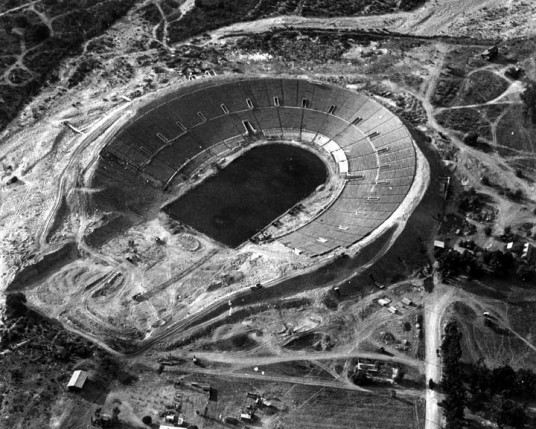
Bezdek led Penn State to two undefeated seasons, and a trip to the Rose Bowl in 1923 (a 14-3 loss to USC), the inaugural game in the newly built Rose Bowl stadium, the construction of which had begun in 1921 when the city of Pasadena realized that the annual football game was becoming larger than what Tournament Park could hold.

Construction of the Rose Bowl began in 1921, completed in time for the 1923 game 

The 1923 game in the new stadium would also mark the first time that the ‘East-West Championship Game’ as it had become known would thereafter be referred to as ‘The Rose Bowl,’ the first official college football bowl game.  Bezdek at Penn State resumed his multi-sport ways, coaching the Penn State basketball and baseball teams as well.

Hugo Bezdek remains the only person to have coached three different teams in the Rose Bowl, with a record of 2-1.  He also remains the only person to coach a major league baseball team and national football league team, and was elected to the College Football Hall of Fame in 1954.
 
1920 ROSE BOWL: THE HUNTINGTON’S RETURN
 
While Bezdek’s departure from the Oregon program was difficult, it also was somewhat of a relief as his hefty salary had become a strain on the University and student body, who had to flip the majority of the bill.  The question remained though, who would replace the genius who had turned Oregon into a west coast powerhouse?

With the war now over and the country settling back into a somewhat-normal routine, it seemed a natural fit that Oregon’s first All-American and the hero of the 1917 Rose Bowl would return home the conquering hero, Charles “Shy” Huntington.  While Bezdek’s ominous shadow was a large one to overcome, Huntington went about his work as both new football coach and also baseball coach for the University of Oregon.  Huntington would remain at the helm for six seasons, leading Oregon to a 26-12-6 record, finishing 4-2 in 1918 his first year, 2nd best in the Pacific Coast Conference.

Oregon's 1919 team, led by coach Shy Huntington (far left) 

In 1919 with the boys returning from overseas, Huntington’s team was bolstered by the return of a familiar face to the University of Oregon, his brother Hollis.  There were a few other returning players from the 1918 team, and just like in 1916 the Webfoots were led in part by multiple pairs of brothers; Francis & Vince Jacobberger, Earl & Keith Leslie, and Bill & W.H. Steers.  Also rounding out the roster was Neil Morfitt, the grandfather of Neil Everett (Morfitt), the ESPN sportscaster and Oregon alumnus who often includes Oregon references in his nightly sports highlights on Sportscenter.

Oregon also had a proud new gem of a stadium to demonstrate their dominance, as the newly built Hayward Field replaced Kincaid Field to house Oregon’s athletics, though bigger games were often played in Portland at Multnomah Stadium to accommodate the larger crowds expected.

Hayward Field 

Huntington’s team started the 1919 campaign out well, defeating MAAC, Idaho (a game in which Huntington scored 4 TDs), and Washington all in convincing fashion.  But a 7-0 loss to Washington Agricultural College (WSU) was a disappointing shocker, in part due to a series of crushing injuries suffered the week prior vs. UW.  Oregon would finish the year defeating their rival, Oregon Agricultural College (Oregon State University today), and MAAC once more for a 5-1 record, tying with Washington as Pacific Coast Conference co-champions.

During the game against rival OAC (OSU), a ceremony had been held officially naming the new structure Hayward Field after track coach and trainer Bill Hayward (who coached at Oregon from 1903-1947).  However, nobody notified him of the honor being bestowed upon him, and he was not present for the event, busily tending to his duties as team trainer back in the locker room at the time.  He found out of the honor the next day while reading the newspaper recap of the game.

Behind the scenes there was grumbling about Huntington not being cut out for the coaching job, and an effort was made to entice Bezdek to return to Oregon.  Huntington’s teams were winning, but not in the same dominating fashion that Bezdek’s Webfoots had been known for, and a longing eye was cast eastward to the success Bezdek was having with his new team, the Penn State Nittany Lions.  Bezdek declined the offer, he would remain at Penn State and Huntington like it or not would stay as Oregon’s coach.

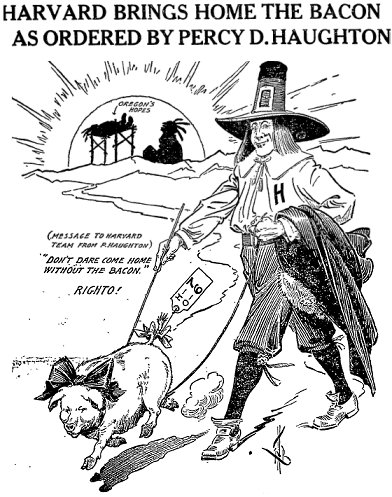
Despite a tie at the top of the conference, once again it was Oregon selected to participate in the Tournament East-West Football Game over Washington for the January 1st, 1920 affair.  This time east coast powerhouse Harvard would be the foe, the eventual national champions (a title that it shared with Illinois).  Harvard was undefeated, with a tie to Princeton their only blemish.

The 1920 Rose Bowl, Harvard vs. Oregon 

With older brother Charles “Shy” Huntington as coach and younger brother Hollis leading the way as star fullback, the Webfoots seemed a solid foe, yet once again east coast bias raised its ugly head.  The faces may have been familiar from the 1916 shocking defeat of Penn, but Harvard was the pride of the east coast and once more the media overwhelmingly chose the east coast team as the clear favorite.  No matter to the Huntington’s, they had been through all of this before, Hollis especially having played not only in the 1917 game but the 1918 matchup as well while a member of Mare Island.

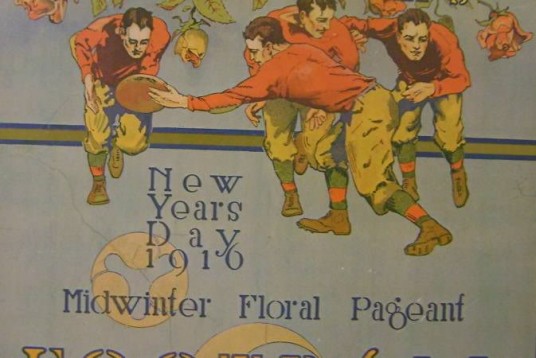
Program from the 1920 Rose Bowl, Harvard vs. Oregon 

The game would have special distinction for Hollis Huntington, as the only player in history to participate in three East-West (Rose Bowl) games, and the only one to ever do so for two different teams.

The game began exactly as the previous ones had, with no scoring in the first quarter as each side fought to achieve supremacy over the opponent.  And just like in 1917 and with Mare Island in 1918, it was the Webfoots striking first.

The scoring began in the 2nd quarter when quarterback Bill Steers nailed a 25-yard drop kick to take a 3-0 lead.  Oregon was moving the ball well, but once the Webfoots got within scoring range the big Harvard Crimson defense would stiffen, stifling their attack.  Hollis Huntington was scorching the Crimson defenders, he would finish the day with 122 yards on 29 carries, but the endzone eluded Hollis and the Webfoots.

Harvard responded with one long drive in the 2nd quarter following Steers’ dropkick, resulting in a touchdown, a 13-yard run by Fred Church.  Harvard took the lead 7-3, and on this day it would prove to be enough.  It wasn’t without great effort by Huntington’s Webfoots, but yardage churned up in the middle of the field couldn’t result in points at each end against the Harvard defense.

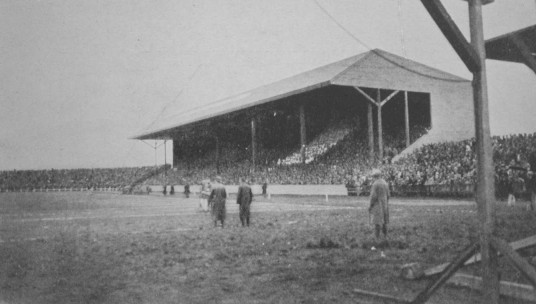
Additional grandstands were built at Tournament Park for the large crowd to witness the Oregon-Harvard game 

Late in the 2nd quarter Oregon did manage to score again, on a 30-yard drop kick by diminutive backup quarterback C.R. “Skeet” Manerud, who weighed in at barely 128 pounds, making the score 7-6.  The remainder of the game was a repetitive affair, Oregon would stop Harvard only to storm down the field, but couldn’t convert on kick attempts.  Three times Oregon’s attempts to take the lead resulted in a kick either missed or blocked.

Harvard was barely clinging to a 7-6 lead while clearly getting outplayed by Oregon.  As the game wore on, Skeet Manerud again had a chance to take the lead, but his kicked sailed barely a foot wide of the goal posts.  It was so close in fact that the scoreboard operator deemed it good, temporarily giving Oregon a 9-7 lead, but the referees overruled it and took the points off the board.  Despite Oregon’s overwhelmingly dominant performance, the game would end with no points scored in the 2nd half, and an agonizing 7-6 loss to Harvard.


The Harvard Crimson barely escaped the East-West game vs. Oregon with a 7-6 victory 

Despite the loss, Oregon was clearly the better team that day, and in the papers they were coined “The Team That Outplayed Harvard.”  The bitter loss only increased the behind-the-scenes awkwardness as Oregon officials continued to believe they could lure Bezdek back to Eugene to take over for his protégé Shy Huntington.  This futile pursuit of Bezdek continued intermittently for several years.
 
While Huntington’s teams continued to win, never losing more than two games in a season, Oregon officials pestered Bezdek to leave Penn State and come back to Eugene.  At one point Bezdek did make a cross-country trip to visit his old school, where he was welcome by a crowd of nearly 2,000 hailing him as a hero, honoring him during a ceremony where Huntington was awkwardly prodded to address the crowd and state “He is the best coach in the United States and I hope that Oregon may hope someday to have Hugo Bezdek come back.”

By the 1923 season, Shy Huntington had enough of the unwelcome attitude.  In his letter of resignation he wrote, “Each year my teams have been with me, but the alumni have not.  They have demanded a high-priced coach, and not for a moment does it appear to have entered their heads that a hometown boy might possibly be a good coach.”  In the wake of Huntington’s resignation, Oregon officials again tried to bring Bezdek back to Eugene, again he declined.


Hugo Bezdek chose to stay a Nittany Lion despite Oregon's repeated attempts to bring him back to Eugene
 
OREGON’S GLORY DAYS END IN THE POST-HUNTINGTON/BEZDEK ERA
 
With the last traces of the Huntington’s no longer a part of the program, Oregon’s glory days were officially over.  The Pacific Coast Conference had been dissolved, and Oregon had not been invited to be a part of the newly formed “Big 3” conference.  Hayward Field had been expanded to house a larger crowd, but the days of Oregon’s dominance on a national level would not return for some time.
Meanwhile in Pasadena the popularity of the annual Rose Parade was blooming, and the Tournament East-West Football Game had given way to an official re-naming to the Rose Bowl by 1923, with the construction of their new jewel of a stadium built on the former grounds of Tournament Park.  Originally a horseshoe design, the Rose Bowl would years later be fully enclosed as a bowl and expanded several times to its current capacity.


The original horseshoe design of the Rose Bowl 

Other bowl games eventually appeared as college football rose in nationwide popularity, but the Rose Bowl is appropriately deemed “the granddaddy of them all,” the oldest and most prominent bowl game in the country.  It still is played on new years day every year following the Tournament of Roses Parade held in Pasadena, unless new years falls on a Sunday in which case the events are delayed until the 2nd.  There was a brief time during World War II that the game was moved out east, fearing that the stadium could fall under Japanese attack, but the Rose Bowl remains the grand old gem of stadiums, host of the granddaddy of them all, the annual Rose Bowl game.


The 1958 Rose Bowl was Oregon's first return to the game since 1920 

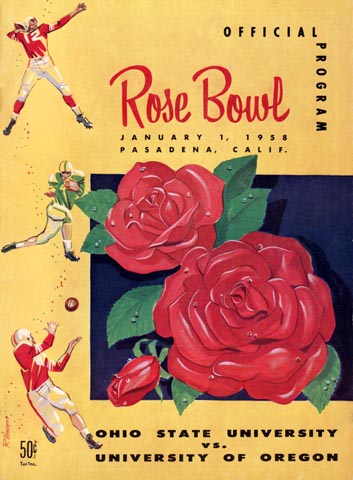
Oregon’s participation in the Rose Bowl would not be nearly as prominent as it was in establishing the game’s foothold as the East-West Game.  The Ducks as they were now known would not return to the Rose Bowl until the 1957 season, losing 10-7 in the 1958 game to #1 ranked and national champion Ohio State, a game where once again the heavily favored east coast team was vastly outplayed on the field by the scrappy Ducks.

As Ohio State fans celebrated the victory, Oregon coach Len Casanova was carried off the field on the shoulders of his players in triumph regardless of what the scoreboard read, Oregon again even in defeat shocking the football world and opening the eyes of everyone that west coast teams could compete toe-to-toe with the big boys east of the Mississippi.
 
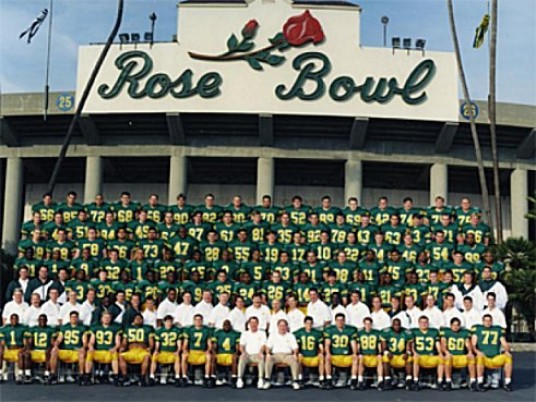
It would be another 37 years before Oregon would return, facing off against the Penn State program that years earlier their former coach and hero Hugo Bezdek had spent decades building into a national power.  It was a welcome return for Oregon to the granddaddy, but one that would again end in frustration despite a valiant effort, as Oregon squandered multiple scoring opportunities and lost to the Penn State Nittany Lions 38-20.


The 1994 Oregon Ducks returned to the Rose Bowl for the first time in 37 years 

The 2009 season for Oregon started off with an embarrassing loss, but was followed by a remarkable winning streak that ended with a brilliant victory over Oregon State to seal the Pac-10 conference title and Oregon’s chance to once more play in the bowl game that the school had helped make famous back in Huntington & Bezdek’s era.  Again, Oregon would come out on the short end, losing to Ohio State 26-17 in the 2010 Rose Bowl.


The 2010 Rose Bowl, Oregon vs. Ohio State 

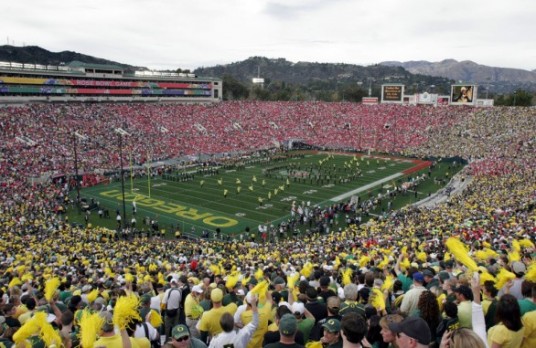
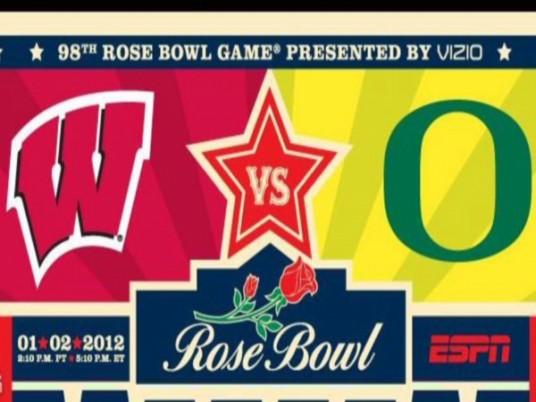
Now, in less than a week Oregon again returns to the Rose Bowl, the granddaddy of them all, Oregon vs. Wisconsin.  Oregon is 1-4 in games played in the event, having outplayed their opponents in 1920 and 1958 but suffering the loss nonetheless.  Perhaps distant memories of the Huntington brothers, the Beckett duo, and the legendary coach Hugo Bezdek that helped establish Oregon as the focal point of the success of the grand old event can lead the Ducks to victory one last time, after all sixth time’s the charm I hear.  As Bezdek and the Huntington’s proved in those early years of the game, all they need is a chance for Oregon to prove their worth.

An interesting sub-text exists with Oregon’s first Rose Bowl, and the opponent of their next one.  1916 was the first season that Oregon used their fight song, “Our Mighty Oregon,” coincidentally the first year they played in the Rose Bowl.  Now less than a week away before their next Rose Bowl, Oregon is playing the team whose song they borrowed prior to 1916.  Indeed, before that 1916 season when Oregon’s prominence in college football began, Oregon used a variation of the fight song “On Wisconsin” during events, with the lyrics slightly changed, as the official school song.