Showing posts with label Rose Bowl. Show all posts

Thursday, January 23, 2014

An unprecedented era of success for University of Oregon athletics

An unprecedented era of success for University of Oregon athletics 

 
Originally posted on FishDuck.com on April 9th, 2012 
 
The University of Oregon can claim 20 team national championships in varsity sports since the school’s founding in 1876, along with numerous individual national champions gracing the history books.

Even when not winning the big one, there have been years when Oregon has been among the elite in the nation in select sports. In football Oregon was the cream of the crop in 1916, 2001, 2007, and competed for a national championship in 2010. But for all the football success, Eugene is still called TrackTown U.S.A. for a reason, with all but two of Oregon’s claimed national championships coming in sports other than Track & Field/Cross-Country (1939-men’s basketball, 2011-Acrobatics & Tumbling).

Add onto that success the 69-individual conference champions and two national champions from the now-defunct wrestling program. Sprinkle on top the 1954 baseball team that made an appearance in the college world series, a sport at the UO that holds 10 conference championships while claiming MLB hall of famer Joe Gordon as an alumnus, despite being shutdown due to budget cuts in 1981 and experiencing a 27 year hiatus before its 2009 resurrection. These are just a few of the notable teams that have achieved great success while representing the University of Oregon.

There is a lot of pride in Oregon’s past, many stories of great individual and team efforts. Yet in all the years of competition and legendary student-athletes that have donned the green & yellow, there has never been a time in Oregon’s history like there is today.

A select handful of major colleges have experienced the great luxury of being able to compete as an elite program in multiple sports. Out west it has been UCLA and Stanford more than any other traditionally that have been able to produce a program competitive in numerous sports, UCLA bearing more collective national championships than any other school in the nation. For most programs though, it is a great achievement to be considered elite in even one single sport, the majority of resources going to continue that success on a national level.

While football may stir the cup for most programs as the largest revenue sport, what would Duke University be without men’s basketball, Connecticut without women’s basketball, Minnesota without hockey, or Northwestern without lacrosse? Great athletic programs come to define a school, the iconic first thought when a program is mentioned.

If there is one sport that has defined the University of Oregon for decades, it has been Track & Field. Be it cross-country, indoor, or outdoor; 18 national championships in all can be claimed by the University of Oregon, earning the well-deserved moniker of Tracktown U.S.A, the birthplace of running, and Nike-U…There is every reason why Eugene and the UO should be synonymous with Track & Field, but as great as the track teams have been in recent years in particular, it is now football that dominates the most attention on a national level of the sports being played in Eugene.

Perhaps it is justified, because Oregon football is not only successful, but flashy. It’s not enough to just win, but doing so with such unique flair and style that it has at times seemed to dwarf other sports at the UO by its achievements. If it’s possible to play football sexy, then the Ducks make a punishing brutal game look as good as a Sports Illustrated swimsuit model. The success and profits earned in football have trickled down to other sports within the program, fueling increased donations for improved facilities that then spur recruiting and national media attention. But is this enough to warrant the vast amount of attention gained by the Oregon football team in comparison to other sports at the UO?

With spring practice in full swing and the Oregon spring game mere weeks away, it’s easy to get caught up in the excitement of the Oregon football program. Focusing solely on the gridiron though does injustice to the grand time Duck fans should be enjoying now, a time of unprecedented achievements as an athletic program, the greatest time for athletics overall in the history of the school. Seven of Oregon’s 20 overall team national championships have been won since 2007, with more room probably needed in the trophy cases shortly.

National Championships at the University of Oregon
Acrobatics & Tumbling
2011


Basketball (Men’s)
1939


Cross Country (Men’s)
1971
1973
1974
1977
2007
2008
 
Cross Country (Women’s)
1983
1987


Indoor Track & Field (Men’s)
2009


Indoor Track & Field (Women’s)
2010
2011
2012


Track & Field (Men’s)
1962
1964
1965
1970
1984
 
Track & Field (Women’s)
1985


There are certain eras that fans may look back upon with great pride when everything seemed right in the world of Oregon athletics, and rightfully so.

1916-1920


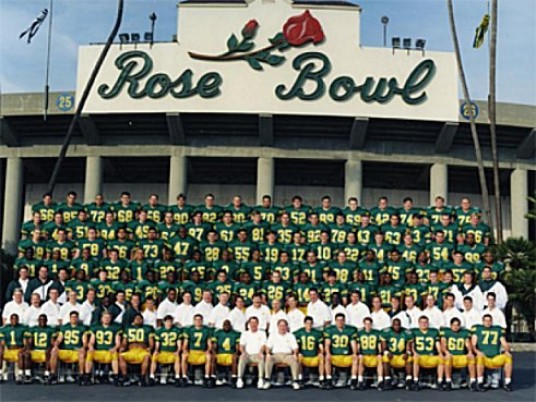
The 1916-17 Oregon Webfoots won the third ever East-West Tournament Game, later known as the Rose Bowl 

The second-coming of Hugo Bezdek to Eugene (he had previously coached briefly at Oregon years prior) saw the coaching legend lead multiple Oregon programs to prominence. In 1916 Bezdek’s football Webfoots earned the right to play in the third-ever East-West Tournament Game, the precursor to the Rose Bowl. The Webfoots won.

Three months later World War I broke out and many Oregon students enlisted for the war effort. During the war Bezdek was asked to coach a military team that featured two of his players from his 1916 championship team, a team that would be asked by President Woodrow Wilson himself (the Mare Island Marines) to play in the East-West Tournament game of 1918. They won, with one of Bezdek’s two Webfoots, Hollis Huntington, being named game MVP.

Winning was something Coach Bezdek did often, whether it was leading the football team, baseball team, or basketball team; all of which he coached. In fact Coach Bezdek is the only person in history to take three different teams to the Rose Bowl (Oregon, Mare Island Marines, Penn State), and the only person to coach both a NFL and MLB team (Pittsburgh Pirates, Cleveland Browns).

He left Oregon in 1919 to manage the Pittsburgh Pirates full-time, followed by a lengthy stay at Penn State, while his former quarterback from the championship 1916 team Charles “Shy” Huntington took over as football coach, again leading the team to the Rose Bowl; albeit in a losing effort falling to Harvard 7-6 on a controversial referee call.

This was an amazing time to be a fan of the Webfoots (the Ducks nickname did not come until years later), but for all the success experienced under Coach Bezdek in Eugene, it wasn’t as good as it is today…
 

1962-1965


Mel Renfro is one of six NFL Hall of Famers who played for Oregon 

During a four-year stretch in the early 1960s (1962-65), the Oregon men’s track team won three national titles. During Coach Bowerman’s tenure he would bring four national titles to Eugene before his retirement in 1972, while preparing 24 individual NCAA champions and 33 Olympians for competition. His 1962 and 1964 teams were two of the most talented, both bringing home team national championships.

During this same time, the football team led by legendary coach Len Casanova would win the 1963 Sun Bowl over SMU, touting a roster that featured two future NFL Hall of Famers, Dave Wilcox and Mel Renfro.

In 1964 the Oregon Ducks baseball team reached the NCAA tournament, one of three appearances in Omaha that Oregon has made in its history.

This was definitely a great time to be a Duck, but not like it is today…
 

1970-1973


Nobody exemplified the winning spirit of Oregon athletics more than Steve Prefontaine 

From 1970-73 the track teams headed by legendary distance runner Steve Prefontaine brought unprecedented success to the place already known as the mecca of running, earning three national championships.

This while Bobby Moore (now Ahmad Rashad) and Dan Fouts were leading the Duck football team to victories, and Coach Harter was establishing his Kamikaze Kids, making life miserable on the rest of the Pac-8 conference any time they visited Mac Court. Yet during this era, the football team never went to a bowl game, nor did the basketball team make the NCAA tournament, though they did earn a spot in the NIT on three separate occasions.

In 1972 Hayward Field would host the US Olympic Trials, a team that would be led by Oregon coach Bill Bowerman for the games held in Munich that summer.

In the greater scheme of things this was a great time to be a Duck fan following multiple sports, but not as great as it is today…
 

2001-2003


Oregon finished #2 in the country in 2001, winning the 2002 Fiesta Bowl 

Two decades later football began awakening from its slumber, earning bowl berths in 1989, 1990, and 1992 before the amazing 1994 season that is commonly thought of as the watershed moment in Oregon sports, when the team improbably won the Pac-10 title earning a Rose Bowl berth. That success inevitably led to the improvement of facilities and increased fan support, which has fueled the facelift of the University of Oregon over the past 20 years helping other programs to succeed as well.

This growth reached a fever pitch in 2001, when Oregon reached as high as #2 in the national rankings in football culminating in a Fiesta Bowl victory, while on the basketball court much noise was being made by a trio of Pacific Northwest ballers who would all go on to be NBA draft lottery picks—Luke Ridnour, Luke Jackson, and Freddie Jones. The Duck basketball team would win the Pac-10 title in 2003, reaching the Elite Eight in the NCAA Tournament.

But as great of a time as this was to be a Duck fan in multiple-sports, it wasn’t like it is today.
 

2007-2008


2007 saw a Cross-Country national championship, Elite-8 finish in basketball, and a Sun Bowl victory 

Then came 2007, a year that saw the hiring of a brash young offensive coordinator named Chip Kelly to take over the football team’s offensive resources and transform it into the flashy unstoppable machine that it continues to be to this day, with Chip now the head coach. That season the Ducks looked to be national championship-bound led by the presumed Heisman Trophy winner Dennis Dixon, but injuries curtailed those hopes. On the basketball court there was much to celebrate too, as senior point guard Aaron Brooks would again lead Oregon all the way to the Elite Eight.

Great success came on the track as well, as the men’s cross country team won back-to-back national championships and Pac-10 titles, while the women’s team finished as runner-ups for the Pac-10 and national titles. In all, the track teams featured 11 All-Americans at the outdoor championships, with Coach Vin Lananna being named as the NCAA Men’s Cross Country Coach of the Year. Hayward Field would again be the host of the US Olympic Trials in 2008, further showcasing the dominance of Oregon’s track program and grand history.

And even still as great of a time this was to be a Duck fan, it wasn’t as good as fans have it today.

 
So what is it that makes Oregon athletics right now so special, greater than these previous tremendous eras of athletic dominance? Simple really, because while many schools may claim prowess in one or two sports, nearly every single one of the 17 sports Oregon competes in are currently among the elite in the nation.

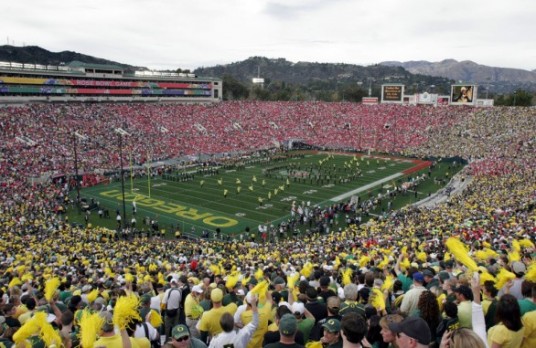
The success goes far beyond just football, though fans still remain abuzz from Oregon’s Rose Bowl victory back in January over Wisconsin and top-5 finish. There is a much greater buzz reverberating from the Cas Center if fans tilt their ear just right, the palpable excitement generated by the unprecedented level of athletic talent currently in the program whose victories on the field of competition may only be overshadowed by their achievements in the classroom.

The Casanova Center: Home to Oregon's ever-expanding Hall of Champions 

Across the board, Oregon features more individual stars and teams at or near the top of the national rankings than any time previously in the program’s history. Oregon athletes have some of the best facilities in the nation, top-level coaches, and an academic, training, and treatment support structure that is the envy of every collegiate athletic program in the country. The Oregon O logo has become an icon, instantly recognizable from coast-to-coast and feared by all foes that must face the great athletes donning its simplistic yet powerful symbol.

Never before has the University of Oregon experienced the kind of athletic success that is seen right here, right now. Certainly at times in the past Oregon has been the talk of the nation in one or two individual sports, but now the Ducks are quickly mentioned alongside such traditional athletics factories as Texas, USC, Notre Dame, Michigan, and Alabama.

Just take a look down the list of sports in which Oregon competes, and the storylines of success associated with each that make this without question the greatest time ever to be a Duck. It goes well beyond football, Oregon Ducks athletics are dominating the field of competition in both men’s and women’s sports.
  • Acrobatics & Tumbling – The youngest collegiate sport in which Oregon competes, the defending 2011 national champion A&T team is undefeated on the year looking to likely repeat as champs with only one meet left before the national tournament at the end of April. Now in its second year of existence as a program, the Ducks have only lost once, EVER!
  • Baseball – Revived from extinction just a couple years ago, the program is ranked #22 with a recent sweep of #14 ASU and taking 2-out-of-3 vs. #5 UCLA this past weekend, putting the team in 2nd place in the conference and clearly bound for the postseason.
  • Basketball (Men’s) – Coach Altman has revived a program that seemed floundering, winning the CBI Tournament last season. Despite losing several players early this season, these Ducks rallied to make an improbable run down the stretch finishing tied for 2nd place in the conference earning a spot in the NIT Tournament, reaching the semifinals before falling to hated-rival Washington.
  • Basketball (Women’s) – It was a little bit of a disappointing year due to multiple injuries, yet not without its accolades as senior Amanda Johnson was named the Toyo Tires National Scholastic Athlete of the Year and named to the All-Pac-12 team, and four other Ducks received Pac-12 All-Academic honors. Even with the graduation of Johnson, barring another injury-plagued season these Ducks should be flying high in the 2012-13 season.
  • Football – The Rose Bowl victory in January is only the latest achievement in a string of victories that has put Oregon among the elite programs in the nation. The Ducks are the only school in the country that can claim to have played in a BCS game every year for the past three seasons, with no signs of slowing down any time soon, presumed to be a top-10 team once more in 2012.
  • Golf – Both the men’s and women’s golf teams are ranked the top-25 (M-#12, W-#22), featuring several notable players, such as wunderkind freshman Cassy Isagawa and senior Eugene Wong, both of which we may be seeing on the PGA tours soon. The NCAA Championships start at the end of May, with both Oregon golf teams expecting to be in the hunt for the title.
  • Lacrosse – The Oregon women’s lacrosse team currently sits atop the MPSF standings, having won 8 of their last 9 outings, and are 9-4 on the season with postseason glory within their grasp at the MPSF Tournament held April 27-29.
  • Soccer – Coach Erickson has reason to be excited for this year’s upcoming season to rebound from last year’s disappointing results. The team did feature eight All-Academic Pac-12 honorees last year, and this season returns sophomore goalkeeper Abby Steele, twice invited to the 20-and-under USA National Team Camp, and was a member of the 18-and-under USA Women’s Team in 2010. The Ducks return 22 players from last year, and feature one of the best recruiting classes in years. With returning veterans, a talented new class, and led by one of the top goalkeepers in the nation, there is no reason to think that this year’s team can’t be among the best in the conference in 2012.
  • Softball – The Duck softball team sits at 17th in the nation in the most recent rankings, winning six of their last eight games including victories over #14 Stanford and #5 ASU. Oregon looks poised to reach the NCAA Regionals, with realistic dreams of Oklahoma City and the Women’s College World Series attainable the way they keep swinging the bats, so far defeating nine NCAA Tournament-qualifying opponents on the year.
  • Tennis – The men’s team rocketed to success early on the year starting out 8-0 thanks to the strong play of Alex Rovello and Robin Cambier, but have been on a recent downturn losing four of their last 5 matches leading into the Pac-12 championships April 26-29. The women’s team picked up their first Pac-12 win on the year this past Friday, defeating #43-ranked Utah.
  • Track & Field – No school in the country can boast the kind of single-sport dominance like Oregon has had the last few years on the indoor track. The women’s team are 3-peat national champions, while the men’s team hold a 2009 national title. The Ducks haven’t been too shabby outdoors or in Cross Country either, placing numerous athletes on All-Academic and All-Conference honors while bringing home multiple individual championships. The women’s team is currently ranked #1, while the men’s team is 16th. This summer when the Olympic Trials are once more held at Hayward Field, it will be merely the stepping stone for multiple Oregon athletes towards representing the United States at the Olympic Games in London. Oregon is without question the big dog, the measuring stick all other schools in the nation strive to emulate.
  • Volleyball – This past season Oregon’s women’s volleyball team climbed as high as 13th in the country, reaching the NCAA Tournament and starting off the season with a bang, ending one of the most impressive streaks in the history of athletics. The Ducks took down #1 Penn State on their home court, ending a consecutive home-winning streak that was the third longest in NCAA history…in ANY sport. The team returns two All-Pac-12 selections in Alaina Bergsma and Lauren Plum, with Bergsma being named an All-American and Plum honorable mention for the All-American team. Five starters return, and there are high expectations for last year’s All-Pac-12 Freshman team selection Liz Brenner, who was the Oregon Prep Athlete of the Year in 2012 before joining the Ducks, leading Jesuit High School to two state championships while being the 6A state basketball player of the year and state champion in the shot put. Not only is Brenner a rising star for the volleyball team, but she also plays basketball at the U of O.
 
Oh, and shall we mention that Oregon’s cheer team is consistently considered the best squad in the nation year after year, and few mascots are more recognized or beloved than the Oregon Duck???
Collecting individual accolades for both their athletic prowess and achievements in the classroom, there has never been a time like this before in Oregon athletics.

Oh sure, teams and athletes in the past have done great things for the University of Oregon, but as a collective group this level of success has never been achieved before. Not in the era of Hugo Bezdek, not in the days of Steve Prefontaine, not when Fouts and Moore made waves in the newly-christened Autzen Stadium, not when the most improbable finish to a football game sparked a revolution in the program, not when Oregon’s football and basketball teams both raised trophies in the early 2000s, and not when Eugene seemed to be the crossroads for all collegiate athletics in 2007…NEVER has there been a time in Eugene where nearly every sport that Oregon competes in was competitive with the nation’s elite top to bottom.

…And this doesn’t even touch on the club sports. Oregon’s trophy cases feature bowl game trophies and track accolades, but also highlight a recent individual national championship in club sports for disc-golf, and hold a national title in Ultimate Frisbee as well (they appeared poised for another one in 2009 had complaints of underage drinking and nudity not forced the executive committee that oversees club sports to cancel the remainder of their season).

Ducks celebrate their first Rose Bowl victory since 1917 

Enjoy it Duck fans, embrace the renaissance of Oregon athletics, revel in the shared victories and continued success of all of Oregon’s various sports, as there has never been a time like this before.
Even if the football team gets slapped with NCAA sanctions stemming from self-reported recruiting violations that have been speculated on often without much tangible public evidence so far, much to the joy of Beavers and Huskies looking to regain a foothold in the northwest; there is no slowing down Oregon athletics across the board, the program competing to be among the top in the Pac-12 conference in nearly every sport.

17 different Oregon sports, and all of them represent the O both in the classroom and on the field of competition as well as any generation of Duck athlete in the past 136 years at the U of O.  When looking at the big picture of this recent string of victory after victory throughout the entire UO athletic program, it is clear that the Ducks have become much, much more than just TrackTown U.S.A…

Oh, but they’re pretty darn good at that too. Didn’t you hear? The Ducks swept the Pepsi Team Invitational this past weekend at Hayward Field, winning 16 events in all, well on their way to adding more championships to the recently-packed full trophy cases at the Casanova Center.
Over the past year, the entirety of University of Oregon athletics have truly Won The Day.


After winning the CBI Tournament in Coach Altman's inaugural season, bright things are ahead for the Ducks basketball program…and that's just the tip of the iceberg of UO athletic success to come. 
 

Oregon’s integral role in the history of the grandaddy of them all

Oregon’s integral role in the history of the grandaddy of them all 

 
Originally posted on December 28th, 2011 
 
On New Years Day in 1890 the first Rose Parade was held in downtown Pasadena, CA; devised as a way to entice people from the east coast to purchase real estate in Southern California, an effort to convince those with deep pockets to escape the cold winter weather for sunny Southern California.
“In New York, people are buried in snow, here our flowers are blooming and our oranges are about to bear,” announced Professor Charles Holder, a noted author and sportsman who had moved out west in 1885 from New York. “Let’s hold a festival to tell the world about our paradise.”

Following the parade were various festive events.  In the first few years a communal picnic was held with contests such as foot races and tug-of-war battles highlighting the post-parade afternoon.  Once there was even a race between an elephant and a camel, with the elephant declared the victor.   But by 1902 it was decided that a college football game should be held to punctuate the annual Tournament of Roses festivities, matching the best teams of the east and the west.


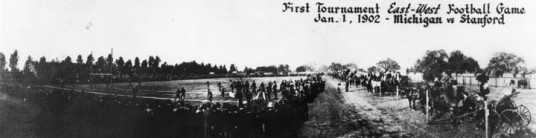
The very first East-West Game (later coined 'The Rose Bowl' was played in 1902 

Tournament Park was determined to be the location for that first game, dubbed the East-West Game, pitting the University of Michigan Wolverines (10-0) vs. the Stanford Indians (3-1-2).  Michigan had been nicknamed “the point-a-minute gang,” having racked up a season total of 550 points to zero, led by legendary coach Fielding Yost, who had been Stanford’s coach the year prior.  Almost 8,000 spectators packed the grandstands for the game following the Rose Parade, though they didn’t get to witness a complete battle as Stanford quit in the 3rdquarter, with the score already 49-0.


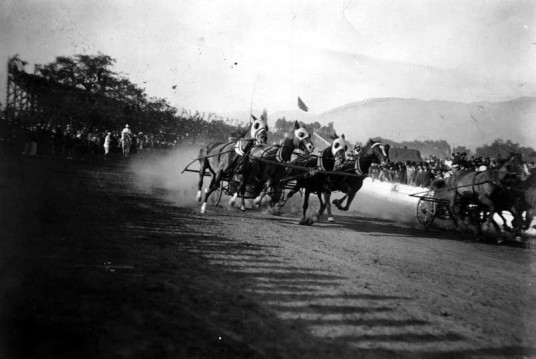
Roman Chariot Races held at Tournament Park in 1908 

Perhaps embarrassed over the lopsided affair, or the premature ending to the game, the East-West Game would not be held the next year, or the next, or the next.  In fact, 14 years would pass before a college football game would be held again in Pasadena as part of the Tournament of Roses slate of events.  During those non-football years the game was replaced with other events, such as ostrich races, polo, and Roman chariot races (which had become all the rage in the wake of the release of the book ‘Ben Hur’).

By 1916 the Great War was raging in Europe, and while the United States had remained out of the conflict, the sinking of the Lusitania in 1915 and amped-up anti-German rhetoric signaled the inevitability that America would someday join the fight.  In anticipation of that, many young men were joining the military, and military bases began fielding teams playing against collegiate squads.  When it was decided to hold another East-West Game in Tournament Park, it was (6-0) Washington Agricultural College (now known as Washington State) defeating the (5-3-1) Brown University Bruins, 14-0.  Brown was invited to play after Syracuse refused to travel cross-country again for a game, having already played Oregon Agricultural College (now Oregon State University) earlier that year.


The 2nd East-West game was held in 1916, Brown vs. Washington Agricultural College (WSU)

Despite the WAC (WSU) victory, eastern teams were considered vastly superior to football teams out west, so it was no surprise that in the third East-West Game The Penn Quakers were considered a huge favorite over the Oregon Webfoots.

Oregon even being able to physically attend the game was a difficult task.  The Oregon Webfoots had finished their season 6-0-1, with a tie against Washington, a team that had not lost a game since 1907.  Oregon was chosen to represent the brand new Pacific Coast Conference (formed in 1915).  Oregon had a larger margin of victory than Washington in their mutual opponent, California, even though Washington had actually played and beaten California twice that year, leaving Washington with one more victory tallied than Oregon.  It also helped that Eugene was closer to Pasadena than Seattle, lessening the travel expenses to reach Pasadena, still the cost associated with representing the PCC was hefty.


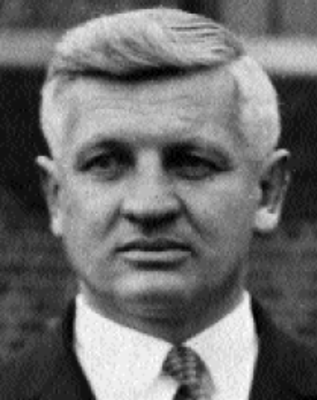
Oregon Coach/Athletic Director Hugo Bezdek 

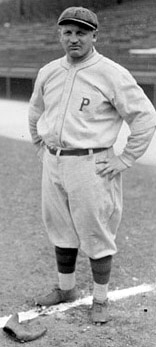
Oregon coach Hugo Bezdek had been a man of many talents, also coaching the baseball and basketball teams while acting as the first Athletic Director at Oregon and a professor of “Outdoor Athletics.”  From 1917-1919 he also was the manager of the Pittsburgh Pirates, traveling by train between Pittsburgh and Eugene to cover his dual duties.  It was Bezdek’s second tenure in Eugene, he had coached the football team in 1906 first, before returning in 1913 after time spent with the University of Arkansas, where he coined the team nickname “Razorbacks.”  Years later after a lengthy stint at Penn State he would coach the Cleveland Browns, becoming the only person in history to coach both a major league baseball and national football league team.

Bezdek’s salary was covered by both the University of Oregon and  the student body, in fact 2/3′s came from the students (imagine the students covering the cost of Chip Kelly’s ample salary today).  Bezdeck was an innovator, a free thinker, the Chip Kelly equivalent of the early 20th century.

Oregon was one of the first teams to openly embrace the forward pass, in spite of rules existing at the time penalizing teams for incomplete throws.  Bezdek implemented odd new formations, training regimens and meals for players, and other techniques that were well beyond their years.  In later years Oregon would be among the first to utilize pre-snap motion in the 1940s, proving that Oregon has clearly been an innovator in the game of football throughout the decades, not just recently in this renaissance era of the Chip Kelly spread and flashy Nike uniforms.

In order to be able to fund the cost of an additional month’s salary for Coach Bezdek and paying for the team to travel to Pasadena, the student body sold the student-owned campus bookstore.  It was worth it to the students and the Eugene community for a chance for the University of Oregon to play in what was at the time the only college football postseason game in the country, and only the third time such a game would occur at that.  Bezdek was stripped of his roles as baseball and basketball coach so as to focus solely on football and the difficult task of shutting up the national pundits who claimed that no west coast team could compete with the might of the east.


Former Penn quarterback Bert Bell, as NFL commissioner, meets with President Harry S. Truman 

The (7-2-1) Penn Quakers featured three All-Americans, including future NFL commissioner Bert Bell (whose father was the Pennsylvania Attorney General), yet Penn had not been the first choice for the game, Harvard and Yale had both initially declined.  Despite being third choice, Pennsylvania had been a powerhouse and innovator as well in the early days of college football; declared the national champions in 1894, 1895, 1897, and 1904.  Penn was credited with creating the quarterback kick (a precursor to the forward pass), the delayed pass, and the place-kick from scrimmage i.e. field goal.  Among the legends who had played for Penn were John Heisman and John Outland, for which two of the most prestigious awards in collegiate sports are named after, along with years later Chuck Bednarik (1947-49), considered the greatest Penn Quaker of all-time.

Penn coach George H. Brooke had quit suddenly the previous season, replaced by Bob Folwell for the 1917 campaign, who had previously coached for Lafayette College (1909-11) and Washington & Jefferson College (1912-15).  Folwell, bolstered by the barrage of media already declaring Penn the victor before the game was even played, invited coaches to come see his team practice.  Among them was Amos Alonzo Stagg, legendary coach of the University of Chicago, later nicknamed ‘the grand old man of football’ for all of his feats (he was part of the initial class elected into the Football Hall of Fame).  Hugo Bezdek had played fullback for Coach Stagg at Chicago, and Stagg had been the one to recommend to the University of Oregon that they hire Bezdek back in 1906 for his first stint in Eugene.

At Bezdek’s request, Stagg compiled a scouting report of the Penn team and provided it to Bezdek in advance of the East-West Game matchup.  Again Folwell showed his cards with his team in Pasadena preparing to take on the Webfoots, inviting Bezdek to attend Penn’s final practice before the East-West Game a day before the game was to commence.  Coach Bezdek happily accepted the offer to attend, took notes, and decided to implement into his own gameplan the trick pass play that Penn demonstrated for Bezdek in practice to him as he and Folwell exchanged pointers (imagine Chip Kelly inviting an opposing coach to come watch the team practice inside the Moshovsky Center the day before a game and go over Chip’s gameplan in detail with them).

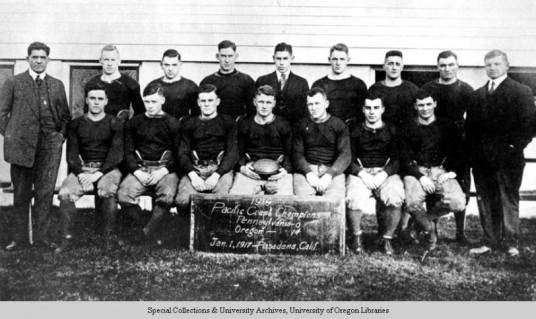
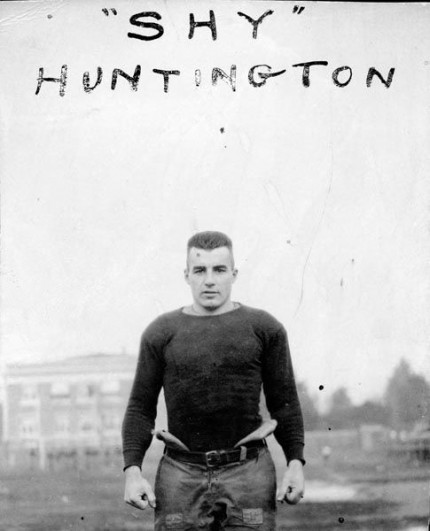
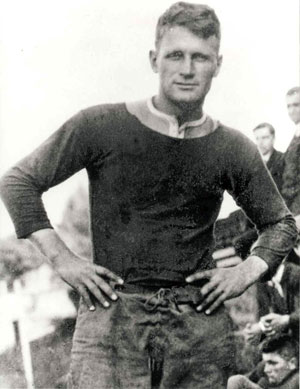
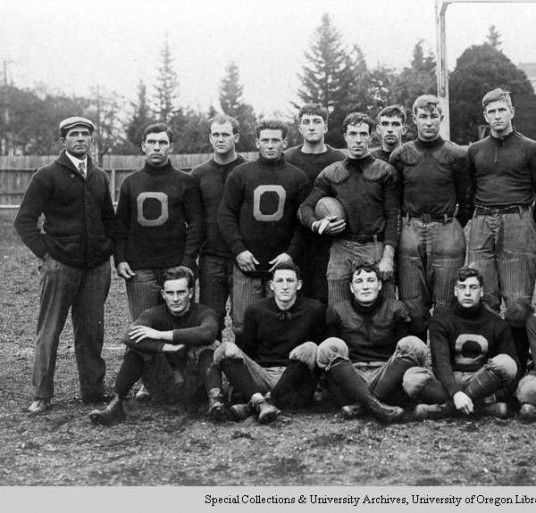
Folwell and Penn’s overconfidence would become their folly, as Oregon came ready to play on January 1st, 1917.  The Webfoots were led by three pairs of brothers, John & Jack Beckett, Leo & Robert Malarkey (Leo’s son Donald Malarkey would gain fame for being portrayed in the HBO series Band of Brothers as a member of the 101st airborne during WWII), and quarterback Charles “Shy” Huntington & Hollis Huntington.  Shy was Oregon’s first All-American, a standout at quarterback as well as a quality kicker and defensive back.  The Huntington duo, and the rest of the Webfoots led by Bezdek would have plenty in store for the Penn Quakers, and college football would never quite be the same again thereafter.

Of course going into the game Coach Hugo Bezdek, ever the strategist, played up the David vs. Goliath matchup to the media perfectly.  “I’ve got only overgrown high school boys, while Penn can field a varsity of big university strength, we haven’t a chance,” he said.  “We are going to put a team on the field that won’t be licked and consequently can’t be licked,” Folwell meanwhile boasted to the press.
 
The 1917 EAST-WEST GAME (3rd Rose  Bowl)
 
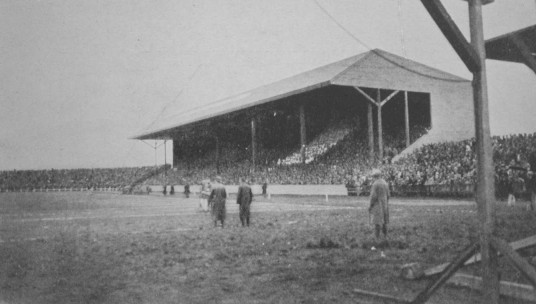
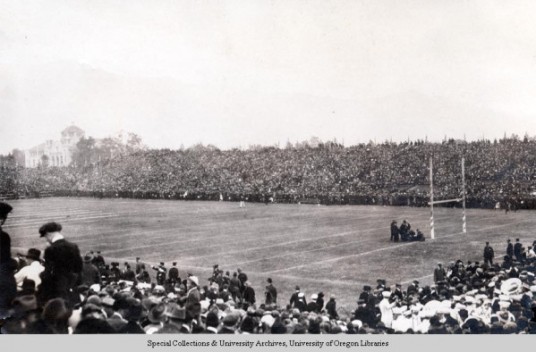
Anticipating a larger crowd than usual, the city had built temporary grandstands to house the 25,000 fans that packed the sidelines at Tournament Park for the Oregon-Penn game, culminating the annual Tournament of Roses event.  Meanwhile back in Eugene, the Heilig Theater (located where the Hult Center now stands) was packed to the rafters with folks watching a simulated football field on stage being updated with the assistance of a telegraph and megaphone announcing each play as they were relayed over the wire.


Pacific Coast Conference Champions, the 1916 Oregon Webfoots 

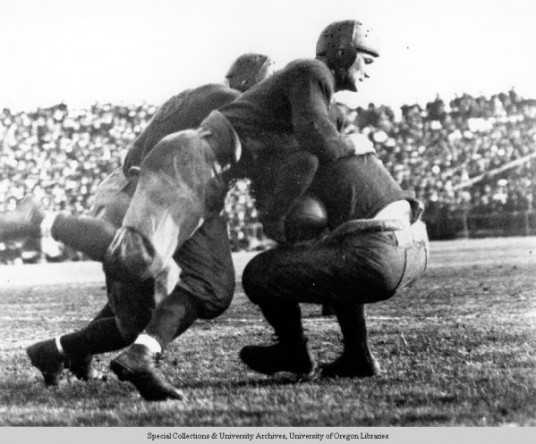
On the field it was a defensive struggle, with Shy Huntington shining.  In an era when teams rarely threw the ball, Huntington intercepted three passes on the day, and would have had a fourth pick but it was called back on a penalty.  Even with the turnovers, it was Penn who first threatened to score, moving the ball to Oregon’s 4-yard line after recovering their own blocked kick followed by a 20-yard run by Penn quarterback Bert Bell setting up the Quakers in scoring range.  The Quakers would be stymied though, as Bell was sacked forcing a field goal attempt that sailed wide.  It remained a scoreless tie at halftime.


Shy Huntington brings down a Penn player in the 1917 Rose Bowl 

The defensive stop was just what the Ducks needed to turn the tide.  Howard Angus, a writer for the Los Angeles Times, noted the following: “The Webfoots defense were steadied as if someone had given them a shot of hop. A big grin spread over their faces that never was erased. From then on Oregon was unbeatable.”

In the third quarter, Oregon finally broke the game open.  Utilizing the same trick pass play that Penn Coach Bob Folwell had invited Coach Bezdek to witness the day prior, Shy Huntington connected with Lloyd Tegart for a 15 yard touchdown.  Shy knocked in the extra point to give the Webfoots a 7-0 lead over the much-favored and clearly frustrated Penn Quakers.

“Imagine what we thought and said when Oregon scored its first touchdown on our own play,” said Bert Bell to reporters after the game, as quoted in the Los Angeles Times.


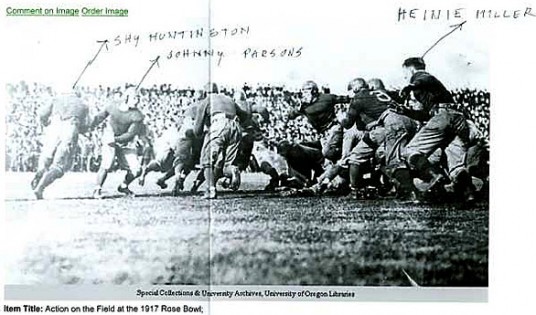
Shy Huntington and Johnny Parsons in action vs. Penn in the 1917 Rose Bowl 

The battle continued, highlighted by Huntington’s great defensive play and John Beckett’s tremendous job in the trenches controlling the line of scrimmage.  In 1953 when MVPs of the Rose Bowl were first assessed, Beckett was retroactively awarded the MVP of the 1917 East-West Game (3rd Rose Bowl).  With each defensive stop the Oregon Webfoots’ confidence grew.  Penn’s much ballyhooed passing attack was stopped in its tracks by Shy Huntington’s interception hat trick, held to only 32 passing yards on the day while Oregon racked up 131 through the air, while Beckett was leading the push up front to allow for the Oregon ground game to grind it out.

In the 4th quarter, the Webfoots broke through again.  A 40-yard run by Johnny Parsons set up Oregon at the 1-yard line, where Shy Huntington ran it in for the second touchdown.  Huntington added the extra point, making it 14-0.


Charles "Shy" Huntington, quarterback/kicker/safety and later coach at Oregon 

Taunts emanated from the Oregon team, “Are the city boys getting tired? Came west to teach us football, did you?” (source: Los Angeles Times) in the wake of the stunning score, while back in Eugene it was jubilation as the score was announced inside the Heilig Theater.  The score would stay, Oregon had shut out their opponent for the fifth game in a row to end the season, stunning the Penn Quakers in a 14-0 upset victory in the East-West Game at Tournament Park, the third Rose Bowl.  Fittingly the game ended with Huntington intercepting a Pennsylvania pass at the end of a long 79-yard drive, and the Webfoots ran out the remainder of the clock to seal the victory.

Oregon had barely outgained Penn, with the Webfoots totaling 242 yards of offense to Penn’s 230, but it was the staunch defensive effort that Oregon displayed that made the game feel like a rout.
Completely bewildered, Coach Folwell said after the game, “We ran into a batch of football that was a cross between a zip of forked lightning and the roll of a fast freight.” 

Folwell would not be the last to grossly underestimate the University of Oregon’s abilities and will to fight against superior talent.

Harry A. Williams of the LA Times joyfully wrote after the game, “west coast teams would lick the stuffing out of every eastern team which ventures far enough away from home to make the discovery that all the football in the world is not bounded on the west by the Mississippi River.”  That sentiment may have been proven by the game outcome at the time, yet as we all know the now infamous ‘east coast bias’ still rings very true nearly a hundred years later.


Hugo Bezdek, as manager of the Pittsburgh Pirates
 
Three months later the United States officially entered The Great War, and campuses across the country drastically changed, including the University of Oregon.  So many young men enlisted or were drafted that the following season Oregon could barely field enough bodies to practice much less play, while military bases sported their own teams comprised of former collegiate superstars.  Bezdek meanwhile had a big change as well, as he was hired to be the manager of the Pittsburgh Pirates and commuted between Pennsylvania and Oregon.  The Huntington brothers entered the military along with the vast majority of the male student body at Oregon to serve their country in the call to arms.

However, an odd twist of fate would keep Oregon’s ties close to the Rose Bowl during America’s involvement in World War I in 1917 and 1918.  After the 1917 baseball season ended, Hugo Bezdek was asked by the United States Marine Corps to become the football coach for a USMC team, the Mare Island Marines of California.  The team just happened to feature two new enlistees that Bezdek was particularly familiar with, Hollis Huntington and John Beckett, Bezdek’s former stars at the University of Oregon.

The Mare Island Marines of California finished the year 5-0, and with the nation caught up in patriotic fervor it was decided that for the 1918 East-West Game (Rose Bowl) two military teams would be featured.  Sure enough, Bezdek’s Mare Island Marines were asked to play against the Camp Lewis Army team (5-1-1) from American Lake, WA.
 
BEZDEK, BECKETT & HUNTINGTON RETURN DURING WAR TIME
 

Crowd shot from the 1918 East-West Game, Mare Island vs. Camp Lewis 

It was an odd but familiar site as the former coach and former players accompanied the rest of the Mare Island USMC team to Pasadena, CA and Tournament Park, the field where exactly a year prior Bezdek had tutored Beckett, Hollis and his brother Shy to a victory over Penn.  President Woodrow Wilson had personally approved the two military teams playing each other in the East-West Game, with the vast majority of America’s premier football players already overseas in the trenches of the European western front or preparing to leave shortly.

The fact that a war was raging overseas hung a dark cloud over the game, while jubilant and patriotic in nature there was also a sense that this game was just a temporary respite before the young men fighting on the field would soon be instead fighting in the trenches of the war to end all wars, with most scheduled to go overseas within weeks of the game’s completion.


John Beckett played in two East-West Games, for Oregon (1917) and Mare Island (1918) 

“This would be the last battle that we would fight in the name of sports,” said John Beckett to reporters prior to the game.

There was no scoring in the first quarter, but in the 2nd quarter Bezdek’s boys from Mare Island got on the board thanks to a 31-yard drop-kick field goal to take the lead 3-0.  The Army team responded with a 6-yard touchdown run by E.L. Romney, the primary weapon in Camp Lewis’ arsenal, taking the lead 7-3.

It would prove to be Camp Lewis’ only bright spot on the day, as the Webfoot trio now in military garb were simply too powerful.  The first half finished with Mare Island quarterback Jap Brown running in for a 5-yard touchdown, though the extra point attempt failed, leaving the score 9-7.

In the fourth quarter Mare Island would extend their lead, scoring with a 1-yard touchdown plunge by Hollis Huntington, and finishing off the game with a 33-yard field goal to defeat Camp Lewis 19-7.  It was Mare Island of California Military Base going down in the record books as the victor, but it might as well have been the University of Oregon credited with being back-to-back champions with Beckett and Huntington being such integral parts of the game while being coached by Bezdek.  Hollis Huntington would be retroactively named the game’s MVP when the award started being given out in 1953, making the Mare Island teammates Huntington and Beckett the owners of two of the first four MVP titles.

Indeed Beckett’s pre-game prediction held true, while Bezdek returned to his coaching duties for both the Pittsburgh Pirates and the University of Oregon, the men who played in the 1918 East-West Game later known as the Rose Bowl would mostly go overseas to fight for their country.


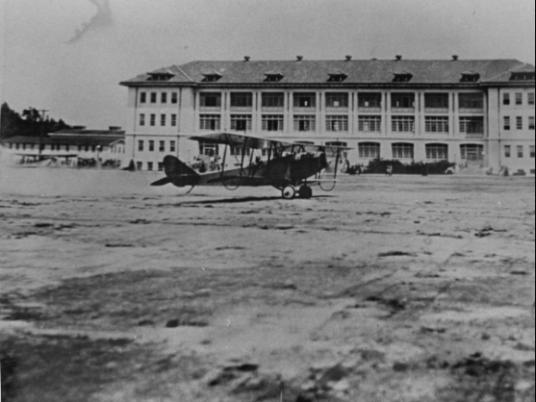
The parade grounds of Mare Island during WWI, near Vallejo, CA 

Armistice Day, the day the war officially ended, was November 11th, 1918, though some sporadic fighting continued on into 1919. There was still a great deal of post-war work to be done by the military with the wounds of the conflict still fresh, while the world simultaneously was losing millions of lives to a global influenza pandemic.   Once again, for the 1919 game it was military teams squaring off against each other.  This time it was a US Navy team (Great Lakes Naval Training Station) defeating the USMC team (once again represented by Mare Island of California), 17-0.

However, this was not the same Mare Island team, none of the same players were there, as they had all been shipped out for the war.  Not even Hugo Bezdek returned, instead William H. Dietz coached Mare Island in 1919.  The US Navy team was led by fullback George Halas, named MVP of the game, who later known as “Papa Bear” became an NFL Hall of Famer for his time as head coach of the Chicago Bears.

The US Navy Team defeated the USMC team in the 1919 game 

As for Hugo Bezdek, the strain of coaching at Oregon, and running a major league baseball team in Pittsburgh, and coaching the Mare Island team was too much of a strain.  By 1918 he had enough of cross-country travel and wrote a letter to the University of Oregon from his home in Chicago, IL.  “I am in too nervous a condition and unable to think or concentrate.”  With that, Hugo Bezdek’s days leading the Oregon Ducks were over.

However, Bezdek’s time at the Rose Bowl was not.  Choosing to find a position a bit closer to home that wouldn’t involve quite as much cross-country rail travel, Bezdek took the job as the new football coach at Penn State University, where he stayed from 1918 to 1936 as both coach and athletic director.  During his time at Penn State he turned the program into a national powerhouse, a stature it retains today despite the recent sex scandal that has rocked Penn State to its foundations.

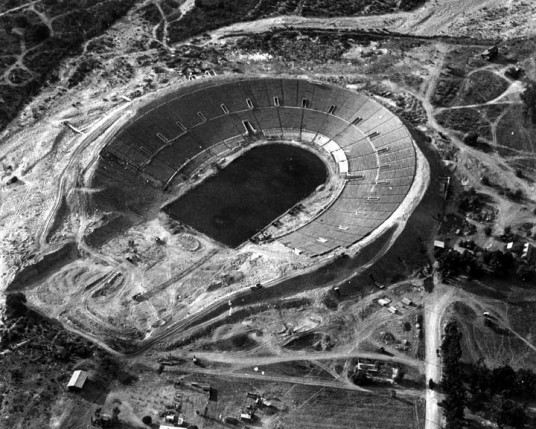
Bezdek led Penn State to two undefeated seasons, and a trip to the Rose Bowl in 1923 (a 14-3 loss to USC), the inaugural game in the newly built Rose Bowl stadium, the construction of which had begun in 1921 when the city of Pasadena realized that the annual football game was becoming larger than what Tournament Park could hold.

Construction of the Rose Bowl began in 1921, completed in time for the 1923 game 

The 1923 game in the new stadium would also mark the first time that the ‘East-West Championship Game’ as it had become known would thereafter be referred to as ‘The Rose Bowl,’ the first official college football bowl game.  Bezdek at Penn State resumed his multi-sport ways, coaching the Penn State basketball and baseball teams as well.

Hugo Bezdek remains the only person to have coached three different teams in the Rose Bowl, with a record of 2-1.  He also remains the only person to coach a major league baseball team and national football league team, and was elected to the College Football Hall of Fame in 1954.
 
1920 ROSE BOWL: THE HUNTINGTON’S RETURN
 
While Bezdek’s departure from the Oregon program was difficult, it also was somewhat of a relief as his hefty salary had become a strain on the University and student body, who had to flip the majority of the bill.  The question remained though, who would replace the genius who had turned Oregon into a west coast powerhouse?

With the war now over and the country settling back into a somewhat-normal routine, it seemed a natural fit that Oregon’s first All-American and the hero of the 1917 Rose Bowl would return home the conquering hero, Charles “Shy” Huntington.  While Bezdek’s ominous shadow was a large one to overcome, Huntington went about his work as both new football coach and also baseball coach for the University of Oregon.  Huntington would remain at the helm for six seasons, leading Oregon to a 26-12-6 record, finishing 4-2 in 1918 his first year, 2nd best in the Pacific Coast Conference.

Oregon's 1919 team, led by coach Shy Huntington (far left) 

In 1919 with the boys returning from overseas, Huntington’s team was bolstered by the return of a familiar face to the University of Oregon, his brother Hollis.  There were a few other returning players from the 1918 team, and just like in 1916 the Webfoots were led in part by multiple pairs of brothers; Francis & Vince Jacobberger, Earl & Keith Leslie, and Bill & W.H. Steers.  Also rounding out the roster was Neil Morfitt, the grandfather of Neil Everett (Morfitt), the ESPN sportscaster and Oregon alumnus who often includes Oregon references in his nightly sports highlights on Sportscenter.

Oregon also had a proud new gem of a stadium to demonstrate their dominance, as the newly built Hayward Field replaced Kincaid Field to house Oregon’s athletics, though bigger games were often played in Portland at Multnomah Stadium to accommodate the larger crowds expected.

Hayward Field 

Huntington’s team started the 1919 campaign out well, defeating MAAC, Idaho (a game in which Huntington scored 4 TDs), and Washington all in convincing fashion.  But a 7-0 loss to Washington Agricultural College (WSU) was a disappointing shocker, in part due to a series of crushing injuries suffered the week prior vs. UW.  Oregon would finish the year defeating their rival, Oregon Agricultural College (Oregon State University today), and MAAC once more for a 5-1 record, tying with Washington as Pacific Coast Conference co-champions.

During the game against rival OAC (OSU), a ceremony had been held officially naming the new structure Hayward Field after track coach and trainer Bill Hayward (who coached at Oregon from 1903-1947).  However, nobody notified him of the honor being bestowed upon him, and he was not present for the event, busily tending to his duties as team trainer back in the locker room at the time.  He found out of the honor the next day while reading the newspaper recap of the game.

Behind the scenes there was grumbling about Huntington not being cut out for the coaching job, and an effort was made to entice Bezdek to return to Oregon.  Huntington’s teams were winning, but not in the same dominating fashion that Bezdek’s Webfoots had been known for, and a longing eye was cast eastward to the success Bezdek was having with his new team, the Penn State Nittany Lions.  Bezdek declined the offer, he would remain at Penn State and Huntington like it or not would stay as Oregon’s coach.

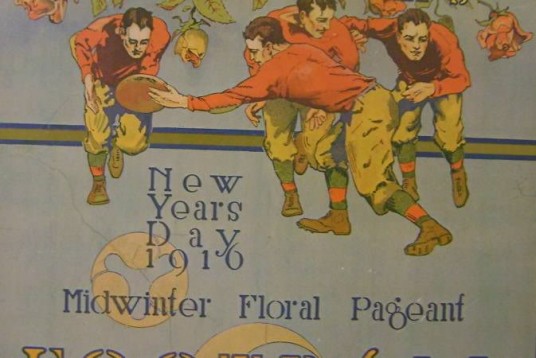
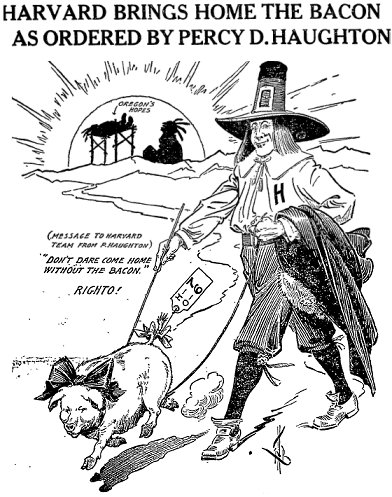
Despite a tie at the top of the conference, once again it was Oregon selected to participate in the Tournament East-West Football Game over Washington for the January 1st, 1920 affair.  This time east coast powerhouse Harvard would be the foe, the eventual national champions (a title that it shared with Illinois).  Harvard was undefeated, with a tie to Princeton their only blemish.

The 1920 Rose Bowl, Harvard vs. Oregon 

With older brother Charles “Shy” Huntington as coach and younger brother Hollis leading the way as star fullback, the Webfoots seemed a solid foe, yet once again east coast bias raised its ugly head.  The faces may have been familiar from the 1916 shocking defeat of Penn, but Harvard was the pride of the east coast and once more the media overwhelmingly chose the east coast team as the clear favorite.  No matter to the Huntington’s, they had been through all of this before, Hollis especially having played not only in the 1917 game but the 1918 matchup as well while a member of Mare Island.

Program from the 1920 Rose Bowl, Harvard vs. Oregon 

The game would have special distinction for Hollis Huntington, as the only player in history to participate in three East-West (Rose Bowl) games, and the only one to ever do so for two different teams.

The game began exactly as the previous ones had, with no scoring in the first quarter as each side fought to achieve supremacy over the opponent.  And just like in 1917 and with Mare Island in 1918, it was the Webfoots striking first.

The scoring began in the 2nd quarter when quarterback Bill Steers nailed a 25-yard drop kick to take a 3-0 lead.  Oregon was moving the ball well, but once the Webfoots got within scoring range the big Harvard Crimson defense would stiffen, stifling their attack.  Hollis Huntington was scorching the Crimson defenders, he would finish the day with 122 yards on 29 carries, but the endzone eluded Hollis and the Webfoots.

Harvard responded with one long drive in the 2nd quarter following Steers’ dropkick, resulting in a touchdown, a 13-yard run by Fred Church.  Harvard took the lead 7-3, and on this day it would prove to be enough.  It wasn’t without great effort by Huntington’s Webfoots, but yardage churned up in the middle of the field couldn’t result in points at each end against the Harvard defense.

Additional grandstands were built at Tournament Park for the large crowd to witness the Oregon-Harvard game 

Late in the 2nd quarter Oregon did manage to score again, on a 30-yard drop kick by diminutive backup quarterback C.R. “Skeet” Manerud, who weighed in at barely 128 pounds, making the score 7-6.  The remainder of the game was a repetitive affair, Oregon would stop Harvard only to storm down the field, but couldn’t convert on kick attempts.  Three times Oregon’s attempts to take the lead resulted in a kick either missed or blocked.

Harvard was barely clinging to a 7-6 lead while clearly getting outplayed by Oregon.  As the game wore on, Skeet Manerud again had a chance to take the lead, but his kicked sailed barely a foot wide of the goal posts.  It was so close in fact that the scoreboard operator deemed it good, temporarily giving Oregon a 9-7 lead, but the referees overruled it and took the points off the board.  Despite Oregon’s overwhelmingly dominant performance, the game would end with no points scored in the 2nd half, and an agonizing 7-6 loss to Harvard.


The Harvard Crimson barely escaped the East-West game vs. Oregon with a 7-6 victory 

Despite the loss, Oregon was clearly the better team that day, and in the papers they were coined “The Team That Outplayed Harvard.”  The bitter loss only increased the behind-the-scenes awkwardness as Oregon officials continued to believe they could lure Bezdek back to Eugene to take over for his protégé Shy Huntington.  This futile pursuit of Bezdek continued intermittently for several years.
 
While Huntington’s teams continued to win, never losing more than two games in a season, Oregon officials pestered Bezdek to leave Penn State and come back to Eugene.  At one point Bezdek did make a cross-country trip to visit his old school, where he was welcome by a crowd of nearly 2,000 hailing him as a hero, honoring him during a ceremony where Huntington was awkwardly prodded to address the crowd and state “He is the best coach in the United States and I hope that Oregon may hope someday to have Hugo Bezdek come back.”

By the 1923 season, Shy Huntington had enough of the unwelcome attitude.  In his letter of resignation he wrote, “Each year my teams have been with me, but the alumni have not.  They have demanded a high-priced coach, and not for a moment does it appear to have entered their heads that a hometown boy might possibly be a good coach.”  In the wake of Huntington’s resignation, Oregon officials again tried to bring Bezdek back to Eugene, again he declined.


Hugo Bezdek chose to stay a Nittany Lion despite Oregon's repeated attempts to bring him back to Eugene
 
OREGON’S GLORY DAYS END IN THE POST-HUNTINGTON/BEZDEK ERA
 
With the last traces of the Huntington’s no longer a part of the program, Oregon’s glory days were officially over.  The Pacific Coast Conference had been dissolved, and Oregon had not been invited to be a part of the newly formed “Big 3” conference.  Hayward Field had been expanded to house a larger crowd, but the days of Oregon’s dominance on a national level would not return for some time.
Meanwhile in Pasadena the popularity of the annual Rose Parade was blooming, and the Tournament East-West Football Game had given way to an official re-naming to the Rose Bowl by 1923, with the construction of their new jewel of a stadium built on the former grounds of Tournament Park.  Originally a horseshoe design, the Rose Bowl would years later be fully enclosed as a bowl and expanded several times to its current capacity.


The original horseshoe design of the Rose Bowl 

Other bowl games eventually appeared as college football rose in nationwide popularity, but the Rose Bowl is appropriately deemed “the granddaddy of them all,” the oldest and most prominent bowl game in the country.  It still is played on new years day every year following the Tournament of Roses Parade held in Pasadena, unless new years falls on a Sunday in which case the events are delayed until the 2nd.  There was a brief time during World War II that the game was moved out east, fearing that the stadium could fall under Japanese attack, but the Rose Bowl remains the grand old gem of stadiums, host of the granddaddy of them all, the annual Rose Bowl game.


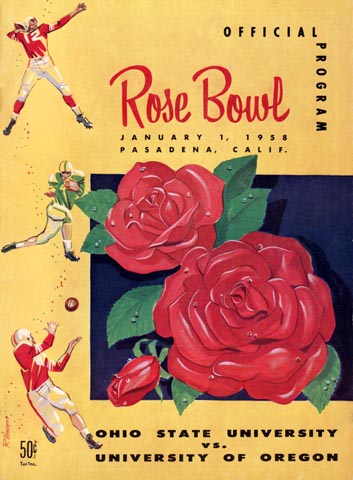
The 1958 Rose Bowl was Oregon's first return to the game since 1920 

Oregon’s participation in the Rose Bowl would not be nearly as prominent as it was in establishing the game’s foothold as the East-West Game.  The Ducks as they were now known would not return to the Rose Bowl until the 1957 season, losing 10-7 in the 1958 game to #1 ranked and national champion Ohio State, a game where once again the heavily favored east coast team was vastly outplayed on the field by the scrappy Ducks.

As Ohio State fans celebrated the victory, Oregon coach Len Casanova was carried off the field on the shoulders of his players in triumph regardless of what the scoreboard read, Oregon again even in defeat shocking the football world and opening the eyes of everyone that west coast teams could compete toe-to-toe with the big boys east of the Mississippi.
 
It would be another 37 years before Oregon would return, facing off against the Penn State program that years earlier their former coach and hero Hugo Bezdek had spent decades building into a national power.  It was a welcome return for Oregon to the granddaddy, but one that would again end in frustration despite a valiant effort, as Oregon squandered multiple scoring opportunities and lost to the Penn State Nittany Lions 38-20.


The 1994 Oregon Ducks returned to the Rose Bowl for the first time in 37 years 

The 2009 season for Oregon started off with an embarrassing loss, but was followed by a remarkable winning streak that ended with a brilliant victory over Oregon State to seal the Pac-10 conference title and Oregon’s chance to once more play in the bowl game that the school had helped make famous back in Huntington & Bezdek’s era.  Again, Oregon would come out on the short end, losing to Ohio State 26-17 in the 2010 Rose Bowl.


The 2010 Rose Bowl, Oregon vs. Ohio State 

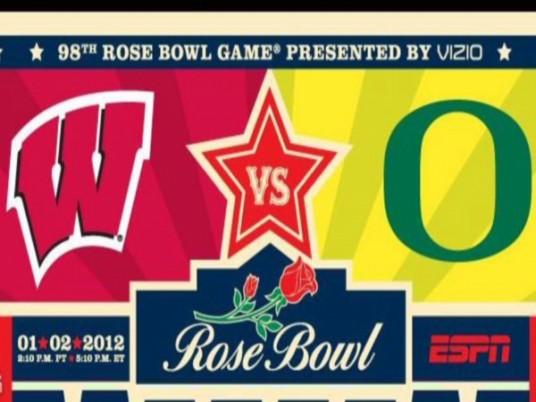
Now, in less than a week Oregon again returns to the Rose Bowl, the granddaddy of them all, Oregon vs. Wisconsin.  Oregon is 1-4 in games played in the event, having outplayed their opponents in 1920 and 1958 but suffering the loss nonetheless.  Perhaps distant memories of the Huntington brothers, the Beckett duo, and the legendary coach Hugo Bezdek that helped establish Oregon as the focal point of the success of the grand old event can lead the Ducks to victory one last time, after all sixth time’s the charm I hear.  As Bezdek and the Huntington’s proved in those early years of the game, all they need is a chance for Oregon to prove their worth.

An interesting sub-text exists with Oregon’s first Rose Bowl, and the opponent of their next one.  1916 was the first season that Oregon used their fight song, “Our Mighty Oregon,” coincidentally the first year they played in the Rose Bowl.  Now less than a week away before their next Rose Bowl, Oregon is playing the team whose song they borrowed prior to 1916.  Indeed, before that 1916 season when Oregon’s prominence in college football began, Oregon used a variation of the fight song “On Wisconsin” during events, with the lyrics slightly changed, as the official school song.


Kenny Wheaton: From the pick to the Oregon Hall of Fame

 Kenny Wheaton: From the pick to the Oregon Hall of Fame

Originally posted on FishDuck.com on November 2nd, 2011
 
Last Saturday a mild-mannered, shy, quiet, unassuming gentleman roamed Autzen stadium with a slight limp in his giddy-up, a lingering ailment due to repeated knee injuries.  He was one of nearly 60,000 present that day enjoying the festivities for the Washington State-Oregon game.  In other cities his presence may have gone largely unnoticed, but in this town on this day he could barely take a step without being recognized and approached by clamoring fans asking for a photo, an autograph, or simply wanting to talk about their memories of him.  The previous night a banquet had been held, largely in his honor, and on this day an entire stadium would cheer him for his efforts long ago during a ceremony at midfield at halftime of Oregon’s victory over WSU.

Kenny Wheaton had returned to Eugene, OR, as he often does, but this time it was different…he was being elected into the Oregon Ducks Hall of Fame.  With the annual grudge match fast approaching this weekend between the Ducks and the Dawgs, it seemed appropriate to have honored the man who will forever be associated with sinking the Husky juggernaut, killing the UW giant, permanently altering the landscape of football in the Pacific Northwest.  His efforts at Oregon have been written about many times, the stories of his greatest moments passed on from the older fans to the newest generation, his kindness and generosity now equally the stuff of legend in his ongoing efforts to give back to the community that he feels gave him so much.

To Oregon fans he is remembered for that one shining moment in time in 1994, to Husky fans he is loathed for that same ugly moment in time in 1994.  For as often as it is said in baseball by fans who can’t let the past go regarding similar iconic moments with players like Bill (expletive) Buckner, Bucky (expletive) Dent, or Aaron (expletive) Boone as they are all known these days, so too do many Husky fans often lament about Kenny (expletive) Wheaton and what he did to rip their hearts out and crush their souls, if they even had one to begin with.

It’s been quite a journey for Kenny Wheaton to reach this point, the culmination of effort and dreams realized, the accomplishment of a personal goal he set out to achieve long ago.  Today it is arguable that he along with Joey Harrington, are the two most recognizable faces in the history of University of Oregon athletics.  Showered with praise wherever he goes, surrounded by fans wearing shirts with images re-creating his greatest moment, it would be easy to expect that Kenny Wheaton could have developed a big head, an ego…yet he remains one of the most humble, kind, and honest people anyone would ever be lucky enough to encounter, while also happening to be one of the greatest to ever don an Oregon jersey.

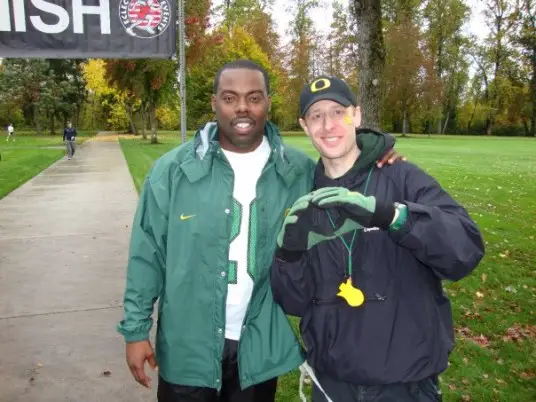
I am but one of many Oregon fans over the years who has mustered up the courage to ask for a photo with Oregon Ducks legend Kenny Wheaton 

It’s a little odd to witness the contradiction first-hand when meeting Kenny Wheaton, the person….Relaxed, shy, gentle, kind and generous with his time to everyone who approaches him.  It is hard to see this mellow individual and associate him with being the same snarling beast on the football field who destroyed the Pac-10 for three years, then the NFL and CFL for a decade.
Could this really be the same guy who played through injuries, including spending half the 1995 season with a broken hand wrapped in a cast so large it looked like he was wielding a club?
 
Could this be the same man who led the team in tackles in 1996, from the cornerback position!  The one who for those efforts was named a 1st team All-American?

Could this be the same man who was so good that the entire 1996 defensive scheme under Defensive Coordinator Rich Stubler was re-designed for the sole purpose of moving him to different areas of the field playing various positions just so that teams couldn’t go away from him every play?

Is this the player feared by all, who could knock the helmet off a receiver one play and return an interception 70 yards for a touchdown the next?  Indeed it is, for as tough and gritty of a player Wheaton was on the football field, off of it he remains humbled and kind, seemingly incapable of a harsh word or raised fist towards anyone.

The call is familiar to all who pack the stands at Autzen Stadium. “Huard gonna go back to throw the ball, sets up, looks, throws toward the corner of the endzone and it’s…INTERCEPTED! IT’S INTERCEPTED!  Kenny Wheaton has the ball!  Down to the 35, the 40…KENNY WHEATON IS GONNA SCORE! KENNY WHEATON IS GONNA SCORE! Touchdown! Touchdown! Kenny Wheaton, On the interceptiiiiiooooooonnnnnn…The Most IMPROBABLE finish to the football gaaaaaaaaammmmmeeee!!!”
 
Jerry Allen’s iconic radio call rings out over the P.A. system at Autzen Stadium moments before the team storms the field before every game, with a raucous crowd chanting the words of Jerry’s call in–synch with the video being displayed.  It was October 22nd, 1994, when that epic moment happened, and by Kenny’s own count it is approximately a quarter of a million people since who have claimed to his face that they were on hand in the stands that day to personally witness the moment as it unfolded.

It was perhaps not the exact moment that changed the face of Oregon football, but in that magical 1994 season that gets credited for changing the tides, it is appropriate that the most memorable play from the most memorable season be etched in the history books for its greater significance.  This is why it is replayed before every game, why every fan has the radio call memorized word-for-word, why even young fans who weren’t born yet still memorialize the moment wearing ‘The Pick’ T-shirts, cheering on the play on the Autzen big screen, and approaching Kenny Wheaton with tentative awe when they see him pass by.  If ever a career could be defined by one glorious moment for which a person will be remembered and beloved for the rest of their lives, it is Kenny Wheaton and this snapshot in time.


Kenny Wheaton signs a photograph of his epic interception return vs. Washington 

It is both a blessing and a curse for Kenny Wheaton though, who will be the first to remind people that he did much more than just make one play.  While appreciative that he is remembered so fondly, he has told me how he wished more people would remember him for the other things he did on the field.  A two-time All-American cornerback (1995, 1996) before a lengthy career in the NFL and CFL, there is so much more to Kenny Wheaton than one play against Washington in 1994.  He has endured horrible personal tragedy, overcome career-threatening injury, and persevered through good times and bad while staying completely grounded.

Now a proud father, retired football player, trainer, and CEO of the Kenny Wheaton Foundation (which sponsors various events to generate funds for school supplies and holiday gifts for under-privileged children in the Lane County community), Kenny Wheaton spends much of his time simply saying thank you and to give back to the community that has done so much for him.

Kenny Wheaton came to Eugene by way of Phoenix, AZ in 1993, an all-state prep athlete with great promise capable of playing multiple positions.  He was paired with fellow incoming freshman safety Jaiya Figueras as roommates, and a close friendship that continues today immediately began.  Kenny was extremely shy, by his own admission he barely spoke to anybody except Jaiya, and he relied on Jaiya to do much of his talking for him.  Kenny and Jaiya were inseparable, pushing each other to always be better.  Jaiya would challenge Kenny to push-up contests in their dorm room, Kenny would challenge Jaiya to watch more film than him.  Together they would go on to change the attitude and success of the Oregon Ducks football program through their mutual efforts both on and off the football field, as was highlighted in a previous DuckTales story on Fishduck.com.

Kenny was a versatile and intelligent player who found his success through film study as much as reps in practice and athletic talent.  In the first game of the season in 1994 Kenny Wheaton was the starting running back for Oregon, due to injuries during fall camp, and he scored his first career touchdown for the Ducks on offense…there would be more to come on the defensive side.
 
Not many recall that the magical season of 1994 didn’t start very magical, a 1-2 opening led to the team being 3-3 and floundering with multiple injuries to key positions when the season turned in Oregon’s favor, spearheaded by Kenny Wheaton and the group of youngsters that were getting their first shot at extensive playing time.

The setting was the Coliseum in Los Angeles, CA, where Oregon arrived to face the #5 USC Trojans without starting QB Danny O’Neil, starting RB Ricky Whittle, or All-American cornerback Herman O’Berry on the field.  Their replacements were many Ducks getting their first chance at significant playing time; quarterback Tony Graziani, junior college transfer runningback Dino Philyaw, and Kenny Wheaton all making their first career starts.

Nobody gave Oregon a chance.  Not the opposing team, not the announcers, not even the USC marching band, who felt obligated to start a fight with some Duck players as they came out of the tunnel.

“When we came out of the locker room a guy in the USC band was blowing his horn at us, and one of the guys punched the horn right into his face, and next thing you know the whole team is in a big scuffle with the marching band before we headed out onto the field,” said Tasi Malepeai, an offensive lineman for the Ducks from 1992 – 1996.

“They thought it was just a stat game, they didn’t respect us at all,” said Dino Philyaw, a senior junior college-transfer runningback getting his first career start. “Keyshawn Johnson told me right to my face he thought it was going to be a stat game, I never forgot that, I responded ‘Yeah it will be, FOR ME!’”

Tasi, Dino, Kenny Wheaton and the rest of the Ducks shocked the world that day.  They dominated the USC Trojans from start to finish, with things getting started early with an astonishing interception by Kenny Wheaton, ripping the ball away from the receiver.
 
Ask Kenny Wheaton today what his favorite moment or favorite game was, and without hesitation he responds 1994 USC.  His favorite play? Not the pick vs. Washington, it was this interception vs. USC. It was his first significant playing time, his first career interception, and according to him his most complete game as a player.  Aside from Wheaton’s performance, it was one of the most complete games from the team, defeating the Trojans 22-7 on national television, the Ducks first win over USC in the Coliseum since 1971.
 
A loss to Washington State and victory against Cal set up the now immortalized Washington matchup.  The Ducks seemed to always battle UW tough, and the Huskies would nonchalantly stroll through the game casually taking the victory in the final minutes.  The script had played out many times before, and everyone in the stands knew it.  Oregon had taken the lead with a 99 yard drive, but Washington in the final minute had driven right back and were threatening to score the game-winning touchdown…just like they ALWAYS did.

Through Kenny Wheaton’s extensive film study he had noticed that when near the goal line Washington liked to throw the out pattern when they lined up in a particular formation.  As Wheaton checked into the game with the Huskies about to score, the same formation he recognized from his personal film study emerged and Wheaton decided then and there he would jump the out-pattern no matter what.  If they ran any other pattern they were going to score, but Wheaton felt confident that his game preparation showed him exactly what would come.

When the ball was snapped, Wheaton jumped the out pattern, and jumped into the history books, intercepting the pass and returning it for a touchdown.
 
The Ducks overcame their greatest bugaboo, the curse was lifted, and greatness lay ahead.  The Ducks won the final four games of the year to win the Pac-10 title and go to the Rose Bowl.  Despite not being a starter, Kenny Wheaton was a hero in fan’s eyes for making the biggest play in the greatest season anyone could recall.  Even his teammates looked at it with awe.

My all-time favorite moment as a Duck was Kenny Wheaton’s interception against Washington,” Josh Wilcox said, a legend in his own right at Oregon for both his performance on the field and his family name.  “Growing up a fan of Oregon, that was my highlight, it was such a great moment.”


While the Ducks lost the Rose Bowl, it didn’t seem to matter much.  The attitude had changed, the perception of Oregon football was different.  The 1995 season would see Wheaton emerge as a leader of the defense and a known commodity in the Pac-10 conference.  His highlights that season included a 71-yard interception return for a touchdown vs. Pacific, and numerous big plays in big games when big players needed to step up.  Kenny was a play-maker through and through, someone who his teammates could rely on to be there backing them up or coming up with a big play of his own.
 
Wheaton was the leader of the defense in 1995, a team that finished the regular season 9-2 earning a trip to the Cotton Bowl, led by a defense that many think was even more talented than the much-hyped ‘Gang Green’ defense of the year prior.  It was also a tough year though, as his best friend Jaiya Figueras had seen the highest highs and lowest lows in a two-week stretch, making the game-winning plays vs. Illinois and UCLA in back-to-back weeks only to shred his knee the following week, ending his season.
 
Wheaton would have to go it alone on the field without his closest comrade, but Wheaton shined in the role as defensive leader, racking up a total of five interceptions on the season, earning him 2nd team All-American honors.  Wheaton played through multiple injuries, suffering a disc problem, bicep injury, and broken hand during the course of the year.

Wheaton was a superstar by his junior year of 1996.  While his friend Jaiya Figueras struggled to return to his previous form before his devastating knee injury, Wheaton had become a one-man wrecking crew.  Under new defensive coordinator Rich Stubler a new defensive scheme was devised, one that would have Wheaton switching between cornerback and safety from snap to snap moving him all over the field, giving him more chances to be around the ball.  A normal player probably couldn’t take on all the responsibilities this entailed, but Kenny was such a cerebral player in his film study and game preparation that coaches felt confident it would work.
 
In the first game of the 1996 season, a 30-27 overtime victory over Fresno State, Wheaton was far and away the best player on the field.  Early in the game he returned an interception 69 yards for a touchdown.  Shortly thereafter he had another interception and long return, putting him in the rare position for a defensive player of accumulating more total yards than either offense.
 
 
Injuries during the season derailed a fast start for Oregon, and a 3-0 start soon turned into a 5-game losing streak before rebounding to win the final three of the year.   The path to redemption in those final three games was of course kick-started by Wheaton, who made a remarkable game-changing play recovering a fumble at the goal line vs. Cal in a game Oregon would go on to win 40-23.
 
In Wheaton’s final game as a Duck, Oregon throttled the rival Oregon State Beavers 49-13 in Corvallis.  Despite expecting to have teams avoid him all year, Stubler’s plan to move Wheaton around the field worked in keeping the superstar around the ball making plays, and despite the team’s disappointing record, it was a season to be proud of for Wheaton, the unquestioned team leader and best player.

During the season Wheaton had been mulling over another issue, whether or not to be the first player in the history of the University of Oregon to declare early for the NFL draft.  He was a two-time All-American, team leader, an icon, and the most feared playmaker on the west coast, there was little left to prove for Wheaton in college.  All indicators were that Wheaton SHOULD go, but family and friends made the decision difficult.

Back in Arizona Kenny’s younger brother Derrek had earned a scholarship offer from Oregon after playing at Phoenix College.  Ask Kenny, and he’ll tell you Derrek was the best athlete in the family, and people were abuzz with the prospect of having two Wheaton’s on the Ducks at the same time.  Then there was also the thought of leaving behind Figueras, who was playing again but still not at full strength due to his 1995 leg injury.  The two had set goals together; to win the Pac-10 title, to change the perception of Oregon football, to earn a place in the Oregon Ducks Hall of Fame.

The double-Wheaton secondary would not turn out to be, as Wheaton chose to enter the draft, and was selected in the third round by the Dallas Cowboys.  Oregon fans said goodbye to Kenny Wheaton’s days as a Duck, but cherished every moment they got to see #20 dominate the game for Oregon.  And there was hope that the name would continue if brother Derrek came to Oregon.

Then tragedy struck…while returning from a team banquet in November, 1997, Derrek Wheaton was shot and killed in a drive-by-shooting in Phoenix, AZ.  With Derrek’s tragic death the Wheaton name would not be seen again in an Oregon uniform, but the family athletic prowess is alive and well, with cousin Marquese Wheaton playing at Southern Miss and cousin Markus Wheaton one of the top weapons for the Oregon State Beavers.

Derrek Wheaton seemed destined to follow in his brother's footsteps at Oregon to perhaps an even greater legacy, but a senseless tragedy deprived us all of getting to know him 

Suffering the loss of a sibling, Kenny was also dealing with tough times on the field, recovering from a catastrophic knee injury that required extensive rehab.  Kenny would check in often with his friend Figueras back in Eugene, now a senior captain struggling to keep the defense together on an Oregon team that had changed from a great defensive team in their early years to now an offensive-minded squad.  Kenny could feel the sorrow in Figueras struggling to overcome injury, struggling to keep the team together, struggling to carry on without Wheaton in the secondary with him.

After three seasons with the Cowboys Kenny Wheaton was released, his knee injury thought to be career-ending.  In 2002 he rebounded and played in the Arena Football League for one season, then 2003 he went north to the Toronto Argonauts of the Canadian Football League.

It was here that Wheaton regained the prowess that had made him a legend in Eugene, gaining a reputation as a heavy-hitter and dangerous man with the ball in his hands.  In a 2004 playoff game vs. Hamilton, Wheaton intercepted a pass in the endzone and returned it 116 yards for a touchdown, a CFL record.  It was a play eerily similar to the pick vs. Washington a decade earlier, a moment that by now was getting replayed before every game at Autzen Stadium.  Four times Wheaton would be named to the all-star team and helped lead the Argonauts to a Grey Cup championship in 2004 alongside another Oregon Duck, safety Michael Fletcher.

Kenny Wheaton played seven years in the CFL, after he was told by doctors he would never play football again due to his knee injury in Dallas
 
The late 90’s and into the 21st century has been a time where the Oregon fan base and appeal has grown by leaps and bounds.  Those who have claimed membership in the Oregon family long after Wheaton’s days in Eugene were done have been introduced to his exploits through the gameday tradition of watching his 1994 interception vs. UW on the replay board, added in 1998, thanks in part to the success of the team during the Wheaton years.  Those who never saw Wheaton in person know verbatim the call of Wheaton’s immortal interception, they know the name, they know the legacy.  He is credited with being the lightning rod of the 1994 season, the year everything changed.

For Kenny Wheaton, who spends his time between Phoenix and Dallas, Eugene has become another home for him.  Nowhere is he more welcomed, more admired, even by those who know him for nothing beyond one single moment that continues to be immortalized every Saturday in the fall.

Kenny Wheaton's interception is always replayed on the big screen at Autzen Stadium, an homage to overcoming adversity and the achievements of those who laid the foundation for Oregon's success 

Wheaton retired from football in 2009 and returned to Dallas and his family.  Now a proud dad of two, he spends his time training athletes, helping the next generation of players pushing them to be the best they can possibly be, just like how Figueras and Wheaton pushed each other years earlier at Oregon.  He founded the Kenny Wheaton Foundation, a non-profit organization that has put together multiple events to raise funds for the benefit of low-income children around the Eugene area.

To Wheaton, it seems like the least he could do.  While everyone is quick to lay praise upon him for what he did on the field, it is how he was and continues to be embraced by the Eugene community that makes him most proud.  In speaking with Wheaton it seems as though he feels obligated to do what he can to help out people around Eugene, a community that gave him so much support over the years.

Now, after four memorable years in Eugene and a decade in the pros, a new accomplishment has been achieved, a goal set years earlier.  Figueras and Wheaton together wanted to someday be in the Oregon Ducks Hall of Fame, it was their ultimate goal, what drove them to succeed.  The 1994 team was inducted a few years ago thereby they achieved that status as part of the larger entity, but the individual goals remained unfulfilled…until last Saturday, when Kenny Wheaton was officially added to the roster of Hall of Fame players at the University of Oregon.


Kenny Wheaton and Jaiya Figueras enjoy some pregame festivities before the national championship game. Also pictured: Lyndsey Kyle. 

It seems only proper that the dignified classy gentleman who does so much to give back would be honored in this manner, returning to Autzen Stadium to once again hear the roar of the crowd cheer for #20, to watch ‘the pick’ play on the big screen moments before the team storms out of the tunnel once more, and to graciously do his best to give back to the community that gave him so much…be it a handshake, a photo, an autograph, or a wave to the crowd, Kenny Wheaton remains humble and gracious that so many continue to show him love and support.

Correction, make that Oregon Ducks Hall of Fame inductee Kenny Wheaton.
Congratulations, Kenny, and THANK YOU for everything.
 
A message of thanks from Kenny Wheaton to everyone can be viewed here.
 
 
———
To find out more about the Kenny Wheaton Foundation, please visit their website at: http://www.kennywheatonfoundation.com/index.html
For information on Kenny Wheaton’s training services, contact KW Next Level Training at: kenny@kwnlt.com