Showing posts with label university. Show all posts

Thursday, January 23, 2014

The era of the Oregon transfer running back

 The era of the Oregon transfer running back

Originally posted on FishDuck.com on October 7th, 2011
 
 
As programs look to fill their rosters with new recruits, every year inevitably teams ponder whether or not to consider adding transfers to their ranks.  Some come from junior colleges, some from other schools.  Sometimes it is due to academics, or disciplinary reasons, or the opportunity for playing time that makes student-athletes pursue alternate choices in their education and football careers.

Whatever the reasoning for the athlete, it is a risky proposition for the program to take on a transfer player.  Some may come with a stigma, either spotty academics or disciplinary problems or ego or a wealth of reasons for why they may have washed out at their previous school.  For junior college recruits, it is expected that the first season will be largely just adjusting to the speed of the game at the FBS level, it is common practice for JC’s to redshirt if they have one available to spend a year adjusting to the speed of the game.  JC’s are thought of mostly as stop-gap measures, a hole in the depth chart necessitating a body to fill for what is hoped to be one solid year of contribution.

Still, transfers have to prove their merit on the team perhaps more than recruits fresh from the prep ranks, having had prior college experience there is added expectation, whether fair or not, that they will be able to acclimate and contribute.

Oregon has had its share of transfers that have panned out well.  Former players like Jeremy Gibbs, James Finley, Fenuki Tu’Pou, Palauni Ma’Sun, Pat So’oalo all provided two solid years, while others after their year of learning curve gave one very solid season to the Ducks (Matt Harper and Terence Scott in recent years).  But for every success, there are tales of washouts, headcases, and injuries derailing the opportunity transfer players have to make their mark.

Thanks to the recruiting efforts and recent successes on the field, Oregon does not recruit junior college players nor pursue potential transfers nearly as often as they once did.  But for a time the Ducks were nicknamed “Second-chance U,” a place where guys could come to redeem themselves for past mistakes.  For others who were under-recruited or looking for that opportunity to shine, Oregon became a destination to prove your merits, a place where the chip on that shoulder could be utilized for maximum effort.

It is in this context that for a stretch of 10 years, Oregon consistently found great fortune through transfer running backs coming to the Ducks to become the battering rams in Oregon’s potent offense.  From 1993 – 2002, only one season (1995) did the Ducks not have a transfer running back leading the charge through the Pac-10.

The era of the transfer runningback being king at Oregon started in 1993, when Dino Philyaw’s long winding cross-country path led him from rural North Carolina to Eugene, OR.
_____________________________________________________________________
DINO PHILYAW (1993 – 1994)
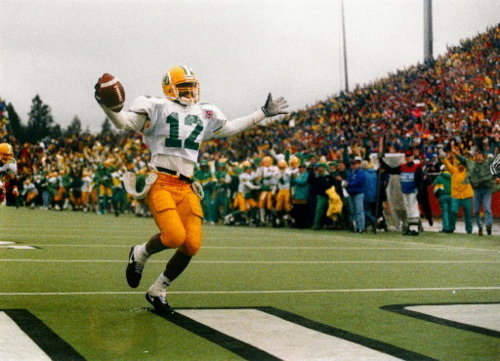
Dino Philyaw (1993-94) proved invaluable as both a runner and receiver out of the backfield

5’10″ 210
Dudley, NC (Southern Wayne High School)
Taft Junior College transfer (Taft, CA)
 
Dino Philyaw had been one of the top high school running backs in North Carolina, he originally signed a scholarship with Maryland, but not having yet passed the SAT he chose instead to play minor league baseball with the Cleveland Indians when the opportunity arose.

“After baseball didn’t work out, I looked at going to junior college to get back into football,” Dino Philyaw remembers, now retired from football and running his own catering service in the Eugene, OR area.  “Taft junior college (Taft, CA) recruited the east coast heavily, there were a lot of guys from back home that came out to play at Taft.  I had the opportunity to as well, so I jumped on a Greyhound Bus and rode it cross-country to California.”

After a stellar first year at Taft, Philyaw was declared a preseason All-American in the JC ranks, but an illness limited his playing time his sophomore year.  Hoping for a shot at division-1 football, Philyaw sent his highlight film to Oregon, which drew the attention of offensive coordinator Mike Bellotti and running backs coach Gary Campbell.

“I watched the 1992 Independence Bowl when Oregon played against Wake Forest, and I had originally commit to Wake.  But I liked what I saw from Oregon, I saw their roster and thought that was the place I needed to be to get to the next level,” said Philyaw.

“I was looking at other schools, at one point I had a flight to Hawaii or last minute a chance to go on a recruiting trip to Oregon, I chose Oregon.  I loved the community, the coaches, the team, it just felt right,” Philyaw recalls.

Coming to play at Oregon in 1993, Philyaw had big expectations for the team.  He told head coach Rich Brooks that he had come to Eugene to lead the Ducks to the Pac-10 title and the Rose Bowl, coach may have patronized him at the time but Philyaw’s prophecy would become all too true.

1993 Oregon had a senior running back workhorse named Sean Burwell, who would finish 5th on the all-time rushing yards list at Oregon after four solid years of contributions.  Philyaw saw the field as a back-up, but he had difficulty acclimating to the new playbook and speed of the game.  It would be the 1994 season, his senior year, when Philyaw would make his iconic marks on the history of Oregon football.

The 1994 Oregon Ducks football season is remembered for many reasons, but often forgotten is the slow start to the season.  Philyaw was the primary backup to Ricky Whittle, but a month into the season Oregon was 2-2 heading into Los Angeles to play #5 USC at the Coliseum.  Whittle was hurt, along with starting QB Danny O’Neil and All-American CB Herman O’Berry, meaning many of the youngsters would get their first consistent playing time.  Most anticipated a bloodbath, what happened instead propelled Oregon towards the Rose Bowl and the rise to national prominence.

“I always felt like the 1994 USC game was the moment when that season turned,” said Philyaw. 

“Nobody gave us a chance whatsoever, that was the turning point.  When we went down there and beat them with the young guys stepping up getting their first real shot, it changed everything.  USC doesn’t give anybody respect, they thought it was just a stat game, Keyshawn Johnson told me that in the tunnel, ‘it’s a stat game.’  I never forgot that, I responded, ‘yeah it will be, for me.’  I wasn’t afraid of USC, I hadn’t grown up watching them.  I saw UNC and NC State as a kid, I wasn’t being disrespectful, but USC’s history didn’t mean anything to me.  I’m from the south, it doesn’t make any difference to me.”

What Philyaw and company did was stomp the Trojans in their own house 22-7 with a lineup comprised of 2nd stringers.  Philyaw shined with multiple long runs, none better than this 49 yard touchdown run.

“We had a bunch of guys that were filling in and felt like we deserved to be starters, it was our goal that we were going to go down there and hit ‘em.  It was our opportunity to showcase what we could do.  SC was constantly talking trash, we had a lot of guys getting their first opportunity but we were hungry and weren’t about to put USC on a pedestal just because they were ‘SC.  It took a little country boy from North Carolina to say ‘it’s just SC it doesn’t mean anything to me’ to get the rest of the guys pumped.  I wasn’t intimidated, it was easier for me to come out and play hard because I had grown up watching a different tradition.”

Coaches knew Philyaw could play, but his stellar performance vs. USC on October 1st, 1994 tallying 123 yards proved that he could be relied on in-game, and a bigger role in the offense soon followed.  Whittle and Philyaw began to split time evenly, and the two-headed combo led Oregon on a winning streak that culminated in the Pac-10 title and Rose Bowl berth.

Philyaw would play a vital role in achieving that team goal, scoring both touchdowns in Oregon’s 17-13 victory in the Civil War vs. Oregon State in rainy Corvallis to seal the Pac-10 title.
 
 
Even though I grew up back east, the Rose Bowl was a big deal.  I used to watch those games on TV and hearing Keith Jackson’s voice, I used to imagine one day Jackson would call my name with me playing in the Rose Bowl.  When I caught that screen pass and scored in the Civil War, it felt like that dream for so long was actually coming to reality.”

Philyaw would play a big role in the 1995 Rose Bowl game, as Oregon’s primary weapon of attack vs. Penn State was screen passes out of the backfield to Philyaw and Whittle.  Oregon racked up 456 yards passing in the game, but came up short on the scoreboard.  Still, it was a great finish to a memorable season.
 
“My mom got to come watch the Rose Bowl, it was the first time she had seen me play in college,” said Philyaw.  “That was a big deal for me.  I remember looking around at the stands, it was so packed and the energy intense.  Penn State were huge, we had never played guys that big before, but we weren’t afraid of them.”

Philyaw finished the 1994 season with 716 yards rushing plus another 211 through the air, showing his versatility he had over 1,000 all-purpose yards and 11 TDs while splitting time with Ricky Whittle.

Philyaw went on to play in the NFL with the New England Patriots, Carolina Panthers, and St. Louis Rams.  He participated in the 2001 XFL season, but after breaking his foot twice that year chose to retire from football.  Dino Philyaw now resides in Eugene, OR and operates Philyaw’s Cookout & Catering, remaining close to the Oregon program and forever remembered for his iconic touchdown scored in the 1994 Civil War.

“Hardly a day goes by that somebody doesn’t stop me to talk about my touchdown in the 1994 Civil War,” said Philyaw, laughing.  “I made other plays too, but I guess it’s great to be remembered for something.”
_____________________________________________________________________

Saladin McCullough (1996-97) racked up 24 touchdowns in 18 games as a Duck

SALADIN MCCULLOUGH (1996 – 1997)
Pasadena, CA (Muir High School)
El Camino Junior College transfer (Torrance, CA)
 
Saladin McCullough ran a long ways before getting to Oregon, then spent two years running all over the Pac-10.  1995 Oregon was led by senior runningback Ricky Whittle, but the 1996 season brought great uncertainty to the role of starting tailback for the Ducks until McCullough emerged.

He had grown up in Los Angeles dreaming of being a USC Trojan.  McCullough was a prep superstar at Muir High School and seemed destined to be the next one to assume the starting role at ‘Tailback U’ under John Robinson in 1993.  He passed the SAT with flying colors, but his score raised flags among faculty and his score was eventually invalidated.  Refusing to take the SAT again, he sat out a year, then attended Pasadena City College, but the lure of the local neighborhood and its temptations proved difficult for McCullough, who was suspended twice for disciplinary reasons, yet still racked up 725 yards and six touchdowns.

Looking for an opportunity to escape the old neighborhood and focus on football, McCullough transferred to El Camino Junior College in Torrance, CA, and excelled, racking up 1,829 all-purpose yards and 12 touchdowns in 10 games.  But despite the great numbers and Associates Degree in hand, USC no longer wanted McCullough.  They had recruited other runningbacks in the time since, not wanting to wait on McCullough the Trojans had moved on.

“I sat down with Coach Robinson, and he said that they had people on their board higher than me,” Saladin McCullough remembers, now the runningbacks coach at Pasadena City College.  “I had always wanted to be a Trojan, I didn’t know what to do.  So I went to 7-11 and bought a college preview magazine.  I looked at Oregon and saw that they had just come off the Cotton Bowl and didn’t have a returning runningback, so I called them up.  I took a trip up there, they offered me a scholarship, and I took it, I never looked at any other school.  I didn’t know what to expect, I just figured I’d go up there and do my best.”

USC’s loss was Oregon’s gain.  The Ducks had kept their eyes on Saladin, but knew there was little chance of tearing him away from his dream school of USC.  But when USC declined to offer a scholarship, Oregon took a chance on McCullough, signing the junior college to join the team for the 1996 campaign.

McCullough arrived to Eugene amidst a crowded backfield all vying for the starting job.  For Oregon’s first game the team took five runningbacks with them to Fresno State for a tailback-by-committee approach until a leader emerged.  Initially it was Jerry Brown who got the majority of the carries, in the opening game McCullough only got one carry vs. FSU.

“I was freaking out because I only got one carry, the next game I got a few more, and after that the job was mine,” said McCullough.

Once acclimating to the system McCullough emerged as the clear top-talent among the challengers for the role.  By mid-season 1996 McCullough was the workhorse.  In the 1996 game against Arizona, McCullough scored five rushing touchdowns, propelling the Ducks to a 49-31 victory.  McCullough was a touchdown machine, racking up 15 TDs in only seven games.  It was a single-season record that stood until the 2008 season.  However, it was a season also filled with injuries and disappointment.

“I sprained my knee and missed a few games.  In the 5 TD game against Arizona I could’ve maybe gone for more, but on the last play of the 3rd quarter I injured my hamstring and didn’t play in the 4th.  I wish I had redshirted once I hurt my knee, but the team really needed me out there so I rushed back and played hurt.”

But the 1996 season would have disappointing results, finishing 6-5 and no postseason bowl game.  However there was hope in Eugene that 1997 could be special, as McCullough had only just started to show what he could do.

1997 was an offensive explosion for the Oregon Ducks.  A vaunted passing attack led by the quarterback duo of Akili Smith and Jason Maas was accented with Saladin McCullough’s rushing heroics, and it started in grandoise fashion, with McCullough returning the opening kickoff of the first game of the season 93 yards for a touchdown vs. Arizona.
 
His run through the Pac-10 would continue in dominant form.  McCullough was the complete package, speedy, shifty, powerful, able to catch the ball, could run between the tackles, he was the perfect all-around back for Oregon’s pro set offense.  He was the most feared weapon in all of the Pac-10.

During his rampage through the Pac-10 his senior year, McCullough made the Trojans pay for their mistake with one of the most unbelievable runs in recent memory, fumbling a pitch for what appeared to be a 10 yard loss, then somehow evading eight tacklers for a 44 yard gain that left onlookers speechless, including USC coach John Robinson.

McCullough appeared to be gliding when he ran, like taking a nonchalant stroll through a park, but moving at a speed faster than anyone else on the field.  He had power to run through defenders, moves to bounce around them, the speed to sprint past them, and was masterful on screen passes.
 
But the 1997 season was a year of growing pains.  McCullough plowed through defenses, but it was a young team still finding their feet.  It would be McCullough’s final game as a Duck where the Ducks began to emerge from their shells, previewing what would come in the future years.  McCullough made the most of his final game, as he took the second Oregon play from scrimmage in the 1997 Las Vegas Bowl for a 76 yard touchdown run vs. Air Force.
 
“Patrick Johnson was my roommate, so when he scored a touchdown on the first play of the game I felt like I needed to do something too, when I scored on the second play it was like, ‘ok, hey, the roommate connection!’”

Oregon would dominate Air Force that day, led by Saladin McCullough and the emerging players that would become stars in 1998.  McCullough finished his career at Oregon with eye-popping numbers.  He finished the 1997 season with 1,343 yards and 9 TDs.  In two years of play, 18 games total, McCullough racked up 2,028 yards and 24 touchdowns at an impressive 5.2 yards-per-carry.  McCullough could do it all, and he did for Oregon, at USC’s peril.

“I wish I could have had four years at Oregon,” McCullough laments.  “I never went through an offseason program before I got to Oregon, never lifted weights.  I think if I had four years to be able to train I could have set just about every rushing record, LaMichael would be chasing me.  I only got to go through an off-season program once, before the 1997 season.  Still, I have a lot of fond memories of playing at Oregon, just hanging out with the fellas or going over to Coach (Gary) Campbell’s house to cook dinner, he’s still like a mentor to me.  I’m really happy that I chose to go to Oregon.  I hear from people all the time who say, ‘I never knew nothing about Oregon until you started playing there,’ that’s special to me knowing that I did my part to help put Oregon on the map.”
In an odd twist of fate, Saladin’s younger brother Sultan McCullough would attend USC and become the starting runningback for the Trojans.  While his career at USC was impressive, he could not match older brother Saladin in overall production.

“I always try to set up an Oregon vs. USC bet with Sultan every year, but he’s scared, doesn’t want to bet,” McCullough laughs.  “Especially these days with how good Oregon has become, he never wants to make any family bet on the game.”

Saladin McCullough proved, just as Philyaw had before him, that Oregon could find tremendous talent in the junior college ranks.

Following his career at Oregon, McCullough spent some time with the San Francisco 49ers, then spent several years in the CFL and one season in the XFL.  He retired from football in 2005 after being released by the Toronto Argonauts to make room for their newest free agent signing, enigmatic NFL outcast Ricky Williams.

Today Saladin McCullough is an assistant coach with Pasadena City College, with aspirations to return to Eugene someday, this time as a coach.  His son, also named Saladin McCullough, is a junior college athlete hoping for a scholarship offer from Oregon to carry on the McCullough legacy.
____________________________________________________________________
REUBEN DROUGHNS (1998 – 1999)
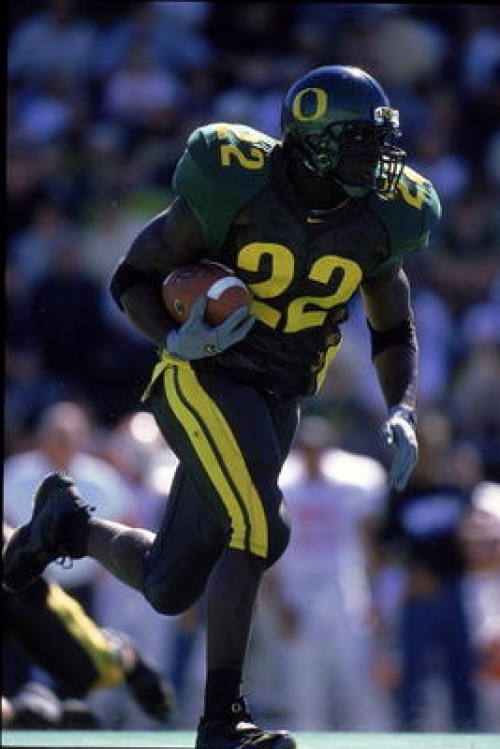
Reuben Droughns (1998-99) was as punishing of a runner as Oregon has ever had

5’11″  220
Anaheim, CA (Anaheim High School)
Merced Junior College transfer (Merced, CA)

Oregon’s running game had been dominant in 1996 and 1997 with Saladin McCullough at the helm, but once again 1998 loomed with questions of who would take over.  Fans had heard rumors about two incoming players, freshman RB Herman Ho-Ching from Long Beach, and Reuben Droughns from Merced Junior College.  After the first game of the season, it would be no question whom was taking over the reins.

Reuben Droughns was a powerful bruiser with great speed.  He had chosen Oregon out of high school but didn’t qualify academically, choosing to go the junior college route he found himself at Merced JC with an opportunity to hone his skills.

“I didn’t have the grades coming out of high school, but I had the option to go up to Merced.  It was the perfect situation for me to go up there and try to groom all of my skills,” said Reuben Droughns, now retired after  lengthy career in the NFL that included a Super Bowl victory with the New York Giants in 2007.  “I chose to go to Oregon, and I stuck by that promise after my time at Merced.  I wanted to leave California, but still play schools in California.  Once I saw Oregon it was done, it was a great atmosphere, it was clean and friendly and the coaches were great.  It just felt like this was the place.  Other schools recruited me, but Oregon was the only place I wanted to be.”

Droughns set multiple rushing records while at Merced, rushing for over 1,600 yards his sophomore year, considered the #1 junior college runningback, it was a major coup for Oregon to land such a touted player.  Still, Droughns had to earn his place, and despite the early production it did not come easy.  Droughns arrived in Eugene Associates Degree in hand to prepare for the 1998 season and the first opponent, highly touted Michigan State coming to Eugene for a national television broadcast.  The Spartans featured superstar Plaxico Burress on offense and were led by head coach Nick Saban, now the head man at Alabama.  Through summer workouts and fall camp Droughns did his best in competition to earn his place on the team.

“I went through summer workouts and camp, but I was still learning.  Protections were really tough for me, it took a while to adjust to the system and get comfortable.  I was scared when I made it to Oregon.  Watching game tape of Michigan State seeing how big those guys were, I knew it was way beyond junior college,” Droughns remembers.  “When coach (Mike Bellotti) told me I was starting the first game the fear ran through my bones, I didn’t know what could happen.  I knew I was gonna get hit, but I didn’t want to make a mistake…then to come out of that tunnel at Autzen Stadium to see and hear that packed crowd, it was unreal.”

If Droughns felt nervous that opening day of the 1998 season, he didn’t show it.  Oregon steamrolled over Michigan State 48-14, and it wasn’t as close as that score suggests.  Leading the way was Droughns, who was still learning the playbook but dominating the overwhelmed MSU defense in every way imaginable.  With a junior college transfer quarterback, Akili Smith, at the helm, Oregon pummeled Michigan State giving Saban the worst loss of his entire coaching career.
 
Reuben Droughns capped the game with a 75 yard touchdown run, putting him over 200 total on the day.  In one game Reuben Droughns had become a team leader and the star of the #1-ranked offense in the country.
 
“That Michigan State game, it was so fun,” said Droughns.  “For so many of us we were just getting started, Akili it was his first time starting as ‘the guy.’  It was so memorable, just the crowd and the way we played, it was amazing.  I didn’t really know the system yet, the coaches basically just said, ‘Reuben, we’ll give you the ball, the endzone is over there, go run towards it.’”

Oregon’s offense averaged over 50 points a game through the first half of the 1998 season led by Droughns, who was averaging nearly 200 yards per game.  The Ducks seemed to be unstoppable, and whispers of national championship contender began to spread.

Droughns was plowing through the competition, but it wasn’t until a month into the season when things started to make sense, during week 4 vs. Stanford.

“The Stanford game was probably my favorite as a Duck, it was the first game where everything started making sense,” said Droughns.  “I felt like for the first time I knew what was going on, I had acclimated to the system, and everybody was on the same page.  Our offense was so good that year, the Stanford game was when we really started realizing how good we could be.”
 
 
If Droughns had relied on his superb physical abilities to date, the prospect of Reuben Droughns with a full understanding of the offense and on the same page with weapons around him like Akili Smith and Damon Griffin, defensive coordinators in the Pac-10 weren’t sleeping much trying to come up with any feasible way to slow down Oregon.

It turned out the only thing that could stop Oregon was themselves. In one of the most amazing football games ever played, the 1998 matchup between Oregon and UCLA featured two top-10 teams playing in the Rose Bowl in front of a national television audience, the victor being the clear frontrunner to return to the Rose Bowl in January. The game had literally everything but the kitchen sink, including UCLA quarterback Cade McNown vomiting on the field while under center about to take the snap. A back and forth battle featured Droughns plowing through defenders when the season took a sharp down turn.


Having already racked up 175 yards rushing in the game by the third quarter, on one play Droughns fell to the ground awkwardly without being touched, breaking his leg.
 
Despite the broken leg, Droughns would not give up.  In one of the gutsiest moves ever witnessed in recent football memory, Droughns returned to the game and continued carrying the ball on a broken leg.  However the pain proved too great and eventually he was forced to exit for good, his season was done.  The game would go to overtime, but Oregon would come up short that day succumbing to UCLA 41-38.

More injuries followed with Droughns being forced to watch from the sidelines, a team that had been the #1 offense in the country in September was reduced to a hollow shell of itself by the end of the year, losing to Colorado in the 1998 Aloha Bowl 51-43 despite a heroic effort by Akili Smith to carry the team, setting nearly every Oregon single-season passing record in the process.

1999 Reuben Droughns would return for his senior year, determined to make amends for his shortened season the year before.  Droughns would again suffer injuries but play through them showing a grit and blue collar mentality that carried over into his lengthy NFL career.  Droughns carried the team in 1999, literally, as the Ducks relied on him almost exclusively to grind out games.  In one game vs. Arizona, Droughns carried the ball 45 times, a single game mark that still stands today as the all-time record for most carries in a game for an Oregon Duck.
 
The Ducks 1999 season would be one of transition, replacing the legend of Akili Smith and starting a new legacy as Joey Harrington took over the starting QB role from AJ Feeley at midseason.  There were last-minute heroics, tough losses, growing pains and physical pain, all the while Droughns was the rock to lean on reliable to grind out the tough yards and still capable of breaking away for a long run.  The Ducks would finish the year with a victory over Minnesota in the 1999 Sun Bowl.

Reuben Droughns finished his career at Oregon having played in 16 games for a total of 2,058 yards rushing and 18 TDs.  No one had ever run harder in their career than Droughns, or dished out more punishment on defenders than him.  Reuben Droughns was selected in the third round of the NFL draft by the Detroit Lions, the start of an NFL career that led to the Denver Broncos, Cleveland Browns, and New York Giants before retiring after the 2008 season.

Reuben Droughns will always remain a fan favorite, not just for the plays he made, but how he made them.  Fearless, ruthless, the ultimate combination of both power and speed.  Yet his legacy is also one of lingering questions, his leg gave out him in the 1998 season but his heart never did.  Few ever ran with as much passion for the game as Reuben, and many fans still ponder the possibilities of how far the 1998 team may have gone if Reuben’s leg had been able to carry the team past UCLA that one day in Pasadena.
____________________________________________________________________
MAURICE MORRIS (2000 – 2001)
Maurice Morris (2000-01) racked up over 2,000 yards in two seasons as a Duck

5’11″   216
Chester, SC (Chester High School)
Fresno City Junior College transfer (Fresno, CA)
 
Just as they had with McCullough and Droughns, Oregon again dipped into the junior college ranks for the start of the new decade to fill the role of runningback for the Ducks.  Just like Droughns, the Ducks once again found a gem in the California junior college ranks that made an immediate impact.
Maurice Morris was built much in the same way as his predecessor Reuben Droughns, big and powerful but possessing deceptive speed, willing to run through or around a defender.  He grew up on the east coast, but moved west to play at Fresno City Junior College.  Morris was a two-time JC Grid-Wire First Team All-American, setting rushing records two years in a row tallying 3,078 rushing yards in two seasons, completely shattering every rushing mark at Fresno City College in the process.  In 1998, Morris and Texas’ Ricky Williams were the only two runningbacks in the nation to total in excess of 2,000 yards rushing in a season.

By the time his two years were up at Fresno, nearly every major university in the country wanted Morris to be their next great power back.  It was Reuben Droughns who would host Morris on his recruiting trip to Eugene and to carry on the now-established tradition of transfer runningbacks at Oregon.  Droughns would be gone, so the opportunity to be the man in the powerful Oregon offense picking up where previous backs had left off proved too enticing to pass up.  Much like with Droughns, there was little doubt who was the best back in Oregon’s arsenal from the moment he set foot on the field.

Morris was like a carbon copy of Reuben Droughns, much to the chagrin of defensive coordinators.  Morris lacked the striding grace of McCullough, in fact when he ran he looked like he had a limp, but what he lacked in style Morris more than made up for in raw power.

It was now the Joey Harrington era, a time when the Ducks found a way to almost always win no matter the odds, when the traditional powers took a back seat to the up-and-comers from Oregon.  While Joey got the praise as ‘Captain Comeback’ for his 4th quarter heroics, it was Morris softening up defenses with his powerful runs gaining the tough yards.
 
The 2000 season with Morris toting the rock was a memorable one for many reasons.  ESPN College Gameday made their first of many trips to Eugene, for the September 23rd matchup against highly-ranked UCLA.  Lee Corso predicted a Duck victory, and Morris & co. did not disappoint pummeling UCLA 29-10 in front of a raucous Autzen Stadium crowd.
Morris on the year would rack up 1,106 yards and 8 TDs on the ground with another hundred through the air, helping lead the Ducks to the 2000 Holiday Bowl.  The Holiday Bowl vs. the Texas Longhorns was a national showcase to prove to everyone that Oregon was a legitimate contender, and thanks to Morris’ efforts, particularly with a long touchdown catch, Oregon was able to hold on 35-30.
 
It was a watershed moment in program history, taking down one of the most storied programs in college football history, propelling Oregon towards the success and hype that would follow in the coming years.  Oregon was now a national contender every year, a team that was discussed ocean to ocean for more than just their uniforms, these Ducks were serious, and with Morris running and Harrington’s leadership quality the sky was the limit going forward.

2001, Morris’ senior year, would see another transfer runningback added to the fold to compliment Maurice Morris’ skills.  Onterrio Smith had sat out the previous year after transferring from Tennessee, a highly skilled runner with all the talents of a NFL-caliber player, but with a troubled past and disciplinary issues with Tennessee that led to his dismissal.  Morris was still the man, but now Oregon had a two-headed threat in he backfield, it seemed almost unfair that the two most talented tailbacks in the entire Pac-10 conference would both be playing for Oregon.

Morris wasted no time picking up where he had left off the previous year, being a consistent chain-mover capable of carrying the ball 20+ times a game, softening up the defense for Onterrio Smith’s gashing big play ability in the 2nd half.  Oregon in 2001 was the buzzworthy team across the country, spurred by a high-profile Heisman campaign for senior QB Joey Harrington and appearing on national television on an almost weekly basis.  Oregon was THE team out west, a top-level program led by the powerful backfield duo of Morris & Smith that had everybody thinking national championship.  Morris was the clear starter, Smith the fresh legs.  But when Morris got hurt mid-season, Smith stepped into the role in dramatic fashion, as Onterrio racked up 285 yards in one game vs. WSU, setting a team record that stood until last week’s 288 performance by LaMichael James vs. Arizona.

A flukey loss to Stanford in mid-season would be the only hiccup, but it would prove enough to hold Oregon out of the national championship conversation, still thanks to Morris’ hard running the Ducks won their first outright Pac-10 title in decades and earned a berth to the Fiesta Bowl to play Colorado.  To earn the title Oregon beat Oregon State in a torrential downpour at Autzen Stadium in a hard-fought low-scoring game, with Maurice Morris scoring the game-winning touchdown.
 
Colorado had become the talk of the college football world, having shocked in back-to-back weeks Nebraska and Oklahoma to win the Big-12.  Through a fluke in the BCS calculations (which has since been fixed in the formula) Nebraska despite finishing third in their conference would play Miami in the national championship game at the Rose Bowl that year, leaving Colorado and Oregon to fight it out for #2.  Based on the way Colorado had ended the season many predicted the Buffaloes to steamroll Oregon, Colorado being in the media’s mind the team deserving to play in the title game.
It didn’t take long for Oregon to prove who was the better team.

Oregon’s defense completely shut down Colorado’s touted rushing attack and forced them into a pass-first offense trying to keep pace with Oregon, who through the hard running of Morris and precise passing of Harrington took a commanding lead.  The Ducks controlled the game, showcasing a confident bravado and panache for the big play that had many wondering if it should have been Oregon playing in the national championship rather than Nebraska.  No play better defined Oregon’s dominance that day than Maurice Morris’ touchdown run, where he rolled over a defender without touching the ground and continued down the field for a long touchdown, completely demoralizing Colorado.  When the dust settled, Oregon had won 38-16.
 
Morris and Smith together became the first runningback tandem at Oregon to both rush for 1,000 yards in one season, leading the charge to the Pac-10 title and Fiesta Bowl victory.  Never before had Oregon had such a dominant ground game, but going forward it would be Onterrio’s show.  Maurice Morris finished his two years at Oregon with 2,066 yards and 16 TDs on the ground, and was drafted in the 2nd round of the NFL draft by the Seattle Seahawks.  Morris continues to play in the NFL to this day, currently a backup on the Detroit Lions.
________________________________________________________________________
ONTERRIO SMITH (2000 – 2002) 

Onterrio Smith became the focal point of Oregon's attack in 2002

5’10″   214
Sacramento, CA (Grant Union High School)
University of Tennessee transfer (Knoxville, TN)

Onterrio Smith had the skills to do anything on the football field.  His speed was unrivaled, his moves jaw-dropping, his ability to plow over defenders surprising, his ability catch the ball majestic.
Coming out of Sacramento, CA, Smith set numerous rushing records in the prep ranks before deciding to attend the University of Tennessee, fresh off a national championship led by Peyton Manning the previous year.  Smith’s first year at Tennessee was a tumultuous one, and after disciplinary and drug issues Coach Philip Fulmer chose to dismiss him from the team.

After sitting out a year, Onterrio decided to give “Second-Chance U” a try, to wipe the slate clean and start over in the friendly confines of Eugene, OR.  Due to NCAA rules he had to sit out the 2000 season watching fellow transfer RB Maurice Morris lead the Ducks to a Holiday Bowl victory, but rumors started to spread about this new guy in practice named Onterrio that was destroying the Oregon defense.

The 2001 season brought with it much hype, and the long-awaited debut of Mr. Smith comes to Eugene.  Extensive playing time didn’t immediately come though, as Oregon already had a dominant runningback demanding the ball, Maurice Morris now in his senior year.  Smith showcased his talents in limited roles early in the season, but when Oregon traveled to Pullman, WA to face Washington State it became Onterrio’s time to shine.  An injury to Morris put Smith in the spotlight, who ran past, around, and through the WSU defense for a school-record 285 yards, a single-game mark that stood for a decade.
 
 
Suddenly everyone was talking about Onterrio Smith, and the prospect of Smith and Morris playing together.  This SEC castaway had re-emerged as a force to be reckoned with out west, no longer when Morris stepped off the field could defenses rest easy, now they had an arguably even more talented runner coming straight at them with fresh legs.  For teams it was simply too much to deal with, the combo of Morris and Smith was too good, a 1-2 punch nobody could counter.

Smith, acting as the backup to Morris, led the team in rushing in 2001, racking up over a thousand yards.  With the Fiesta Bowl victory and departure of Morris and Harrington to the NFL, 2002 suddenly Oregon became Onterrio’s team.  Replacing two legends wouldn’t be easy, but people knew that if Onterrio was given the ball, magic could happen.  Smith graced the cover of ESPN the Magazine for their college football preview, all eyes were on #2 and what he could do when no longer sharing the carries with another transfer runningback.


Onterrio Smith graced the cover of ESPN the Magazine prior to the 2002 season
 
The 2002 season started off exactly as predicted.  Onterrio Smith was the centerpiece of Oregon’s new offense, and things were rolling.  Big victories also matched big numbers by Smith, and the hype campaign was in full swing for his likelihood to be a Heisman candidate.  Onterrio did everything; run, catch, return kicks.  Scouts drooled over the prospect of drafting him, the anticipation being that Smith would forego his senior year for a shot at the NFL.

But things would derail sharply mid-season.  After leading 21-3 over ASU at halftime during a home game for the 6-0 Ducks, Oregon’s secondary collapsed as ASU QB Andrew Walter set new Pac-10 passing records leading an unbelievable comeback that ended in a 45-42 loss for the Ducks.  Worse still, Onterrio Smith suffered an ankle injury that would slow his season from there, later aggravated forcing his season to be shut down entirely.  Smith’s chances for the Heisman were over, and with his departure from the lineup Oregon limped through the rest of the season losing 5 of their 6 including an embarrassing defeat to Wake Forest in the 2002 Seattle Bowl.

Still, despite missing much of the 2nd half of the season, Onterrio Smith racked up 1,141 yards and 12 TDs, back-to-back thousand yard seasons.  As predicted Smith chose to leave school early, and was drafted in the 3rd round of the NFL draft for the Minnesota Vikings, where he played for three years until legal issues prematurely ended his career.
 
________________________________________________________________________
 
In the time since Oregon has once more dipped into the transfer ranks, bringing in RB LeGarrette Blount from a Mississippi junior college for the 2008 season.  Blount and Jeremiah Johnson would each have thousand yard rushing seasons in 2008, while Blount set the new single-season rushing touchdown mark at Oregon with 18, a record previously held by Saladin McCullough with 17 in 1997.

But things had changed.  Oregon’s recruiting in the 2000′s improved thanks to the success on the field and improved facilities.  No longer was it a necessity that Oregon dip into the junior college ranks as a stop-gap measure to find a runningback, now it was a luxury they could do only if a player was special enough to bring in, like Blount.  Oregon would rely on runningbacks recruited from the high school ranks, to prep and mold them over time maximizing their abilities rather than thrusting players directly into games out of need like with the transfer runningbacks of the previous years.

Yet the legacy remains.  For a ten-year stretch, Oregon achieved heights never before realized, thanks largely to the efforts provided by the transfer runningbacks that chose to call Eugene home for the remainder of their collegiate careers.  From Dino Philyaw starting in 1993 to Onterrio Smith in 2002, the decade-long stretch of transfer RB’s at Oregon set the precedent for success, the piledrivers in Oregon’s offensive weaponry that opened eyes, wowed a nation, and proved that Oregon was here to stay. 

1958 Rose Bowl: a recipe for overachievement repeated 37 years later

 1958 Rose Bowl: a recipe for overachievement repeated 37 years later

Originally published on FishDuck.com on September 7th, 2011
 
 
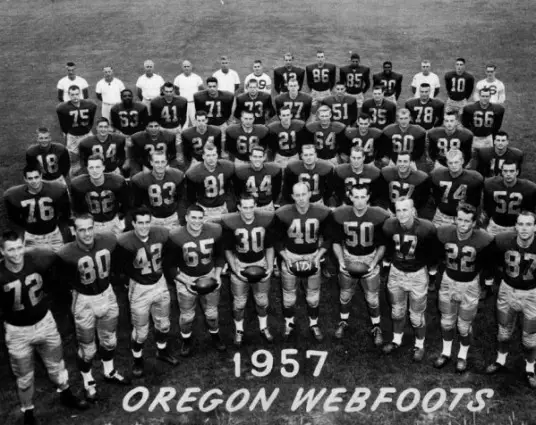
The 1957 Oregon Webfoots were an unlikely conference champion, the scrappy ugly ducklings that overachieved proving the nation to not underestimate Oregon.  Decades later, Oregon would have an encore of this in eerily similar circumstance and comparable results, but the country would never again take Oregon lightly thereafter.

The 1957 Oregon Webfoots overachieved and earned national respect for their play in the 1958 Rose Bowl. Photo Courtesy: Special Collections & University Archives: University of Oregon Libraries
 
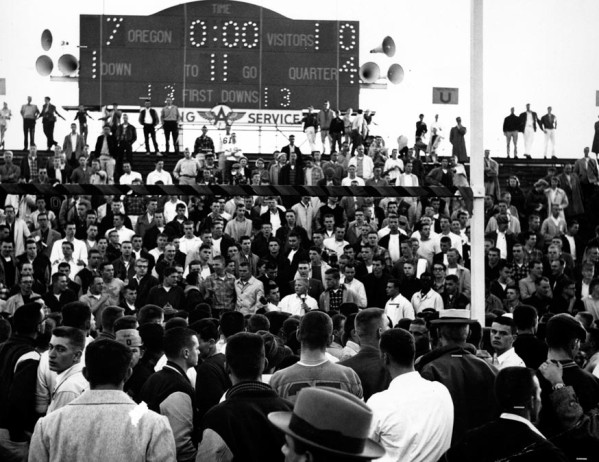
The Pacific Coast Conference was owned by the state of Oregon that year, though few expected it, with both Oregon and OSU having only one loss each on the year going into the Civil War.  However, Oregon had already clinched the right to represent the PCC in the Rose Bowl over Oregon State thanks to the previous week’s victory over USC because at the time there was a “no repeat” clause, which left Beaver fans grumbling when OSU defeated Oregon in the 1957 Civil War 10-7, yet it was Oregon that was Pasadena-bound.

The game, in typical Civil War fashion, was not without great controversy, as Oregon halfback Jim Shanley dove for a touchdown as time expired, but the referees ruled that he had fumbled just prior to crossing the line.  Despite Oregon State claiming the PCC title, the Ducks headed south for winter for their first trip to the Rose Bowl since 1920.


Despite losing the Civil War, Oregon received the invite to the 1958 Rose Bowl because of the PCC's 'No-Repeat" clause. Photo Courtesy: Special Collections & University Archives: University of Oregon Libraries
 
37 years later, another Oregon Ducks team in 1994 would improbably fight their way through the Pac-10 conference schedule, finding themselves conference champions playing in the Rose Bowl following the blueprint set in 1957, led by a coaching staff that included defensive line coach Joe Schaffeld, who had played for the Ducks in the game in ’57.

It hadn’t been easy getting to the Rose Bowl in 1957 or 1994, nearly every game was a close battle with some odd circumstances coming down to the wire.  In 1957 in the second week of the season Oregon had led Pittsburgh 3-0 until the final 20 seconds when quarterback/cornerback Jack Crabtree gave up a long touchdown pass over the top that resulted in a heartbreaking 6-3 loss.  37 years later, an embarrassing blowout loss to Hawaii got Oregon’s season off to a very rough start.  For both the 1957 and 1994 Oregon teams, their ugly starts gave little confidence that either would play any factor in the conference standings that season.

In 1957 against Washington State, a dog ran onto the field just as WSU was about to kick the game-winning field goal, distracting the kicker just enough to miss wide resulting in a 14-13 Oregon victory.
 
Big wins over UCLA, San Jose State, and Cal were balanced out with a string of close nail-biters against Idaho, Pittsburgh, Stanford Washington, USC, and OSU.  Oregon was winning its games, but it wasn’t aesthetically pleasing, more of a blue collar by-any-means-necessary approach scrapping and clawing out tough victories.

The team was led by quarterback Jack Crabtree, brother of Tom Crabtree, who had been the quarterback at Oregon the previous two seasons.


Oregon head coach Len Casanova, assistant coach John McKay, and Oregon QB Jack Crabtree. Photo Courtesy: Special Collections & University Archives: University of Oregon Libraries
 
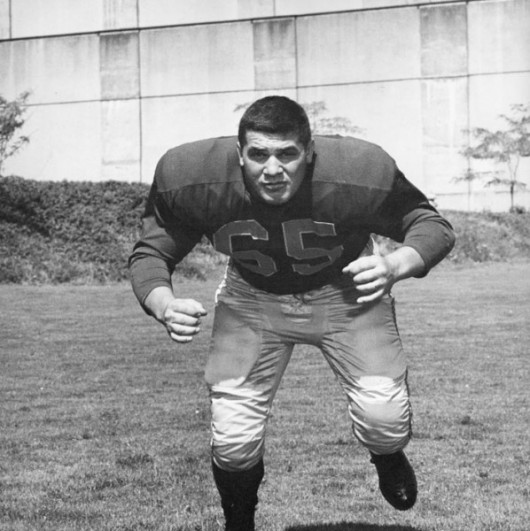
Crabtree had a wealth of running backs to give the ball to, including speedy fullback Jack Morris, who would go on to a 4-year career in the NFL, the elusive Willie West, and Jim Shanley, who finished the year with 693 yards making him the all-time career leader in rushing yards at Oregon.  Shanley along with guard Harry Mondale were both named to the All-Coast Conference team, but much like in 1994 when Oregon would next return to the Rose Bowl, few had anticipated that this underdog group of also-rans had any legitimate shot to compete alongside the powerhouses of the day USC, UCLA, Washington, and Oregon State.


Harry Mondale was one of two All-Conference players for Oregon in 1957, but he was injured on the third play of the 1958 Rose Bowl, making Oregon's task to compete with the Buckeyes that much harder. Photo Courtesy: Special Collections & University Archives: University of Oregon Libraries
 
The task was thought to be impossible, to simply hang with the top-ranked Ohio State Buckeyes in the Rose Bowl.  Almost nobody thought Oregon had any chance whatsoever to win.  Yet Oregon’s run to the roses had been impressive and had moments that turned heads, including Oregon’s 21-0 shutout victory over UCLA and a 16-7 victory over USC where fullback Jack Morris had run for 212 yards.
 
Ohio State was ranked #1 in the coaches poll and #2 in the AP poll behind Auburn, though the Tigers were on probation due to recruiting violations and ineligible to participate in post-season play.  The Buckeyes, stacked with a roster of All-Americans and future NFL hall of famers, were widely considered the top team in the nation.

Oregon may have been lacking in superstars, but it was a collective effort struggling to earn victories through sheer will that came to define the 1957 Webfoots, a blueprint that also defined Oregon in the coming decades, particularly the 1994 team that followed in the 1957 team’s footsteps to face a team in Penn State that  most agreed should have been national champions.

In fact the parallels between the 1957 Oregon team and 1994 team are stunning.  Both were led by impressive coaching legends that define Oregon’s proud past, Len Casanova and Rich Brooks.  Both started off the season with tough out-of-conference losses and were not expected to compete for the league title.  Both teams lacked superstar names or great size/speed/athleticism that was thought to be able to consistently compete with the best teams in the nation.  It had been 38 years since Oregon played in the Rose Bowl when the 1957 team made it, for the 1994 team it was 37 years.  In 1957 Oregon faced a Big-10 coaching legend in Woody Hayes, in 1994 it was the only Big-10 coach who could surpass the immense shadow of Hayes’ legacy, Joe Paterno.


The Oregon Ducks team in 1994 was the first to return to the Rose Bowl since the 1957-58 Oregon Webfoots
 
What they may have lacked in stature on the surface, both the 1957 and 1994 Oregon teams made up for by perfecting the art of football synergy, working together to overcome their flaws to defeat teams thought far superior that year to improbably make a run to the Rose Bowl.  The 1957 team was the first Oregon squad that defeated all four California schools in a single-season, the 1994 team didn’t play UCLA but defeated the other three.  This straight sweep of all California schools would not be accomplished again by an Oregon team until the perfect 12-0 regular season Oregon had in 2010 on its way to the national championship game.

The 1957 team featured a string of unlikely victories over highly ranked opponents like USC and UCLA to propel Oregon to the Rose Bowl.  The same could be said 37 years later, when Oregon’s 1994 team defeated USC, Washington, and Arizona in games where it seemed unfathomable that the Ducks could defeat such powerful teams.
 
 
The 1957 co-national champion Ohio State Buckeyes boasted a stacked roster of All-Americans including Jim Marshall, Joe Cannavino, and Dick Lebeau.  1994 Penn State was led by multiple All-Americans and NFL stars, including Kerry Collins, Kyle Brady, Bobby Engram, and the #1 overall NFL draft pick Ki-jana Carter.

In both 1957 and 1994 it was considered a laughable David vs. Goliath matchup, no self-respecting sports writer in the country giving Oregon any legitimate shot…why should they?  In 1957 Oregon had made it to the Rose Bowl over Oregon State because of a no repeat-clause, not because they were the best team in the conference as decided on the field, and in 1994 it was thought a fluke that Oregon was there, while Penn State was consensus #1 in the country for much of the season.
The common thread among news stories of the day in 1957 was that this would be the most mismatched game in the 44-year history of the Rose Bowl, and that Oregon didn’t even deserve to be on the same field as the Buckeyes.
 

The 1958 Rose Bowl was considered one of the biggest mismatches in the game's history, but the game played out much differently from expectations
 
Len Casanova’s team didn’t look the part of a great football team, nicknamed “The Ugly Ducklings.”  What Oregon lacked in overall talent, they made up for in competitiveness and grit.  Never underestimate the motivation of a defiant group being told they shouldn’t even show up or they will be laughed out of the building.


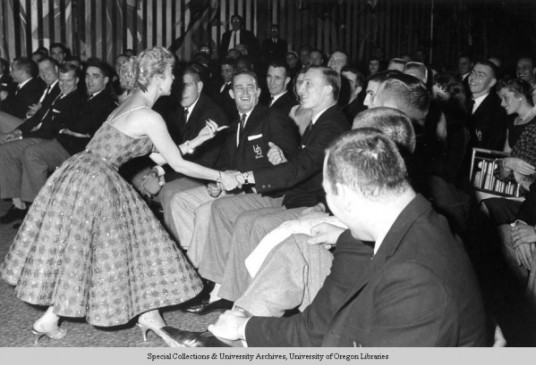
WR Ron Stover says it's HB Jim Shanley that she wants, at an event in Hollywood before the 1958 Rose Bowl. Photo Courtesy: Special Collections & University Archives: University of Oregon Libraries
 
Oregon had two foes to overcome in the game, Ohio State and the media.  They had a new determination, win or lose they wanted to make the papers look bad.  While Ohio State may not have considered Oregon much of a foe, they and the doubters found out quickly that they were in for a battle on January 1st, 1958 at the Rose Bowl in Pasadena, CA.


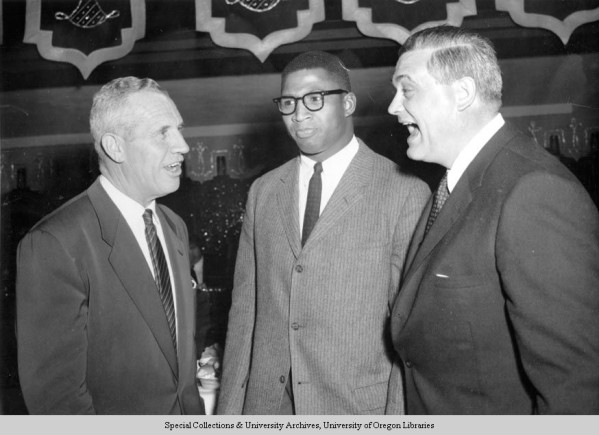
Oregon coach Len Casanova, Ohio State guard Aurelius Thomas, and OSU coach Woody Hayes at an event before the 1958 Rose Bowl. Photo Courtesy: Special Collections & University Archives: University of Oregon Libraries
 
Legends of broadcasting were there that day to cover the game, Keith Jackson covering the radio broadcast while Mel Allen and Chick Hearn handled the television duties for the national television audience.  While trying to stay as impartial as possible, even they couldn’t help but subtly predict a slaughter.  Ohio State was favored in the game by 19, many thought it should have been more than that.

Oregon showed up surprisingly early for the game, making their way out onto the field nearly two hours before they were scheduled to go through warm-ups, grossly miscalculating the amount of traffic that would be encountered due to the annual Parade of Roses in Pasadena.


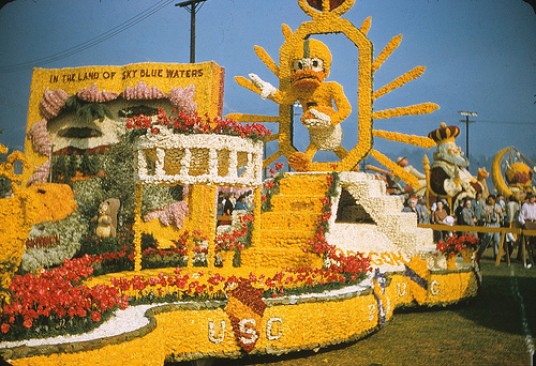
Oregon's float at the annual Parade of Roses on new years day in 1958 before the Rose Bowl 


Ohio State's float at the Parade of Roses before the 1958 Rose Bowl
 
Not quite sure what to do, Head Coach Len Casanova told his assistant coaches to take their respective position groups and go relax them, tell some jokes or stories for a while to occupy time.  By the time the team returned to the dressing room for pregame preparations, Casanova recognized how loose and ready his team was and asked for simply one thing, “Make me proud today.”

It started as many expected, with Ohio State slowly marching 79 yards for a touchdown to take the lead 7-0, despite solid defense by Oregon it appeared like it would be a long day, the first of many scores for Ohio State that were predicted to follow.
 
It didn’t help any that Oregon team captain Norm Chapman wasn’t playing, suffering a broken leg vs. Washington State earlier in the year.  On the third play of the opening drive things got worse, as Oregon’s All-Conference guard Harry Mondale was injured, forcing backup Joe Schaffeld into the lineup.  Schaffeld would hold the line admirably against OSU all game, and years later would become a mainstay at the university of Oregon as the Ducks’ defensive line coach, including the 1994 season when Oregon next returned to the Rose Bowl.

What happened next though in the 1958 Rose Bowl shocked everyone, except those clad in green & yellow.  Ohio State’s predictably traditional Big-10 style 3-yards-and-a-cloud-of-dust offense slowly ground out small chunks of yards at a time, but Oregon was all over the field.  Halfback option passes, deceptive quarterback fake jump pass draws, option plays, even a triple reverse pass had Oregon marching up and down the field.
 
 
Meanwhile Oregon’s defense, while missing Chapman and Mondale, were stout at stacking the line and putting plenty of pressure on OSU QB Francis Kremblas.
 
 
It was a fluke game from many respects.  Oregon was dominating the stats, but turnovers kept Ohio State in the game.  Oregon’s defense was solid, holding Ohio State’s superstars of the game to short yardage all day except for a couple broken tackles resulting in big gains.
 
But turnovers took their toll. Despite the yards being racked up, two interceptions by Joe Cannavino and two fumbles stacked the odds further against them. Oregon was winning at the line of scrimmage and with their wide-open playbook, but four turnovers is difficult to overcome regardless of the opponent, three of these turnovers coming in field goal range.


Oregon had a chance to score on one of the strangest fluke plays in the history of the Rose Bowl, when a pitch to halfback Willie West, who then tried to throw, was deflected by an Ohio State lineman into the hands of Oregon offensive lineman Tom Keele, who had been knocked to the ground and was just standing back up to find the ball suddenly in his hands…immediately Keele started sprinting into the open field with only one Ohio State defender between Keele and the endzone, unfortunately in his panic Keele ran directly towards the defender and only managed to pick up a first down.
 
The score was tied 7-7 at halftime, stunning the audience in the stands and those watching on TV, thanks to a touchdown run by Oregon halfback Jim Shanley.
 
Nobody expected Oregon to hang with the national champions, but Oregon’s defense had been extremely impressive and the offense with their innovative playbook had OSU on their toes.  OSU drove close to a touchdown, but the Ducks held on a 4th down as QB/safety Jack Crabtree leaped over a receiver to bat the ball down.
 
Each team had split short touchdown runs, but it was Oregon the far more impressive team racking up tons of yards on long plays while Ohio State slowly ground out gains in short bursts with an occasional big run or play-action pass. The Ducks were playing loose, above and beyond what anyone had predicted.

In the 2nd half Oregon had a chance to take the lead with a field goal attempted from the 24 yard line, but Jack Crabtree’s kick unfortunately sailed just wide.  In the 4th quarter Ohio State from the exact same spot on the field did successfully hit a field goal, making the score 10-7.
 
 
Oregon continued to roll up and down the field but failed to execute once within scoring range.  Ohio State sitting on 10-7 lead had played ball control, trying to bleed off the clock. However a 4th down stop by Oregon’s defense gave one more chance to tie or win it.
 
With seconds left in the game Oregon had a chance to win, as wide receiver Ron Stover had a long pass completion putting the Ducks in range to at least tie it with a field goal or go for the victory, but Stover was stripped of the ball as he was going to the ground and fumbled.
 
Stover had 10 catches in the game, but his final one closed the door on Oregon’s chances.  Ohio State ran out the clock, winning the Rose Bowl 10-7.
 
However, the final score didn’t tell the whole story.  Just like 37 years later with the 1994 Oregon football team, just getting there was as much of a victory than the final score, and the valiant efforts of the scrappy Oregon Ducks shocked the world.

It was Ohio State winning the game on the scoreboard, but Oregon Head Coach Len Casanova was the one being carried off the field by his players in celebration.
 
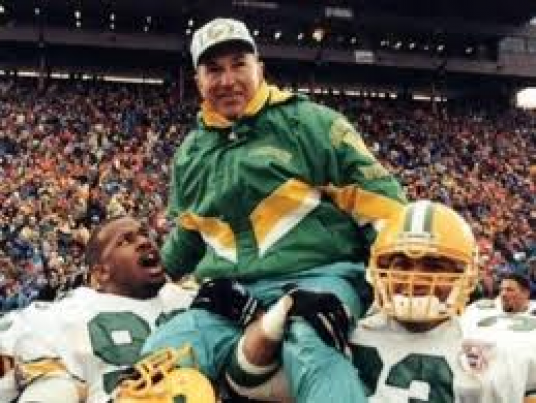
This would be repeated in the 1995 Rose Bowl, as coach Rich Brooks was carried off in celebration for Oregon’s efforts to end a magical season despite losing to Penn State 38-24.


Oregon coach Rich Brooks would be carried off the field by his players in his last two games as Oregon's coach, against Oregon State (pictured here) and in the 1995 Rose Bowl.
 
Following the 1958 Rose Bowl, Oregon quarterback Jack Crabtree in a losing effort was named the game MVP, something that again would be repeated by Oregon in 1995 when quarterback Danny O’Neil set a Rose Bowl record with 456 passing yards and was named co-game MVP desspite losing 38-24.

Regardless of the final scores in the 1958 and 1995 Rose Bowl games, both teams turned heads.  Little Oregon had competed with the big boys and completely out-shined their favored opponents in every way on the field, yet unfortunately bad luck kept them from winning on the scoreboard as well.  What they had failed to earn in the trophy case, the Oregon Ducks earned ten-fold in national respect.
Following the 1958 Rose Bowl the writers who had done everything they could to humiliate Oregon in the press took notice and admitted they were wrong, Oregon had earned the right to compete with anybody.
Ohio State players congratulated Oregon for the way they played, the decidedly larger Ohio State fan base in attendance cheered the Oregon team as they departed the field.  Oregon may not have won on the scoreboard, but the Webfoots were victorious in every other way imaginable that day.  Most importantly of all, despite the 10-7 loss, the 1957-58 Oregon Ducks had indeed done everything that coach Casanova had asked of them, they had made him proud.

37 years later after the final seconds of the 1995 Rose Bowl ticked away, and with Len Casanova looking on Oregon Head Coach Brooks would utter similar words in defeat…never was he more proud of a team.

Following the 1958 Rose Bowl Len Casanova remained head coach for years, and eventually became an administrator and mentor for the Oregon Ducks athletic program for decades.  He would oversee the construction of new facilities, support the many years under Coach Rich Brooks when it seemed like Oregon has sunk to its lowest point, and be there to show support when Oregon arose from the ashes like a phoenix.  The Casanova Center built in 1990 was a launching point, with baby steps being accomplished each season building up the program.

But while hard times for years followed after Oregon’s loss to Ohio State in the 1958 Rose Bowl, the loss in the 1995 Rose Bowl was a turning point for the program. 

The team followed it up with a 10-2 season and trip to the Cotton Bowl, while with Casanova’s assistance Oregon began expanding and improving its facilities.  The Moshofsky Center was built within a few years, Autzen Stadium was expanded, other facilities were added, and suddenly Oregon winning was not a fluke, it was a tradition.

The success Oregon experiences today is built upon the shoulders of those who struggled for decades with minimal facilities and underdog players who achieved in spite of the naysayers.  The 1957 Oregon team epitomized the spirit that defined what it means to be a Duck, an ideology mimicked again in 1994 and every year thereafter. 

Track athletes-turned-football players a fruitful experiment for Oregon and beyond

 Track athletes-turned-football players a fruitful experiment for Oregon and beyond

Originally published on FishDuck.com on August 31st, 2011
 
Oregon has never been a school to shy away from experimentation over the years.  From being one of the first schools to utilize pre-snap motion in the 1940s (known as “Oliver’s Twist,” named after head coach Tex Oliver), to the edge defense in the 90s, and the innovative spread offense the Ducks run today; there has never been a fear to tinker with the game of football.

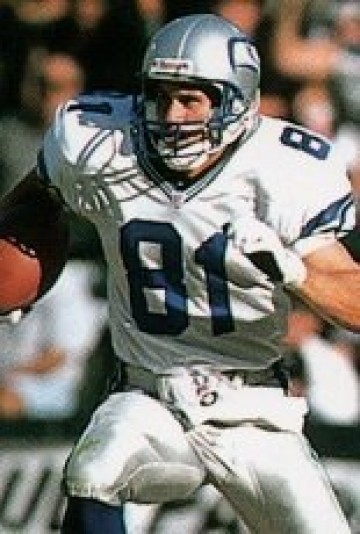
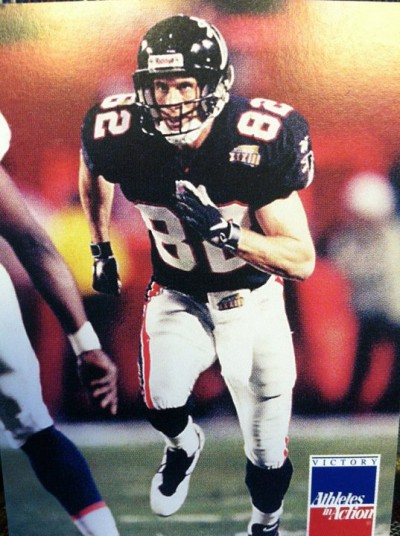
Keeping in mind Oregon’s ability to be innovative and think outside the box, It should not be surprising that over the past three decades the University of Oregon has had repeated success in taking sought-after track athletes and converting them into quality wide receivers that have excelled in the NFL.  Starting with JJ Birden in the 80s, leading into Ronnie Harris and Patrick Johnson in the 90s, and Samie Parker and Jordan Kent in the aughts, the NFL has reaped the benefits of Oregon’s extensive efforts to take pure track athletes over time converting them into wide receivers.

At Tracktown U.S.A., the mecca of running and birthplace of Nike, it seems as likely a place as any to take athletes in one sport and mold them into another.  While the overall production of these efforts has been mixed in college, all have gone on to fruitful careers in the NFL.  There’s clearly something to this experiment that the professional ranks find appealing.  Is it something in the water or something in the track at Hayward Field? 

Perhaps it is the Oregon coaching staff, a crew that has been together for decades willing to take a chance on athletes knowing what it takes to be successful?  Is it the versatility in skills constantly emphasized by Oregon coaches, or the plyometrics training Coach Jim Radcliffe preaches?

What is it about performing in track & field that compensates for lack of football experience and gives student-athletes a direct path to a professional football career?
For these track stars-turned-football players, all except Jordan Kent had actually played football in high school, but that didn’t necessarily mean that colleges were pursuing them initially for the gridiron.
 
JJ BIRDEN SETS THE MOLD
 
J.J. Birden came to Oregon in 1984, an all-state wide receiver at Lakeridge High School in Portland, OR, yet known primarily as a track athlete considered too small to play football.

“The only schools that gave me a chance to try out for football while on a track scholarship were Boise State, Idaho State, and Oregon,” said Birden, now retired after a lengthy NFL career residing in Arizona as a distributor for Xocai Healthy Chocolate.  “The track coaches said they would at least ask the football coaches if I could try out, but it didn’t seem like anyone was going to give me a realistic shot.”

Birden immediately began making his mark in track & field, but the thought of also playing football lingered.  He would sneak into Autzen Stadium to watch practice, but was never spotted.  Birden did participate in intramural football, and dominated.  Track and field though remained his passion, his drive, his focus; while football was a lingering pipe dream.  Oregon track coaches had indeed reached out to the Oregon football staff, but nothing materialized as far as a tryout.


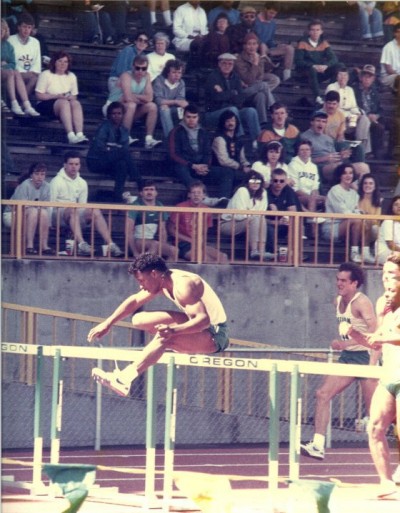
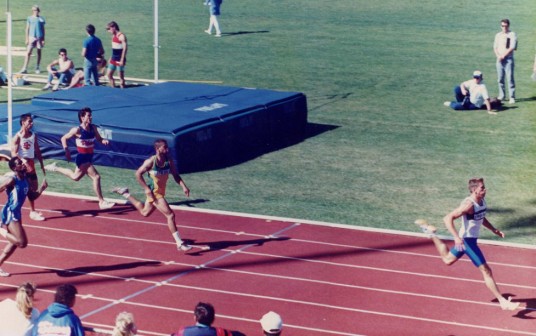
J.J. Birden was an elite track athlete at Oregon in the long jump and hurdles
 
His sophomore year Birden would finally get noticed, unintentionally so.  One day Birden snuck onto the field at Autzen and was hiding behind the goalposts to observe practice.  Head Coach Rich Brooks eventually spotted him and walked the full distance of the field towards him, Birden panicking wondering whether or not to run away.

“Coach Brooks approached me and said, ‘Birden, right? I noticed you’ve been watching practice, want to give this a try?’ He said to meet him at his office the next day and we’d talk.”

Birden did arrive at Coach Brooks’ office the next day, and was told that Brooks had spoken with the Oregon track coaches and agreed that they would give him a tryout for a year with the football team.  If it didn’t work out, then his scholarship would be switched back to track.  Brooks did not guarantee however that if it worked Birden would stick with the football team.

“So I showed up at camp, and I was pretty fearless for a little guy,” Birden remembers. “First two weeks I was 8th or 9th on the depth chart, but after about a week Coach Bob Toledo came up to me and said ‘wow, we never knew you could actually play this position!’ I told them ‘yeah well you guys never gave me a chance.’”

Within a couple weeks of practice JJ Birden had moved up to second string on the depth chart and his future as a two-sport star seemed bright.  Coaches worked closely with him to teach Birden the finer details of the wide receiver position, while simultaneously his career flourished on the track.  The two sports did overlap somewhat, meaning that Birden only was able to participate in spring ball once during his time at Oregon, though considering his smaller frame perhaps this wasn’t such a bad thing.
“I don’t think any other guys who went out for both football and track after me got away with only participating in spring ball once, I played four years and only had one spring ball.  Because I was a small guy though it was good for me to have less wear and tear on my body, even though spring ball would have really helped me contribute more in college.”

Birden not participating in spring ball shows how far Oregon football has come from the 1980s, when track & field was the premiere sport in Eugene.  The likelihood of this happening today, a student-athlete on a football scholarship skipping spring football to focus on track, seems absurd.
Birden trained with the coaching staff, worked closely with strength & condition coach Jim Radcliffe to develop his body more to sustain the blows of football, and learned the ropes of how to play wide receiver in the pro-set offense.

However, all the training and preparation did little in terms of production at Oregon, as injuries unfortunately derailed JJ Birden’s production at Oregon.  His junior year (1986) he had a real shot to become a consistent contributor and was playing often, but a broken arm suffered in the third week of the season at Nebraska ended Birden’s year.

1987 Birden again suffered a severe injury, a badly sprained ankle suffered vs. UCLA limited his playing time for much of the season, and Birden would finish his career as an Oregon Duck with only one career touchdown catch.


J.J. Birden played football for three years at Oregon, but injuries limited his playing time
 
“I didn’t have much of a college football career in all honesty, I trained hard for it but with the injuries it never quite came together.  Plus I was more focused on my track career.  That’s why I was surprised when I got invited to the NFL combine, I didn’t even know what it was but figured I would give it a try.  So I go there, and I’m sitting at a table with Sterling Sharpe, Michael Irvin, Brian Blades, Tim Brown, and all these other superstars, and little ol’ me at the end wondering what I’m doing here,” Birden laughed. “Talk about intimidating…”

“So I ran and I caught passes, but I figured that was it, I was focused on trying to make the Olympic team, I was going to go back to finish up my season in track, but teams started talking to me.  I couldn’t believe they were actually interested in drafting me.”

Coach Rich Brooks helped JJ Birden acquire an agent for the NFL draft, but despite the advice to stay in the dorms Birden chose to skip the draft and go to classes, so convinced that there was no way an NFL team would actually draft someone with such little college football game experience.

“I got a call from Marty Schottenheimer of the Cleveland Browns and he said that they just drafted me in the 8th round, I thought it was a prank call.  Marty wanted me to come to Cleveland as soon as possible, and I told him I was in the middle of track season and the Olympic trials were coming up.  I was doing great that year competing in the long jump and hurdles.”

Oregon’s track coaches gave Birden permission to travel to Cleveland to participate in the mini-camp, but asked that he do nothing so as to avoid injury…at mini-camp, Birden tore his ACL during the third practice.

Birden finished school and decided that the NFL facilities might help him rehab while on the IR for a year still in the hopes of a career in track & field.  After stops in Cleveland and Dallas spending two years on NFL rosters without playing in a single game, Birden found himself once again being courted by Marty Schottenheimer, now the coach at Kansas City.

“If I hadn’t been hurt, I don’t think I would have played in the NFL, I had more of a passion for track than I did football.  But after rehabbing for two years I felt ready, I ran the fastest 40 time and looked good.  I went through training camp with the Chiefs but got cut, but two weeks later somebody got hurt and they brought me back.  I wasn’t trying to be the star, just make the team.  I was an overachiever, and I learned everybody’s positions so that they could move me around.  A couple games into the season some guys got hurt so I got a chance to play, and I had a game with about 180 yards and 2 TDs, it opened a lot of eyes.”

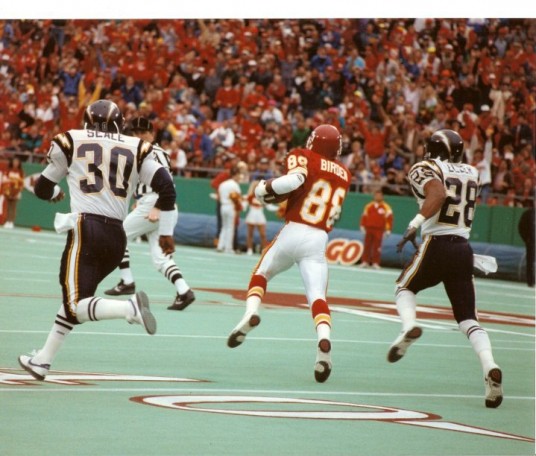
The diminutive but speedy J.J. Birden had lots of guys playing catchup during his NFL career 

Birden’s NFL career was off and running, one that for the next seven years with the Chiefs and Falcons would make Birden one of the best speedy deep threat wide receivers in the game.  Despite his size, the skills and work ethic instilled in him from his time at Oregon with football and track had turned this little guy nobody wanted into one of the top receivers in the pros.  Over his career Birden caught 244 passes for 3,441 yards and 17 TDs, including 7 catches over 40 yards while playing with some of the best quarterbacks of the era in Joe Montana, Dave Krieg, and Bobby Hebert.
“I tore up my knee my last year, I could have kept playing but I had spent 9 years in the NFL, which was 9 years longer than I thought I ever would, and I chose to walk away from the game,” said Birden.

“Even though I didn’t play much, I have a lot of fond memories of Oregon. I’m very proud that I was a part of the team in the 80s when things started to turn around, and I worked a lot with guys like Terry Obee and Tony Hargain showing them the ropes…it was kind of funny when Tony (Hargain) and I both ended up playing for the Kansas City Chiefs one year playing side-by-side.  I remember one of my first games with the Chiefs I go in for a 4-WR set and I look up and the cornerback covering me is Chris Oldham (Oregon CB 1986-1989).  I said, ‘Chris?’ and he said ‘JJ? Is that you?’ Can you believe this is my first game and we’re playing against each other?’  And I remember playing against Anthony Newman and he kept yelling at me the whole game and telling his guys to mess with JJ the whole time…but that was fun, it was great to stay connected with Oregon through the guys that made it to the pros.”


J.J. Birden spent nine years in the NFL after his time at Oregon
 
While JJ Birden’s success in the pros was undeniable, the effort put into training him at Oregon had come with little reward for the Ducks.  Yet the mold had been set, Birden had proved that coaches could take a raw athlete and convert them into an effective football player, and the Ducks would again find success in converting track athletes to top-level wide receivers.
 
RONNIE HARRIS PROVES EVERYONE WRONG
 
One year after J.J. Birden’s unlikely departure for the NFL, another athlete would come to Oregon finding success in both track & field and as a wide receiver, Ronnie Harris.

At Valley Christian High School in San Jose, CA, Ronnie Harris was an accomplished multi-sport athlete despite not looking the part at first glance.

“I didn’t look like a football player,” said Ronnie Harris.  “I never played football until I was 15, the coach talked me into playing.  I was the kicker for the football team and goalie for the soccer team, played basketball, and ran track.  Soccer was my main sport, I was MVP of the varsity soccer team.”
Harris was blessed with incredible foot speed and a long stride, deceptively able to cover a lot of ground for someone of his stature.  One day Harris was approached by the football coach and asked what his 40-time was, when Harris responded 4.5, the coach flipped out and demanded he play football.


Ronnie Harris ran track, played soccer, basketball, and football at Christian Valley High School in San Jose, CA.
 
“He taught me the game, he’d put me outside and say, ‘now just run as fast as you can down the field and we’ll throw you the ball.”

Harris was recruited heavily by Washington, but they canceled his recruiting trip to the UW campus at the last minute because they were closely recruiting another player at the same position, so instead Harris chose to visit Oregon and ended up signing a letter of intent to play football with the Ducks.
“I chose Oregon because of Eugene and the family atmosphere, a college town that rallies around its school, everything it offered in 1988 was really cool to me.  I came to Oregon to play football, track was just a bonus.  I ran against a lot of athletes in high school in California.  I had a good track career, but I didn’t think it would be the main deal for me.  I came into Oregon hurt, on crutches because of a hyper-extended knee, and then right before spring ball freshman year I pulled my hamstring, but still ran a 4.3.  I hadn’t really talked to anyone about track as I was there with a football scholarship, and I was barely getting by in that as the 6th or 7th wide receiver.”

A phone call from Oregon decathlete Mohammed Oliver would change Harris’ planned football-only career at Oregon.  Some athletes on the Oregon track team had been injured, and Oliver asked Harris to run in a meet vs. Nebraska, Harris agreed.

“It was so much fun, I decided that I wanted to do both football and track,” said Harris.
His first couple seasons at Oregon Harris played football sporadically, often injured and still learning how to play wide receiver, working with the coaches to learn the finer details of football.  Harris received a blessing from Head Coach Rich Brooks to join the track team full time.  Harris spent many hours with Coach Radcliffe fielding punts in Autzen Stadium and running routes, while improving his running technique with Track Coach George Walcott.

“I remember in high school I had an opposing coach tell me that I was the fastest guy he had ever seen that can’t run.  I was fast in spite of myself.  Over time once I started running track I was able to improve my body mechanics, become a more proficient runner, learn how to improve my momentum.  It really helped in football immensely.  The first couple years in football were tough on me because I was hurt and not playing much, and I took it so seriously.  The dynamics of football vs. track are so different though, it’s a team effort but you’re also out there alone as an individual.  I tried to adjust pressure on myself, and running track taught me to relax, and I was able to apply that to football.  It made me a better football player.”


Ronnie Harris was a deceptive athlete in size, speed, strength, and drive.
 
Junior year at Oregon Harris’ training efforts in both sports would finally pay off, with veteran wide receivers and sprinters graduating suddenly opening up opportunities for Harris to shine in both sports.

“Early on I was playing hurt a lot and it would set me back, I’d get moved down the depth chart.  You only get so many opportunities, and it comes down to what happens in a particular given opportunity, do you maximize on your chance?”

Harris did just that, becoming a go-to wide receiver and runner for the track team on the 4×100 team.  Harris, not looking the part of a typical wide receiver, would repeatedly torch cornerbacks for long plays over-the-top on deep slants and posts for 40+ yard touchdowns with his long stride beating guys deep.

“I’m a white, skinny guy with a long stride, so yeah nobody gave me much respect.  I didn’t have the big physique, I looked like a regular dude.  But once I started doing really well in football, other guys started going out for the track team too, seeing if they could also improve their speed and technique.”
Senior year in 1992 Harris became the Ducks primary punt returner after an injury opened up a spot, and Harris took full advantage.  As both a wide receiver and punt returner, the deceptively fast Ronnie Harris became the primary deep threat for Oregon.


Following his senior year, Harris signed a free agent deal with the New England Patriots.
“My track experience was 51% of why I was in the NFL.  At that level they still look at how they can take a raw talent guy and make them better.”

Ronnie Harris was a versatile athlete in the NFL as a WR and special teams player
 
“Teams took a chance and tried to develop me.  I had to prove myself every year to make the team as a receiver even though my whole career I didn’t play much receiver, I had to do other things like cover kicks and punts.  You have to be sustainable, I learned to become a better receiver in the NFL knowing that I needed to do more than that to stay.”

Ronnie Harris played seven years in the NFL with the Patriots, Seahawks, and Falcons
 
The versatility and training paid off, as a seven year career in the NFL was to follow with the New England Patriots, Seattle Seahawks, and Atlanta Falcons until retiring in 1999.

Just like in high school and college, Harris didn’t fit the part, but through hard work, raw talent, and training he proved the doubters wrong.
 
PATRICK JOHNSON BECOMES OREGON’S ELITE DEEP THREAT
 
With Birden and Harris both in the NFL, in the mid-90s another two-sport star would arrive on campus to continue the trend, lifting Oregon to unprecedented levels.

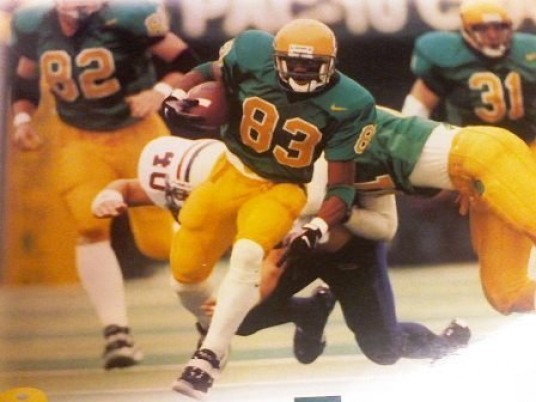
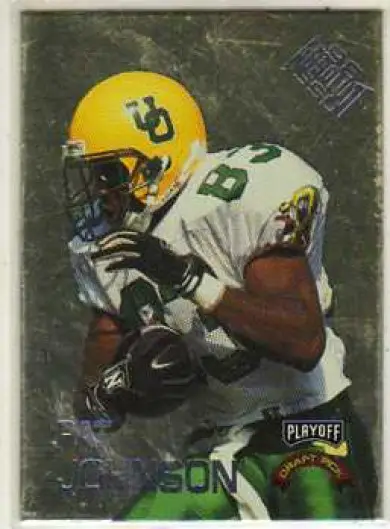
For Patrick Johnson, athletics wasn’t immediately his goal.   He didn’t start running track at Redlands High School in California until his junior year, and finished 4th place in finals at the state meet.  His senior year he went out for the football team, becoming a running back.  Blossoming into a track star, Patrick became the California State Track Champion in both the 100m and 200m his senior season.  Still learning the game of football though, a chance encounter would set Patrick’s course to Oregon.
“Coach Don Pellum is from a place about 20 minutes away from Redlands, so he was in town visiting his mom and randomly came to a game and saw me play.  He clearly liked what he saw, because Oregon started recruiting me from there,” Patrick Johnson recalled.

“A couple other schools had recruited me to play defense, Oregon was the only program that wanted me to play offense.  I met with John Gillespie (assistant coach under track coach Bill Dillinger) on my visit to Oregon and I asked about running track.  They were iffy on it, said we’d talk about it when I got into school.  I signed a football scholarship, and then my senior year of high school I got a lot better at track, won the state championship and all of a sudden (John) Gillespie started calling me a lot asking if I was going to run track.  I arrived in 1994 knowing I was going to go out for the track team, but I never had the track mentality, I am a football person first who happened to be able to run really fast, but I had only played one year so I still had to learn how to play the game.”

Johnson became an accomplished runner for the Oregon track team, but playing time early at wide receiver was tough to come by, buried beneath veteran wide receivers during Oregon’s remarkable run to the Rose Bowl in the 1994 season.
 
He defeated legendary track star Carl Lewis in a 100m race at the Drake Relays, and won the Pac-10 championship in the 400m as a freshman, becoming one of the top sprinters in the nation.  But for all his success on the track, football remained his primary goal.

Patrick Johnson was dynamic as a returner and deep-threat wide receiver at Oregon
 
“John Ramsey (now quarterbacks coach with the San Diego Chargers) was my receivers coach my freshman year, and then Chris Peterson (now Boise State head coach) was my position coach the rest of the way.  They helped me so much in just learning how to play the game.  They taught me so much, I had to learn how to catch the ball and I’d spend hours catching passes from them and working on running routes, it took a long time for me.  It all really didn’t click until my senior year in 1997.”
 
Through repetition Patrick Johnson slowly acclimated to college football.  Speed wasn’t his problem, any time he stepped on the track or the turf he was the fastest man out there, but learning the fundamentals of football was a different matter.

Just like with Birden and Harris before him, coaches went above and beyond to teach him the finer points of the game and make him as versatile as possible.  Johnson learned every wide receiver position; slot, flanker, split end, and how to return kickoffs and punts.
 
The stability in the coaching staff year-to-year made it possible to work with Patrick on a long-term plan to learn the position and grow as an athlete, while his time on the track team improved his foot speed and body mechanics.

Patrick Johnson was one of the fastest players in Oregon Ducks history
 
By the time his senior year came around in 1997, Patrick Johnson was one of the deadliest weapons in the Pac-10.  Being able to play multiple positions and the best return man in the conference, nearly every game Johnson was able to beat opponents deep for long pass completions, matched with two quarterbacks in Akili Smith and Jason Maas with cannons for arms unafraid to just chuck it deep and let Johnson run after it.
 
During that 1997 season Johnson made one of the greatest touchdown catches in Ducks history in Oregon’s improbable 1997 comeback victory over Washington in Husky Stadium.
 
Following his senior year, Patrick Johnson was selected in the 2nd round of the 1998 NFL draft by the Baltimore Ravens.  He played 8 years in the NFL and CFL, winning a Super Bowl with the Ravens.  After a lengthy career with the Ravens, Redskins, Jaguars, and Toronto Argonauts, he retired following the 2007 football season.

Patrick Johnson played professional football for 8 years, and earned a Super Bowl Ring with the Baltimore Ravens.
 
“The more I knew about being able to play multiple positions on the field, the longer I was able to stay in the league.  If you only do one thing, you won’t last.  When I got to the NFL there was no learning curve because I knew all the concepts already because of the coaches I had at Oregon, they made my career.”
 
THE TREND CONTINUES…
 
The grand experiment of JJ Birden had turned into solid production with Ronnie Harris and the creation of the ultimate deep threat in Patrick Johnson.  The mold was set, the project proven.  Oregon was a team now defined by speed, and the coaching staff would pursue it wherever they could find it in an attempt to capture the magic once more.

They would repeat this success twice more to date, with Samie Parker and Jordan Kent.
Parker was a star track and baseball athlete in Long Beach, CA, when he was recruited to come to Oregon in 1999.  Much like with Ronnie Harris, initially Samie Parker focused only on football, but like the others there were a lot of growing pains learning the position.  As a kick returner and deep threat his skills slowly began emerging, right around the same time he joined the track team in 2000.

Oregon wide receiver Samie Parker wore #1, appropriate for the #1 receiver for the Ducks in career receptions and yards
 
Parker’s career at Oregon would end quite prolifically, with his final game as a Duck in 2003 being one for the ages with 16 catches against Minnesota in the Sun Bowl.  The Ducks would lose that day, but Parker became the all-time and single-game receptions leader and all-time yardage leader at Oregon while also setting multiple Sun Bowl records.
 
His most iconic moment exemplified Oregon’s success in transforming track athletes into wide receivers, catching an 80 yard touchdown pass in the 2001 Fiesta Bowl from Joey Harrington, the signature moment in one of the best seasons in Oregon Ducks history.
 
Parker’s career at Hayward Field was also fruitful.  He finished 4th in the 60m at the 2002 NCAA Indoor Championships and was named an All-American.  2003 he would repeat this feat, as All-American Samie Parker finished 5th in the 100m NCAA Championships and 3rd in the 60m NCAA Indoor Championships.

Samie Parker was an accomplished athlete on the track and the football field for Oregon
 
NFL teams drooled over yet another speedy Oregon wide receiver/track star, and Samie Parker was drafted by the Kansas City Chiefs in the 4th round.  Parker played four seasons with the Chiefs, followed by time with the Oakland Raiders in 2009, and has continued his professional football career playing in the arena football league and currently in the UFL with the Las Vegas Locomotives (alongside fellow Oregon wide receiver Cameron Colvin).


Samie Parker played for the Chiefs and Raiders in the NFL, and continues his professional career currently with the Las Vegas Locomotives of the UFL
 
After Parker, it seemed expected that any time a natural track athlete came to Oregon they would try out for football.  Numerous track athletes participated in football as walk-ons, and many football players were now running on the track team, the symbiotic relationship between the two sports now clearly defined as being mutually beneficial.

Jordan Kent had not played organized football at any level, a local product from Churchill High School and son of Oregon men’s basketball coach Ernie Kent.  Yet after two years of playing basketball and running track for the Ducks, the constant nudging of Oregon coaches to try out for football convinced him to do so.  He had never even put on a football uniform before prior to 2005 when he became one of only a handful of athletes to letter in three sports at Oregon, the first since World War II, and the first in the Pac-10 since 1970.


In 2005 Jordan Kent became the first Oregon Ducks athlete to letter in three sports since World War II
 
Like had been done before with his predecessors, coaches worked with him extensively teaching him the fundamentals of football.  Recognizing his pure athletic abilities, they trained him on how to run a route tree, how to catch, how to block, how to take his track and basketball abilities and apply them to the game of football.

By mid-season 2005 Kent was ready, and against Washington State the third catch of his career would be a long touchdown that proved key in Oregon’s narrow victory over the Cougars in Pullman, WA.
 
Kent’s contributions during the 2005 season were minimal, but his speed and athleticism shined when he was on the field.  2006 he dedicated his efforts to football, choosing to not participate in basketball.
 
His senior year in 2006 Kent finished 2nd on the team in receptions and was a lethal deep threat, going from raw athlete to talented veteran receiver.


Jordan Kent had never played organized football prior to his junior year of college, but became a viable weapon for the Ducks
 
On the track Kent was a four-time All-American, anchoring the 4×100 relay team and 4x400m relay, and as a runner in the 200m.  His relay team finished 3rd in the 4×400 and 6th in the 4×100 at the 2005 NCAA Championships and Kent was named an All-American.  2006 the team would return, becoming Pac-10 champions in the 4x100m relay, and finishing 7th in the 4×100 and 6th in the 4×400 at the 2006 NCAA Championships.

Jordan Kent was a four-time All-American in track & field for the Ducks
 
Once again the NFL immediately took notice.  At this point based on the success of Birden, Harris, Johnson, and Parker it was expected that any track athlete Oregon converted into a wide receiver would make it in the NFL.  The Seattle Seahawks drafted Kent in the 6th round of the 2007 draft, and he played several years with the Seahawks and Rams.

Now whenever Oregon’s football recruiting classes are announced it is an expectation that many of the wide receivers, running backs, and cornerbacks will also compete in track & field for the Ducks.  Track athletes in turn are occasionally nudged to perhaps give football a try as well.  Oregon coaches encourage the overlap to refine their athletic skills.  The NFL has taken notice, with more Oregon athletes entering the professional ranks than ever before, the tradition established by Birden, Harris, Johnson, Parker, and Kent will continue for the foreseeable future.


-After retiring from the NFL J.J. Birden invested in several successful businesses. He lives in Arizona and is a distributor for Xocai Healthy Chocolate, http://www.jjbirden.com.

-Ronnie Harris is a youth pastor in Bothell, WA, who remains close to the Oregon Ducks traveling to games often with his family.

-Patrick Johnson is retired from the NFL and living in Dallas, TX, the VP of Investor Relations at 1st Resource Group.

-Samie Parker continues to pursue professional football, currently playing in the UFL with the Las Vegas Locomotives alongside fellow former Oregon Ducks wide receiver Cameron Colvin.

-Jordan Kent continues to pursue track aspirations while working as a trainer with Edge Combines, and co-hosts ‘Talkin’ Ducks’ on Comcast Sports Net.