Showing posts with label Mac Court. Show all posts

Friday, January 24, 2014

THEORETICAL UO CAMPUS: Ewok Villages, Duck Domes, Giant Bubbles and other could’ve beens

THEORETICAL UO CAMPUS: Ewok Villages, Duck Domes, Giant Bubbles and other could’ve beens

Originally published on CampusAttic.com on October 9th, 2013


2013 marks yet another achievement by the University of Oregon, raising the bar once more in world-class unrivaled athletic facilities, amateur or pro, anywhere in the world. The new football operations center, named the Hatfield-Dowlin Complex (the term HD fitting Oregon’s swag a little too perfectly), is the envy of every school and professional team around, and the additions to the north side of Autzen Stadium further adds to the aesthetic of gamedays in Eugene as one of the best fan experiences anywhere.

The new Hatfield-Dowlin Complex Football Operations Center. (Nate Barrett/Emerald).


The HD Complex is true to its name, embellished with flat-screens and luxuries at every turn more typical of McMansions not college student training centers. It is only the latest in what has been a long-term process at the UO stretching back decades, developing top-notch facilities both athletically and academically to attract the best athletes to Eugene in order to maintain Oregon’s competitiveness on a national scale.

The success of on-field athletics causes a trickle-down effect positively impacting the entire school, despite inevitable griping from some that believe the emphasis on athletics detracts from the overall point of a college as an educational institution. Yet it still is a business, and the most accessible form of profits for the business of higher education comes through athletic ticket sales, hence what’s good on the field translates to what’s good in the classrooms.

The Lillis Business Center, one of the many modern buildings to appear on campus in recent years. (©UO Special Collections)


Just consider the overall facelift to the entire school that has taken effect since the success of the 1994 football season, when the team improbably won the Pac-10 title (picked to finish 9th in the conference in the preseason), reaching the Rose Bowl, which sparked an influx of donations and ticket sales. Those donations and investments have resulted in not just amazing new football facilities, but improvements to structures throughout all of academia at the UO.

While it may have started a little slow, as momentum was gained on the field it fueled expedited construction and even an overall re-branding of the entire school on a national level, no longer the block intersecting UO but now simply known as the O.

The late 90s saw a change in logo.

Despite critics, for an institution such as the University of Oregon this spending spree to maintain on-field success as a low comparative local population in the state of Oregon simply doesn’t generate enough top athletes. In order to sustain a competitive athletic program in all sports, attracting out-of-state talent is imperative.

Current students only know of success at what is today one of the best and most popular collegiate athletic programs in the country, Oregon thanks to a multi-decade campaign is now considered as a national brand. That didn’t happen overnight, nor has it always gone to plan. The end results instill pride in fans and breed on-field success, but long before the flashy uniforms and towering monuments to sport existed, Oregon’s teams competed in rather sorrowful conditions.
Talk to athletes who competed on the football field of Hayward before Autzen Stadium was built in 1967, they’ll wax poetic of sitting on lawn mowers and garbage cans in the meager locker rooms under the stands. Talk to athletes who competed in Mac Court of its facilities, and hear stories of how the walls would ooze in the lower recesses of the old building where the locker rooms were located, from the bathroom pipes above.

Yet even Autzen Stadium itself, a monument in its original form to thrifty and expedited construction (its basic berm design completed in 1967 for barely over a million dollars), has undergone some interesting variations in its evolution. The original architectural designs for what would become Autzen Stadium definitely went outside the box, amidst the height of the drive-in theater/restaurant craze why not make a drive-in stadium? The original designs of the football stadium to replace Hayward Field included endzone parking for fans to watch from the comfort of their cars.

Early designs for what would eventually become Autzen Stadium included endzone parking. (Benzduck.com)

This change in Oregon’s personality from humble low-income blue-collar worker to the spoiled rich kid didn’t happen overnight. Phil Knight, Nike’s former CEO and famous philanthropic uber-booster, didn’t suddenly snap his fingers and suddenly there were trophies. Regardless of how great a locker room or treatment center may be, Oregon’s success has and always will be about the people first, the coaches and players. It is not the uniform that wins a game, but the individual within the uniform.

This is certainly evidenced by history, whereas claims today of best year ever for the UO athletic program in terms of on-field performance are justified, records show that 1976 was quite possibly the best year in the history of the program’s existence in terms of overall athletic performance, despite run-down facilities and an abysmal football program while facing major budgetary issues.

Matthew Knight Arena, the Casanova Center and its repeated upgrades, the Moshofsky Center, PK Park, Jacqua Athlete Center, Pape’ Field, Student Tennis Center, Student Rec Center and more; construction crews have been busy for the past two decades taking Oregon from among the worst to first. Older structures like Howe Field, Autzen Stadium, and Hayward Field have received repeated upgrades to give the older structures new life, while only McArthur Court’s future hangs in doubt as to its future after its nearly 90 years of service.

For every one of these projects realized, there have been previous attempts to solve an inherent issue, some more successful than others. From the 19th century to the 21st, the University of Oregon has been consistent in its outside-the-box thinking of trying to find the best means to compete.

Space to build has been a common issue, finding a suitable location to address inherent needs occasionally trumping the construction plans, or causing some interesting solutions. Take for example the 1963 plan to build new structures on stilts and raised walkways and bridges above the graves of Pioneer Cemetery, utilizing the valuable space of the graveyard while still keeping the grave sites intact. This plan thankfully fell through, and the pioneer cemetery remains in its original state.

Might this have been Oregon’s campus above the cemetery?


Other innovative ideas though have come to fruition, such as the construction of Onyx Bridge in 1961, elevating the new science wing above ground spanning Onyx St. to permit at least partial traffic to pass below.

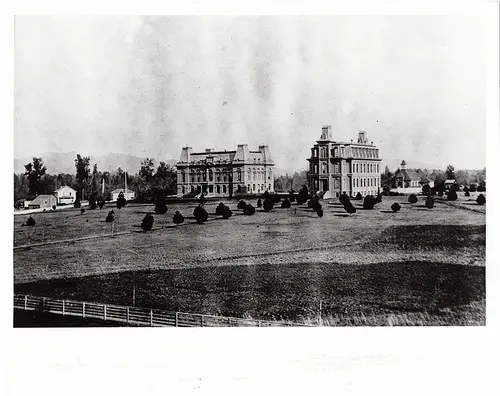
In the university’s early years it was becoming clear that Deady Hall and Villard Hall were not enough alone to house the expanding university, so what was Oregon’s solution? Buy the house of one of the school’s professors nearby and convert it into a library, and transform its barn and garage into classrooms and an observatory to replace the unusable observatory on top of Skinner’s Butte. This bold move thought at first to be a quick temporary fix, completed in 1890, resulted in Collier House and Barn Hall. While Barn Hall was razed long ago to make room for more permanent structures, Collier House remains a useful building for the university now into its third century, currently housing offices for the music department across from the EMU.

Other times initial failures have been re-envisioned years later, such as the Moshofsky Center. Built in 1998, “the Mo” was the first indoor practice facility in the Pac-10, a landmark building providing indoor facilities for football, track, softball, acrobatics and tumbling, and other sports needing an opportunity to get out of the rain. The Mo has clearly been a vital cog in the progression of Oregon football success to becoming one of the top programs in the nation.

The Balloon Field House. (©UO Special Collections)


But while the Mo was indeed the first indoor practice facility in the Pac-10, it wasn’t in the Pac-8. Indeed, Oregon had attempted an indoor structure three decades prior. In 1968 Oregon football was in its second year under coach Jerry Frei, with Autzen Stadium barely a year old. Coach Frei wanted a way to work out of the rain, and lobbied for any means to do so. The result was the Balloon Field House, a pneumatic structure (think of a giant balloon or inflatable geodesic dome) on campus that in theory provided room to practice inside. The Field House though was fraught with problems, leaks, and other issues making it largely unusable, leading to its sale and removal in 1971.

The University of Oregon has also had a long-standing, if albeit unofficial, policy of recycling structures whenever possible. Buildings once designed for one purpose have over time evolved and been remodeled to incorporate the foundations for newer structures. Much of the Lillis Business Complex is comprised of the previously separate structures Gilbert Hall, Peterson Hall, and Commonwealth Hall. Esslinger Hall, home of the physical education school (which partially burned down in the 1970s) next to McArthur Court, now incorporates Leighton Pool and the Student Rec Center. 

A portion of the original Architecture Building (1914) and Mechanical Hall (1901) now comprise portions of Lawrence Hall. Emerald Hall was transported from Corvallis to the UO campus after World War II and utilized until its demolition in 1987 to make room for Willamette Hall. The examples of structures for other purposes as the campus has evolved goes on and on.

Space is the primary issue today facing Oregon, with one highly desired athletic facility yet to see fruition–an indoor track facility. It seems odd that Tracktown USA would be lacking in track facilities, but such is the case. Whether or not funds could be raised to build a state-of-the-art indoor track is not in doubt, but where to put it is definitely a problem.

The possible solution exists in demolishing historic McArthur Court and Howe Field, but then where to put a new softball field? Well, there is a teeny tiny sliver of the original Autzen Stadium parking lot that could provide the solution for a new softball field, but the outcry over the destruction of two historic campus landmarks and the total loss of tailgating for fall Saturdays may be too much to overcome the necessity of an indoor track.

While construction crews working both on campus and across the river at the Autzen complex have become such a familiar site in recent years it could be said that the work crews have spent more time in classrooms than students, the roots of this construction boom can be traced back to 1984. It was that year that Bill Byrne was hired as the athletic director for the University of Oregon, from that point Byrne and then Oregon head football coach Rich Brooks worked together to forever alter the landscape of the university and community.

For as much resistance and calls for Brooks’ head existed until his departure to the NFL after the 1994 season, not nearly enough credit in hindsight is given to Byrne and Brooks in establishing Oregon’s march to facility-victory. The field at Autzen Stadium was branded as Rich Brooks Field in 1995, but it is Brooks’ and Byrne’s efforts off the field rather than on-field performance that really deserves honors.

The first step in the Byrne-Brooks masterplan was simple, raise funds. Byrne got to work fast, generating $19 million in a 1985 campaign. Bill Byrne was named the National Fundraiser of the Year by the NAFA for his efforts, while the “Quack Attack” ad campaigns began getting national press for its efforts to brand the university beyond its traditional regional reach.

Plans to make Autzen a dome came closer than people think. (Register Guard)


So what were the funds intended for? A radical change to match their outside-the-box thinking to make Oregon stand out–turn the nearly twenty-year old Autzen Stadium into a dome. The added bonus of making Autzen into a dome was to make the football facility double as a replacement basketball arena for the aging McArthur Court, hanging a curtain from the roof dividing the field to set up a court in an endzone, similar to how the Alamo Dome was utilized for the San Antonio Spurs.

While plans for the Autzen dome fell through, the funding went to good use on plan B, the construction of the sky suites on the Autzen Stadium north side. Through the funds generated from the sale of suites and other fundraising over the next three years, this set the path towards the construction of the Casanova Center beginning in 1989.

For further funding Oregon spearheaded a statewide campaign, utilizing lottery funds in a new program called “Sports Action,” receiving much controversy over the association of gambling and sports tied in with academic institutions. While it had its critics, it served its purposes, raising much needed funds for Oregon and other schools, but it also had its negative side…the NCAA to have NCAA Tournament basketball regional rounds take place in the state until Sports Action was halted, something much desired by Nike and the city of Portland after construction of the Rose Garden–home of the Portland Trailblazers.

The Cas Center brought stability to the entire athletic program, and marked the first identifiable watermark step forward in transforming Oregon from little-known also-ran into perennial contender. While it took several years to complete the Casanova Center, with multiple upgrades made to the building such as new locker rooms, expanded offices, and a treatment center; the Casanova Center stands as the monument to the new University of Oregon.
The Autzen Stadium complex now has everything, except maybe room for parking.


Prior to the Cas Center there had been a culture of repair and maintain, such as Hayward Field’s multiple restorations in the 1920s, 1950s, 1970s, and 1980s, now after the Casanova Center the age of modernism and a cavalier spare-no-expense attitude permeates. What was once nothing but parking lot surrounding Autzen Stadium has now become a massive all-encompassing athletic complex. The Moshofsky Center, PK Park (home of the revived Oregon baseball program), Pape’ Field (lacrosse, soccer), the HD complex, practice fields, treatment centers. The area around Autzen now has everything a collegiate athletic program could ever ask for…except maybe room for fans to park.

Across the river, Campus too is now glitz and glitter. The Jaqua Center stands as the premier student-athlete academic center, in stark contrast to the cramped dank offices in the basement of McArthur Court that previously held those offices. The Knight Law Center across the street from Hayward Field sparkles, the journalism program has a completely remodeled Allen Hall, and Hayward Field with its new Powell Plaza and upgrades looks nothing like a 94-year old facility should. Everything, even the old buildings, have bright new polish, a shiny exterior of a bustling futuristic university of the 21st century.

 This is the fruition of the University of Oregon in the new era, and has brought with it new ideas of how students have the opportunity to attend college-the state of Oregon now leading efforts to alter how students afford a college education. While new buildings go up, old ones are utilized for new purposes. Some see a new life, while innovative ideas are presented to address campus needs. Some of these come to fruition, such as the HD complex, while others like the Duck Dome or cemetery ewok village remain rarely mentioned distant memories.

Just one part of the ever-evolving University of Oregon identity.

Thursday, January 23, 2014

A look back at Oregon’s facilities: the secret to UO’s success?

A look back at Oregon’s facilities: the secret to UO’s success? 
 
Originally posted on FishDuck.com on January 11th, 2012 
 
Ask anybody in the country today their impression of University of Oregon athletics, and three words will immediately be uttered: uniforms, Nike, facilities.  Oregon’s facilities now are the envy of the country, even many pro teams don’t have the plush amenities that Oregon athletes appreciate today.  It didn’t happen overnight though, and over the years of the University of Oregon’s rich history many facilities outgrew their use, many being retired, many others being used long past their usefulness out of necessity.

Villard Hall and Deady Hall stick out in the pastoral lands of the University of Oregon campus circa 1901 

With all the talk about facilities, let’s take a look at the history of the venues that have housed the athletes of Oregon past and present, and all it has taken to rebuild the University of Oregon campus from humble old place of learning to athletic jewel of the west.

1873 construction of Deady Hall began, the start of the University of Oregon.  Four years later a baseball game was held between UO and Monmouth College.  In the first inning Monmouth scored 17 runs, an inauspicious start for the Webfoots, marking the beginning of many more days of sorrow, and some of great triumph and glory, to follow over the course of the next 145 years to present day.

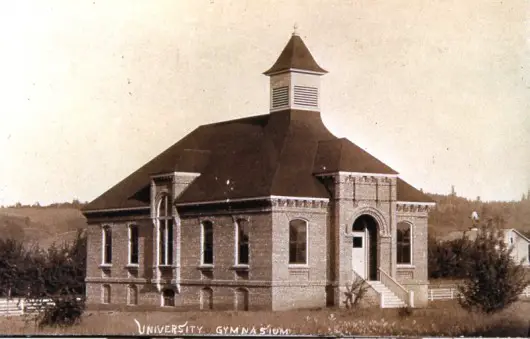
Initially the third floor of Deady Hall was reserved as a men’s gymnasium, but the construction of a gym in 1881 replaced the need for this space.  In 1890 a larger gymnasium was constructed, housing men’s athletics (all male students were required to exercise twice a week).  By 1909 a new gymnasium was built to house men’s athletic, while the 1890 gym became the women’s gym.  It burned down in 1922.

Oregon's first football game was played against Albany College in 1893, a 44-2 Oregon victory 

Organized athletics were still in its infancy at the time, while back east collegiate football had been played for some time, in the west collegiate athletics barely registered.  The first Oregon football game took place in on March 24th, 1893, in an open field in the shadows of Deady Hall, where Oregon (coached by Cal Young) defeated Albany College 44-2.

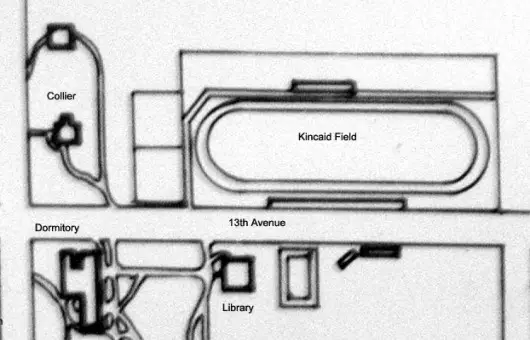
Around this same time a running track was built at the corner of 13th and A Street (now Kincaid Street), as indicated on this campus map from 1894.


1894 campus map. Things have changed quite a bit in the past 118 years…
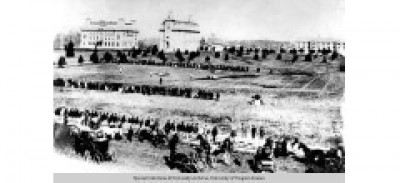
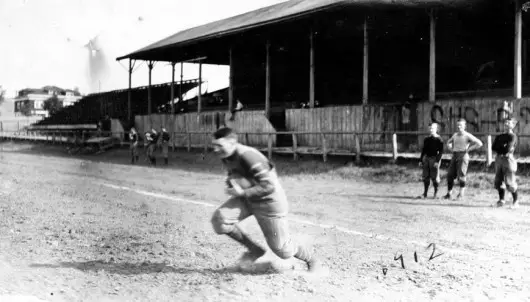
This track would become the site of the first official Oregon athletic facility, Kincaid Field.  Bleachers were constructed in 1902, with the university acquiring the property along 13thavenue for an all-purpose venue to hold the Webfoots football and track&field events.  Students helped construct the bleachers that would hold the crowds that cheered on Oregon’s highly successful football program in those early days led by coaching legend Hugo Bezdek.  With more sports being added (women’s tennis became Oregon’s first female sport in 1909) and collegiate sports gaining in popularity, the need for more buildings to house Oregon’s athletics was apparent.  To facilitate larger crowds for big events, often football games were held in Portland at Multnomah Field for matchups that were expected to far exceed what the stands at Kincaid Field could hold.

Kincaid Field, the original home of the Oregon football team
The pinnacle of these early days came in 1916, the Webfoots football team finished with a 6-0-1 record and represented the Pacific Coast Conference in the 1917 East-West Tournament Game, later known as the Rose Bowl.  Oregon defeated Penn in the 1917 East-West Tournament Game 14-0, putting Oregon on the map as a powerhouse in collegiate athletics on the west
coast.  With Hugo Bezdek as coach of the Oregon football, baseball, and basketball teams and the school’s first athletic director, the Webfoots were formidable.


A plaque now marks the site of Kincaid Field
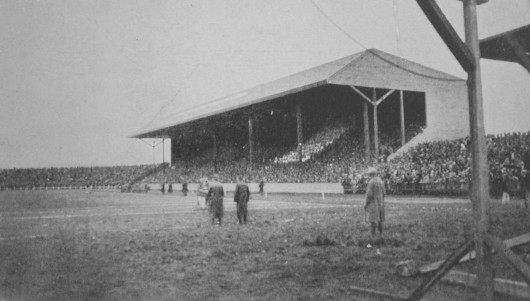
With the success of the Bezdek era came increased crowds, and it became clear that Kincaid Field could no longer keep up with demand, construction began on a larger facility to house Oregon’s football and track programs, Hayward Field.  Built in 1919, its inaugural season saw Oregon’s football team continue its dominance, once again representing the PCC in the 1920 East-West Tournament Game.

The new facility was named Hayward Field to honor the track coach and trainer Bill Hayward (Oregon track coach 1903-1947) during a ceremony on November 15th, 1919 during the game against bitter rival Oregon Agricultural College (now Oregon State).  The Webfoots won the game 9-0, but the ceremony honoring the longtime coach Hayward with the name of the facility was noticeably absent one person, Bill Hayward.  Nobody had bothered to inform him in advance of the ceremony taking place, and he was back in the locker room providing treatment for the football team at the time.  Coach Hayward did not discover that the new stadium had been named after him until he read about it in the newspaper the following morning.

Hayward Field replaced Kincaid Field in 1919 for football, and added a track in 1921
In 1921 a six-lane cinder track was added surrounding the football field to allow for track events, marking the end of Kincaid Field’s usefulness.  With Hayward Field now capable of holding football and track&field events, Kincaid Field was closed in 1922.  A plaque near the northwest corner of the Museum of Art commemorates the athletes who competed at the site where Kincaid Field once stood.
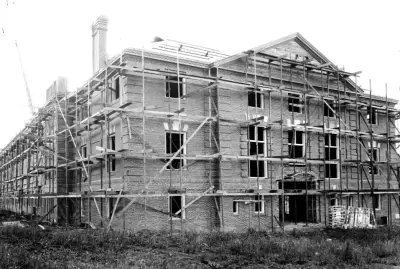
Gerlinger Hall, site of women's athletics for many years, here seen under construction in 1919
While construction of Hayward Field was taking place, nearby another building was also taking shape, Gerlinger Hall.  Built 1919-1921, it replaced the “old gym” as it was known as a new place to house women’s athletics.  The timing turned out to be rather apt, as the old gym burned down in 1922.

The gymnasium, built in 1890, housed many of Oregon's athletics, before a new gym was built in 1909 and this became the women's gym. It burned down in 1922. 

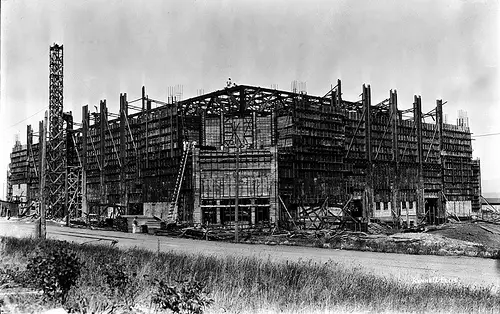
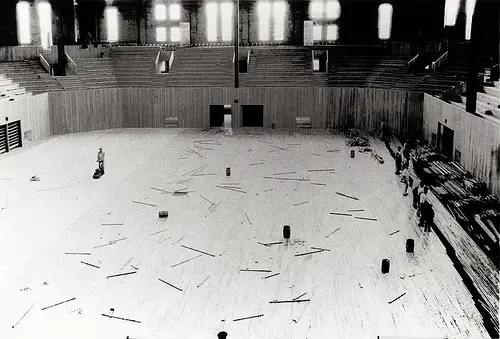
While football and track enjoyed the cozy confines of their new facility, basketball was facing an arena issue of its own, its popularity far exceeding the space available in the men’s gymnasium.  Starting in 1926, construction of a new facility to house basketball and other athletics began, McArthur Court.

Construction of McArthur Court began in 1926 

McArthur Court was a grand multi-purpose facility, named after Clifton McArthur, prominent UO athlete and first student-body president who later became Congressman McArthur.  By 1927 the new building was complete and ready for its debut, a 38-10 victory over Willamette University on January 14th, 1927. 

The new arena featured a capacity in excess of 6,000 (later expanded to seat over 9,000) and athletic offices in the lower level, it was a huge step forward in athletic facilities at the time for the university, though its construction cost was sizable.  To fund the construction a $15 fee was added by the Associated Students of the University of Oregon, once finally paid off students held an extravagant “mortgage papers burning” ceremony to mark the end of the imposed arena fees.


Installation of McArthur Court's wood floor is underway in 1926 

In 1937 repairs were made to the roof.  Other improvements followed in the 40s and 50s, including the addition of the familiar exterior steel support structures above the roof.  Mac Court, or “The Igloo” as it was originally nicknamed later to be known as “The Pit,” proved valuable well past its expiration date.  Only recently replaced by the construction of the Matt Knight Arena, it was the centerpiece of Oregon athletics for almost 85 years, becoming the second oldest collegiate basketball arena in the nation behind only Fordham University’s Rose Hill Gym.

McArthur Court, named after the first student body president Clifton McArthur 

For decades minor projects continued, improvements here and there, some older buildings demolished for new structures, but the athletic arenas remained relatively intact.  Hayward Field hosted football and track&field, Mac Court had basketball, Gerlinger Hall housed women’s athletics.
 
But by the late 1950s, it was obvious that football had outgrown Hayward Field and a new stadium would need to be built, even with Oregon playing typically only three games a year on campus at Hayward.  In 1959 the university purchased 90 acres of land on the north side of the Willamette River.  By 1966 construction was underway for a new stadium, the new mecca of Oregon football, Autzen Stadium.  Completed in 1967 just days before the first game slated for September 23rd, 1967, the design instituting an artificial crater with the removed dirt forming the slopes that the grandstands were built upon.


Oregon lost the first game held at Autzen Stadium 17-13 vs Colorado in 1967 

John Harrington was Oregon’s starting quarterback for that first game, a close 17-13 loss to Colorado.  Years later John’s son Joey Harrington would become arguably the most iconic student-athlete in the history of the program through repeated triumphs in the stadium his father helped open.  Autzen featured a grass surface in its first two years of existence, but with the wet climate it was determined it would be far easier and cheaper to replace it with artificial turf.

Finances were a big issue, stark contrast to today’s athletic program.  The university in the 1970s and 1980s was strapped for cash, and Autzen Stadium proved to be a financial boon for the program, acting as a host for many summer concerts that would help fund the athletics in the fall.  Often it was the student-athletes directing traffic in the parking lot or acting as security at events while artists such as the Grateful Dead and Bob Dylan would rock Autzen.
 
Meanwhile with football now vacated from Hayward Field, it became a full-time track & field facility.  The track was expanded to 8-lanes, and altered to an all-weather rubber surface.  With these improvements and the track program flourishing under legendary coach Bill Bowerman and buzz emerging from a brash young runner named Steve Prefontaine, it was decided that Hayward should host the Olympic Trials in 1972.  Hayward Field would again host the Olympic Trials in 1976 and 1980, and following an expansion/renovation in 2004 the trials returned to the holy ground of track & field in the city commonly referred to as Tracktown U.S.A.  In 2012 Hayward Field will once again be the site where athletes make their first step towards Olympic glory with the trials, scheduled to take place at venerable Hayward Field June 22nd – July 1st.
 
Women’s basketball made its debut inside Mac Court in 1974, but facing harsh budget cuts Oregon’s successful baseball program had to be cut in 1980.  Football was also on life support, dealing with NCAA sanctions for rules violations and the sub-par facilities of the woefully small weight room behind the east endzone bleachers as part of the Barker Stadium Club expansion in 1981, and the locker rooms under the west endzone consisting of little more than three hooks and wood planks for each player.  It was clear that fundraising efforts would be needed to put Oregon in a position to be competitive with the rest of the conference.  So bad was Oregon’s football team in the 1970s, that there was talk of kicking them out of the Pacific Conference.

It was then that Oregon Athletic Director Bill Byrne developed a novel concept, to make money it was necessary to spend money.  Funding was raised for several projects to improve facilities that could then in turn fund further construction, beginning the cycle of modern Oregon athletics as we know it.  Better facilities would mean better recruiting, get better athletes to come to Oregon and the improved athletic play would lead to larger crowds, resulting in increased revenue.
 
It began with the sky-suite complex along the north rim of Autzen Stadium in 1988, moving the press box to the south side under the roof providing space for luxury suites that would serve as the prime financial support for future facilities.  Costing $2.3 million to build along with a million dollar press box on the opposite side, it was the first step towards transforming Oregon athletics from the antiquated humble cash-strapped program into the national powerhouse Oregon athletics have become.
 
The revenue earned through the leasing of the sky suites helped to fund the epicenter of Oregon athletics, the Casanova Center.  Located outside of Autzen Stadium, it was built to house all the athletic offices, replacing the overcrowded space beneath Mac Court.  Named after legendary coach and athletic director Len Casanova, it was expected to cost over nine million for its construction as part of a 14 million in total planned package to improve Oregon’s athletic facilities, paid for through state bonds and fundraising efforts, but costs inflated to over twelve million before its official dedication on September 27th, 1991. 

The new home to Oregon’s locker rooms, weight rooms, coaching offices and meeting areas, it didn’t come without controversy, as many in the community balked at the aesthetic additions to the grounds, such as sculptures that cost thousands deemed unnecessary by many.

Coinciding with the unveiling of the Cas Center, Autzen’s carpet also got an upgrade, removing the old Astroturf for a new Omniturf, designed to lessen the impact and turf-burns commonplace of the era from the hard artificial surfaces.  The concerted efforts to upgrade Oregon’s facilities coincided with improved on-field play, as Oregon fans reveled in Oregon’s first trip to a bowl game in 27 years when the Ducks won the 1989 Independence Bowl in Shreveport, LA.  This was followed the next year with an appearance in the 1990 Freedom Bowl, and it seemed like the program had turned the tide of the ugly days of consistent losing for decades.

Oregon’s athletic programs now had the means with which to compete on an even plane, and compete they did.  Oregon went from perennial cellar dweller to one of the most prominent programs on the west coast, and Autzen and Mac Court gained reputations as two of the loudest and most hostile environments for an opposing team to enter.

But costs were mounting, and facing budget cuts a controversial solution was proposed to offset expenses.  Oregon Sports Action began in 1991, legalized gambling on professional sports as a means to fund public university athletic programs.  While hindered with legal hassles from the get-go, Sports Action did provide much needed funding to the Oregon athletic program.
 
 
The watershed moment of this renaissance came in 1994, when the football team, picked to finish 9th in the conference that year, won the Pac-10 conference and was invited to play in the 1995 Rose Bowl, the school’s first appearance in the prestigious game since 1958.  The Ducks would lose to Penn State in the Rose Bowl, but the enthusiasm for Oregon sports created in the wake of that run to glory was undeniable.  Donations to the program flooded in, season ticket sales soared, suddenly there was nothing cooler than being an Oregon Duck.

Following an impressive 10-win season the next year that ended in bowl disappointment once more, a conversation between head football coach Mike Bellotti and prominent alum and Nike CEO Phil Knight would spark a movement lifting Oregon from being simply on par with their competition to pulling away from the pack with state-of-the-art facilities the envy of the world.  Following Oregon’s embarrassing loss to Colorado in the 1996 Cotton Bowl, Knight asked Bellotti what was needed for Oregon to remain competitive.  Bellotti responded that they needed an indoor practice facility.
 
Three years later, Bellotti had his indoor practice facility, and the rest of the conference began taking notice.  The Moshofsky Center opened in August of 1998 just in time for football season, sporting a complete artificial turf football field, a 4-lane running track, climate control, medical facilities, and batting cages.  Not only did it service student-athletes, but on gamedays “The Mo” as it is known became a hotspot for fans as well, providing space for food vendors and other gameday events catering to the fans, it has come to be called the world’s largest indoor tailgate party.  Inside the stadium fans were treated to something that had long been desired at Autzen Stadium, a video replay screen.

New turf was also installed in Autzen Stadium, and with the program now financially stable there was no longer a need to hold concerts or other events inside Autzen to balance the budget, Autzen would be the house of Oregon football and nothing more going forward.  The final concert held at Autzen was in 1997, featuring U2 and Rage Against the Machine.  A Rolling Stones concert had been discussed a few months later, but the university declined, angering many in the community when news of the refusal became public.

Outside the Moshofsky Center, sections of the Autzen parking lot were converted to football practice fields, soccer and lacrosse fields. The construction of the Moshofsky Center and the surrounding facilities did help improve Oregon compete with the top echelon of athletic programs across the nation, but it was not without its outspoken critics.  An outcry over the excess of spending on athletics while education programs were being ignored or outright cut at the university fell on largely deaf ears, and an arms race began that continues to this day.  Oregon builds a new facility, competing schools counter with an indoor practice facility or stadium improvement of their own.

The relationship between Nike and Oregon has blossomed in the time since that post-Cotton Bowl conversation between Knight and Bellotti, starting with a focused marketing effort on branding Oregon.  It worked. 

Over time the attempts to market the University of Oregon athletic program have increased in flash and innovation, from new uniforms to promotional campaigns.  Through Nike’s efforts working with the University of Oregon, the Ducks have gone from the laughing stock of the west to the most innovative futuristic program in the country, everyone knows about the Ducks, everyone wants to be like the Ducks.  If imitation is the greatest form of flattery, then the U of O is clearly the cool kid everyone is trying to follow, and with it the Ducks have gained not only a financial foothold to support the various sports but can recruit top-notch athletes on a national level.

Additional upgrades continue to be made.  In 2002 Autzen Stadium was renovated, expanding seating to 54,000 and further improving amenities available within the stadium.  So too were Oregon’s football locker rooms inside the Casanova Center, as well as improved treatment facilities and weight rooms.
 
 
The Jaqua Academic Center provides the best academic support structure for student-athletes in the country, and renovations to Hayward Field will permit the grand old mecca of track & field to continue to host national competitions.  The construction of PK Park east of Autzen Stadium signaled the return of the baseball program to Oregon athletics.  Further construction of the Casanova Center is currently underway, adding additional meeting rooms and state-of-the-art technology components to further prepare Oregon athletes for their competition.
 
Last year the newest upgrade was completed, with the opening of the Matthew Knight Arena.  Several years in the making with multiple mis-steps and hitches before its final completion, the arena replaces the beloved but well-past-retirement McArthur Court as the new home for Oregon’s indoor athletics.  It already in its short lifespan has hosted multiple concerts, a tennis tournament, and was highlighted by the Oregon men’s basketball team CBI Tournament Championship.
 
Once the scrappy but underfunded little guy, Oregon now is the big dog.  A program once hopeful to win a few games each year, the Ducks now have transformed over time into the home of innovation, new technology, the athletic elite.  So is it the facilities or the athletes that have led to Oregon’s vault into national prominence?  Perhaps both, the success on the field of athletic competition is determined through the effort given by the person behind the uniform, but by providing elite level facilities and great coaching (a hallmark of Oregon for over a hundred years as a coaching factory and stability in the various sports) it affords the modern Oregon student-athletes the tools needed to give their absolute best effort.
 
(all photos used courtesy of the Knight Library and UO special collections archive)