Miracle in the Desert: Oregon beats ASU in double overtime (2000)
Originally posted on FishDuck.com on October 12th, 2011
It was one of those days where by the end the masses can do little more than shrug and lament, “what else could possibly happen?” A game where the improbable and unfathomable becomes commonplace, where those who walked out early would regret it for a lifetime. A game that would be talked about for years to come, and for those who witnessed it or were lucky enough to play in it would wear their participation as a badge of honor.
The bizarre, the unlikely, the confusing and the downright wacky; one day in 2000 an unassuming game between Oregon and Arizona State exhibited everything imaginable that can take place on a football field. Through multiple fluke plays, odd decisions, a little luck, and an undying spirit, somehow Oregon would find a way to win in a game that has come to be known as “The Miracle in the Desert.”
On a personal level, it was one of the few games I was able to attend during the 2000 season, sitting in the endzone with a friend from Phoenix, an ASU fan. We had hoped for a good game to cheer on our collective teams, instead what we witnessed would become the stuff of legend, a story we would re-tell often for years to come, one that regardless of the victor we were thankful to have been able to witness it.
The big game on the slate October 28, 2000 was the matchup between #1 Nebraska and #3 Oklahoma, but by the end of the day the upset of the top-ranked team would take a backseat to the improbable events that occurred in Tempe, AZ.
There was much talk about the up-and-coming 6-1 Oregon Ducks, ranked #7 in the country, tying the highest ranking in school history (1964), taking on the 5-2 Arizona State Sun Devils. Media and fans were still abuzz about Oregon’s victory the previous week at home vs. Arizona, as much for the hard-fought 14-10 win as for the huge hit made by Oregon linebacker Wesly Mallard that shattered the jaw of Arizona cornerback Michael Jolivette.
Arizona State was still trying to find a proper replacement at runningback for superstar J.R. Redmond, who was in his first season in the NFL, but still featured a lethal starting lineup of multiple future NFL players like Todd Heap, Levi Jones, Shaun McDonald, Terrell Suggs, and the leading tackler in the Pac-10, linebacker Adam Archuleta. The Sun Devils were led by a former Duck, Head Coach Bruce Snyder, who always seemed to give his former team fits any time they played.
“My freshman year they blew us out, 52-31” Jason Nikolao remembers, a senior starting defensive tackle in 2000, now retired from football living in Tennessee. “Next year we beat them badly, my junior year we beat them on a last-minute touchdown, but ASU always seemed to play us so tough. They always wanted to run us into the ground.”
Oregon was confident coming into the game, boasting the 10th ranked defense in the country, #1 in nearly every defensive category across the board in the Pac-10 conference. Add to it that Arizona State was starting a walk-on runningback, a pool man from the Phoenix area named Tom Pace, and the Ducks felt they could shut down ASU’s run game and force them to be one-dimensional. The events that transpired would drastically contrast Oregon’s expectations, yet somehow through intense adversity the Ducks would find a way to persevere.
Just arriving proved difficult, as thunderstorms the night before the game in Phoenix delayed Oregon’s charter flight.
“We were stuck on the runway for two hours, we watched an entire movie while just sitting there waiting to takeoff, then we deboarded and hung out in the terminal for a while until the weather cleared,” said Jason Willis, a redshirt sophomore safety-turned-wide receiver for Oregon, who was getting his first career start in the game vs. ASU due to a hip injury to Keenan Howry. “It was a long day, we had school and meetings and then on the plane, we didn’t end up leaving Eugene until almost 10pm. When we touched down in Phoenix it was well after midnight, Coach (Mike Bellotti) said all meetings were canceled and to get some sleep, since it was a day game (12:30 kickoff) the next day we had to be up by 7:30 so it was straight to bed for essentially a power nap.”
For a team that emphasized routine down to the tiniest detail doing everything the same way for game preparation every week, the delayed flight wreaked havoc.
“We weren’t able to go through the normal routine, missed our morning meetings,” Nikolao recalls. “It absolutely had an effect on the way the team played early on. When you’re used to doing things a certain way, keeping things routine, we had it timed down to a T from two days out leading up to kickoff. Meetings at this time, meals at this time, sleep at this time, it was clockwork. But when the flight was delayed suddenly our game prep was completely different.”
“You could tell everybody wasn’t there,” said Willis. “The flight took our whole flow out, our chemistry was off, everybody was so out of it. It showed, it was a factor, we were just out of it mentally early on. It was hot that day too, so (Wide Receivers) Coach (Chris) Peterson—now head coach at Boise State—had us shorten up our pregame stuff to save energy. The defense got fatigued, on offense we had a lot of mental breakdowns, we could never get going, especially early.”
The crowd packed into Sun Devil Stadium seeking any respite from the heat bearing down in the valley of the sun. The heat and sunshine would cause problems for the players all day, the combination of lost sleep, added fatigue, and bright sunlight making life difficult for receivers to keep track of the ball.
Oregon misfired early, picking up a few yards but it was clear things were out of sync for the Ducks.
“It was my first time starting, replacing Keenan (Howry),” said Jason Willis. “Joey had such a strong connection with Keenan, it took some time for him to adjust to Marshaun (Tucker) and I being the starters out there instead of his usual receivers.”
“The previous week I was blocking and took a knee to the hip,” said Keenan Howry. “I had a bad hip pointer, I didn’t practice all week, so with Jason having a good week of practice they decided to start him. I didn’t play the whole first quarter, they gave me a shot to numb it up and eventually we decided I’d give it a go. I was able to play with only a slight hitch in my giddy-up.”
Things would turn worse in the opening minutes of the game, as Jason Nikolao would suffer a MCL sprain, removing one of the team’s key senior leaders from the lineup for the rest of the day.
“It was a freak thing how I got hurt, after the play the offensive lineman threw a guy on my knee. I felt a pop, heard a pop, knew it was bad,” Nikolao recalls. “I tried to lie my way back onto the field, but it didn’t work. It was tough to spend all week preparing to play and then only get one series and have to sit out the rest of the game. Just sitting there knowing I couldn’t play, my heart was broken. Tears were streaming down, the fans were laughing at me letting me have it. I went in before halftime and changed clothes and for the rest of the day I was the biggest cheerleader out there. All I could do was encourage the guys, and for a game like that to occur where I couldn’t contribute, it really bothered me, I was so frustrated. The way ASU was playing I kept thinking ‘if only I could be out there maybe I could have made that play,’ seeing how tired they were it killed me not being able to contribute. Sometimes injuries happen, freak stuff. But it can eat at you, destroy you emotionally, it’s such a rollercoaster ride being forced to watch your team struggle knowing you should be playing.”
If being unable to participate is mentally and emotionally draining, to have to stand by watching one of the most epic struggles in Oregon history occur while being unable to participate would be beyond measure. Nikolao’s replacement along the line was Zach Freiter, a blue collar beast who immediately made his presence felt, sacking ASU quarterback Jeff Krohn on his second snap on the field.
With the Oregon offense struggling, Arizona State would strike first. On 3rd & 16 Jeff Krohn rolled right under duress, dumping the pass off to runningback Tom Pace who found himself in the open field and sprinted for a 70-yard touchdown.
The stunned Oregon defense couldn’t believe they gave up a touchdown like that, and to a walk-on. The defense knew very little about Tom Pace aside from him being an undersized walk-on, but the Ducks were in for a big surprise, as were the ASU fan base who also knew little of Pace prior to the game, as questions of “who was that? Tom who? Who is Tom Pace?” echoed throughout the stands following the big play.
“I was a walk-on too, so I know the mentality,” said Jason Willis of the trouble Oregon had in stopping the diminutive walk-on unknown runningback for ASU, Tom Pace. “Walk-ons and undrafted free agents in the pros will always be the hardest workers on a team, because they have to do so much more to prove themselves. Tom Pace may have been a walk-on, but just would not go down, the defensive guys said he was slippery. Pace had a lot of long runs that day, there really weren’t a lot of long drives by either team, just one big play after another.”
Oregon responded, finally finding some rhythm behind the hard-running of tailback Maurice Morris, who capped a drive with a 17-yard touchdown run. The score/immediate response back-and-forth action would become the theme for the day.
Arizona State put together a long drive that ended with a 28 yard touchdown pass to Donny O’Neal, to retake the lead 14-7. Two very good defenses seemed to be no-shows, having little response for the two offenses. While Oregon had started slow, there was a feeling in the air that it could quickly turn into a shootout.
Team leader Joey Harrington, in his second year as starter, was more vocal than usual roaming the sidelines, perhaps sensing the fatigue in the team due to the heat, late arrival, and shock of ASU’s ability to move the ball on the ground with a no-name walk-on.
“Joey sat us all down and said ‘let’s do this one play at a time, I know it’s hot and we’re tired,’” Jason Willis remembers. “Once we started going we knew it was going to be a shootout, we just had to re-focus.”
Yet Harrington seemed to be the one struggling most of all the Oregon players. After one quarter, Harrington was 4/11 for 40 yards, while for ASU Jeff Krohn had already thrown for 178 yards and two TDs.
Into the 2nd quarter Oregon still wasn’t in sync, but ASU was starting to gouge the Duck defense. With Oregon pinned back on the 1 yard line, ASU linebacker Adam Archuleta blitzed and hit Joey Harrington in the endzone causing a fumble recovered by ASU for a touchdown. It appeared that Harrington’s arm was clearly going forward which should have been ruled an incomplete pass, but this was before the day of instant replay so the bad call stood, ASU now led 21-7 with Oregon appearing to be going nowhere.
ASU forced a punt and got the ball back and were driving for yet another score, but a fumbled handoff the result of Krohn’s foot being stepped on by a lineman gave Oregon a slight respite.
With time ticking down to halftime, Oregon’s passing game finally came alive. On a 2nd and 13 from the 26 yard line Harrington fired his first accurate downfield pass of the day, finding Keenan Howry for a touchdown. It was questioned how much Howry could play if at all due to the hip injury, and if it would affect his ability to contribute, but with the Ducks struggling Howry knew he had to fight through the pain to help out the team.
“It was still painful for me to move, but after they numbed it up I was able to go out there and move and run, with just a little limp,” said Howry. “I was still able to give it my all.”
Feeding off the energy of the offense finally starting to click, the Oregon defense started showing signs of life as well. Oregon linebacker Matt Smith was able to eventually sack the elusive Jeff Krohn forcing a punt, and Oregon would quickly capitalize.
For as bad as Joey Harrington had looked in the first quarter, Harrington now appeared to have finally shrugged off the rust from the change in routine, firing passes downfield with lethal precision despite taking big hits after almost every throw. A 29-yard catch by Marshaun Tucker set up Oregon near the goal line with less than a minute before halftime, which was finished off by Tucker with a 5-yard touchdown catch.
ASU had dominated the total yardage, and Tom Pace was out-rushing the powerful Maurice Morris on the ground, but Harrington was getting into a groove, which spelled trouble for the Sun Devils. The Ducks had tied it up at 21-21 before the half, and Head Coach Mike Bellotti was proud of the way his team had battled back.
At the half each team had turned the ball over twice, resulting in 7 points each. Neither team had found much success on 3rd downs or sustaining drives, but the hard running of Tom Pace and the big play ability of Jeff Krohn clearly had the momentum on Arizona State’s side. In the 2nd half ASU continued where they left off, driving the field with huge gashing runs by Tom Pace and helped with an incredible one-handed catch by tight end Todd Heap.
Finding a crease, the pool man Tom Pace would again break off a big run, scoring on a 36-yarder to again give ASU the lead 28-21.
But Oregon would not give up. In spite of the pain, WR Keenan Howry gutted it out continuing to play, and mere seconds later Howry found a gap behind the coverage as Harrington lofted a perfect pass to him for a 66-yard touchdown, again tying the score, now 28-28.
The fatigue and injuries were both racking up, as ASU was exploiting the depleted Oregon defensive line attacking the spot vacated by Nikolao, while the Harrington to Howry combo was a direct response to a knee injury suffered by starting ASU cornerback Kenny Williams following the Marshaun Tucker touchdown in the first half. Even with the bad hip, Williams’ replacement was simply no match for the hobbled Howry.
“That was something Marshaun and I worked on all season,” Howry remembers. “We knew that nobody could guard us, and if teams did a double press on us we’d run a scissor and one of us would be open. Joey lofted a perfect pass and I just ran as fast as I could.”
But it wasn’t all good news for Oregon. They were matching ASU tit for tat, but the running game was almost non-existent, as Maurice Morris suffered bruised ribs that had him wheezing on the sidelines unable to play. Allan Amundson stepped into the role, but Oregon all but abandoned the run game. It didn’t matter much though, as Harrington after starting so bad was in a zone like teammates had never witnessed before. Harrington would stand in the pocket unafraid of the relentless pressure administered by Archuleta and Terrell Suggs, taking huge blow after blow and delivering the ball downfield with pinpoint precision.
The sun was making life difficult for receivers to see the ball, but with the way their leader was delivering it nobody wanted to let him down. On the sidelines, Harrington was as fiery as he had ever been seen, screaming like a mad man pushing his teammates demanding more effort, to keep fighting, to not give up.
In the 4th quarter ASU would continue the onslaught, as a blown coverage in the secondary with ASU pinned deep resulted in an easy 91-yard touchdown pass from Krohn to Richard Williams, giving ASU a two-touchdown lead. Oregon kept answering, but couldn’t keep going blow-for-blow unless the #1 ranked defense in the Pac-10 conference could muster some way to stop ASU.
Joey had no quit on this day. Knowing a response was needed to give the Oregon defense a chance to rest, Harrington led a methodical drive with accurate downfield passes to Keenan Howry and tight end LaCorey Collins to move the chains.
Oregon was in all-pass mode, and why not with the way Harrington was slinging the ball, but with Morris still hurt the Ducks caught ASU off-guard with a run by Allan Amundson that set up the Ducks near the goal line.
Harrington would quickly finish off the drive, once again finding Marshaun Tucker for a touchdown. It was Harrington’s fourth touchdown pass of the game, now well over 300 yards, he was in a zone, as if in a trance, that mindset where everything is working.
He had already earned the nickname “Captain Comeback” for his last-minute heroics, but on this day the unstoppable late game focus that led Harrington to last minute victories in the past had been with him since the 2nd quarter, nobody had seen Harrington play like this before consistently throughout an entire game.
“First and foremost it requires some luck, but luck breeds confidence,” said Joey Harrington, in an interview last year with Fishduck.com writer Brian Libby. “In games we would get a couple things and they would build on each other. I wouldn’t walk into that situation and automatically have that confidence, it was something that we had over time…we’d get a couple breaks along the way, which made us think, ‘You know what? We can do it!” You’re not worried about forcing the issue, or having to make the play, because you know it’s going to happen. I would be scared to death, but you’d never get me to admit it. Part of playing that role, part of being the quarterback, is convincing the ten other guys that you know what’s going on, even if you have no clue. If they don’t look at you and see complete confidence, they will doubt themselves, the only way to get anything done is for them to believe in you.”
Down a touchdown 42-35 with time now the enemy of the Oregon Ducks, Arizona State got the ball back and went right back to attacking Oregon running up the gut where Nikolao would have been. A minute after Oregon’s touchdown, ASU administered a back-breaker, a 60 yard touchdown run by freshman runningback Mike Williams to again make it a two touchdown deficit, 49-35. With six minutes left to play and the defense coming up with no answer to stop the ASU offense, the task seemed overwhelming. Yet Harrington would not cave, and more heroics were yet to come…
The Ducks would not go away quietly, and Harrington’s arm could not be stopped. Short passes kept the chains moving for Oregon’s response drive, but on 4th & 1 the Ducks took a chance, throwing deep to Marshaun Tucker who beat the cornerback playing close in run support, burning the defense for a 31-yard touchdown, Tucker’s third TD catch of the game, Harrington’s 5th touchdown pass on the day.
Still down a touchdown, Oregon’s defense needed to come up with a stop. Arizona State had effectively run the ball all game long, and all the Sun Devils now had to do was burn off the clock. Yet the Devils seemed unwilling to go the smart route, after the way the series between the two teams had been so bitterly fought the past few years they wanted to show their dominance over the highly-ranked Oregon Ducks. Over a thousand yards of total offense had been racked up between the two teams, ASU getting the better of it with over 600 yards tallied, and with under 3-minutes to go it seemed likely that they could exact their will upon the exhausted Oregon defense once again…but Bruce Snyder dialed up something different.
In an odd moment, on 2nd down Arizona State chose to pass, but the throw from Krohn was errant resulting in an incompletion, stopping the clock.
The crowd booed, ASU fans perplexed over the gift that had just been given to the Ducks. A chant of “Fiiiii-iiiire Snyyyyyy-ddderrr” started up in the ASU student section, and my friend and I laughed watching the ASU players turning around yelling at the students to shut up. The students had been randomly tossing tortillas in Snyder’s general direction for much of the 2nd half. One student threw a grapefruit that pegged Snyder in the back of the head.
On 3rd down, a Tom Pace run was stuffed. Just outside of field goal range, rather than punt to pin the Ducks deep Arizona State made an odd choice, choosing to throw deep, a pass that was tipped away by cornerback Steve Smith again preserving valuable seconds for Oregon.
“When ASU decided to pass when they could have run out the clock, we thought it was disrespectful,” said Jason Willis. “But at the same time the clock was our biggest enemy, so it was good for us. It was amazing to us that they would be that arrogant.”
“I couldn’t believe that ASU did that,” said Jason Nikolao. “ASU messed up bad, the guys were going crazy when they did that, we couldn’t believe their arrogance in trying to pass in that situation, we took it personal that they would do that. They had the game won, all they had to do was sit on it. Some of the decisions they made down the stretch we thought were disrespectful, they could have run out the clock and won the game but instead they tried to still move the ball. But we also thought any time you want to disrespect us again that’s fine, you’ll make a mistake and we’ll capitalize.”
Harrington and company would immediately make ASU pay for their mistake. On 2nd down after the change of possession Harrington would find tight end Justin Peelle. Splitting the safeties, Peelle made a great catch looking back at the sun and rumbled down the field for a 59-yard gain all the way to the 9-yard line.
“That was a great catch by Justin, for much of the quarter we could only throw to the sidelines where the sun wasn’t a factor, it was blinding us, we couldn’t see the ball coming towards us,” Jason Willis remembers.
Set up within scoring range to send the game to overtime, the crowd was going nuts. Sitting in the endzone where Oregon was driving with the teams right in front of us, my friend was practically punching me repeatedly out of anxiety and frustration wondering how it was possible that ASU hadn’t closed this game out already. I had no response, I was as stunned as he was, as was everyone else inside the stadium or watching on television.
An Allan Amundson run moved the ball to the 4 yard line, but a momentary lapse of composure resulted in a false start penalty pushing Oregon back to the 9. An incomplete pass set up 3rd down. With a little over a minute left, Harrington fired a laser to Justin Peelle, hitting him in the chest as he fell to the ground in the endzone for the apparent game-tying touchdown, but Peelle couldn’t hang onto the rocket ball, letting it hit the ground.
Oregon was down to its last chance. The game rested on one more play. My friend and I stood silently, too overcome with anxiety to speak or cheer, we could only watch, our hearts beating out of our chests. I couldn’t imagine the pressure that the players must have been feeling, one play would make or break the entire season for either team.
“We drove the length of the field with whatever it was, a minute and a half or two minutes left,” said Harrington. “I threw Justin (Peelle) a little stick route from the 6-yard line going in. I was expecting to get single coverage on the backside receiver, but they played a cover-two, which dictated that I go to Justin. He ran a great route and got open and I put the ball there. But as he turned, the linebacker clipped his back heel, and Justin stumbled just enough where he didn’t have enough power to get to the goal line. The safety met him at the one. We were walking off the field and I’m thinking, ‘How did that just happen? We just lost the game.’ All that ranting and raving on the sidelines, and we were going to lose.”
“When we got stopped, it was a feeling of frustration,” said Howry. “It was 4th down and all or nothing, Justin was the only one who had the chance to get into the endzone and came up a little short. Everyone was frustrated, we had an opportunity to tie it up and we failed.”
ASU had scored relentlessly and racked up huge yardage all game. Oregon had responded time and again to the ASU onslaught, everyone assumed Captain Comeback would find a way to win, he always did. But the Ducks had failed. For a game that had seen over a thousand yards of offense, the Ducks had come up a foot short. With a minute left in the game, all ASU had to do was run a QB sneak or two and run out the clock.
My friend began pulling on my shirt for us to leave. “C’mon dude, the game’s over!” he said again and again wanting to beat the crowd out of the stadium and get some food down on Mill Ave. He had friends in the student section he wanted to meet up with, but I was stubborn. “I’ve sat through enough Oregon games to know you NEVER leave a Duck game until the clock hits zeroes,” I emphatically responded, refusing to leave.
On the sidelines the Oregon bench looked devastated. They had fought so hard, overcome so much, and had lost by a foot…The Ducks were the team that always came through in the clutch, how could they lose by that little?
Tom Pace was on the sidelines nursing a shoulder injury, so it was freshman runningback Mike Williams in the backfield behind Jeff Krohn. Rather than run a simple QB sneak to burn off the clock, Krohn handed it off to Williams for a small gain. The clock ticked down, the stands were quickly being vacated, my friend kept tugging at my shirt to get me to leave while I stubbornly held out hope for a miracle.
A miracle is exactly what happened.
Another short run set up 3rd & 5, plenty of room to simply kneel down and let the clock expire. ASU students were in full throat with the standard antagonistic ‘Over-rated!’ chant while the teams lined up to go through the motions for the final snap of the game.
Rather than kneel on the ball, ASU again showed their arrogance, their want to rub it in against the Ducks. Krohn handed it off to Williams again, who found a seam and ran for a first down, but rather than fall to the ground to end it when he was wrapped up by linebacker Matt Smith, Williams chose to keep churning the legs and left the ball exposed. Linebacker Michael Callier struck Williams from behind, knocking the ball loose, and cornerback Jermaine Hanspard fell on the fumble.
My friend let go of my shirt finally and slumped in his seat, stunned. I was speechless. The crowd that had rapidly been vacating the stands stopped in the aisles to turn and look. The Oregon sidelines erupted. That just doesn’t happen in a game, those types of miracles are often requested, never answered.
“The game was over,” Howry remembers. “That’s why we do all the preparation in practice, to know the situation. That’s the difference between high school and college, having that freshman back in he didn’t know any better but to do what he’d done in high school keep on churning the legs rather than go down, he’s never gone through that situation before, he may make a mistake. He did, and we made them pay for it.”
Oregon’s offense sprinted onto the field, and in one play made ASU pay for their greed. Harrington fired a ball towards Justin Peelle in the corner of the endzone staring directly back at the blinding sun, who caught it and got a foot down for a touchdown. Through the miracle fumble, Oregon had tied the game 49-49 with only seconds left on the clock. Oregon had lost, but thanks to ASU bravado, Oregon had been given another chance.
“We thought it was karma, if they’re going to try to run the score up and embarrass us, the fumble was karma,” said Jason Willis. “I’ve never seen the eyes of people in the huddle so big when we got the play-call in, but the focus was intense. We knew somebody upstairs liked us that day, we’d been given a second life and were going to take advantage. Joey threw the ball to Peelle and he caught it with the sun in his eyes, Justin said he barely saw the ball.”
The touchdown was the sixth of the game for Joey Harrington, tying an Oregon school record set six years prior by Danny O’Neil vs. Stanford in 1994. This record has only been matched once since, by Darron Thomas a few weeks ago vs. Nevada.
While Arizona State sat on the ball to prep for overtime, Joey Harrington roamed the sideline as fiery as ever. “We’re NOT losing! We are NOT going to lose this game!” Joey shouted at every single player, going to each teammate one-by-one with a look in his eyes like a man possessed. It could be heard on the TV broadcast, and from the stands where my friend and I sat in complete bewilderment over the events that had just transpired in front of us.
“’We’re not gonna lose!’ I remember shouting that repeatedly,” Harrington recalls. “It was honestly how I felt. I don’t know what else to say except that it was exactly how I felt at that moment, and people on the sideline needed to hear it.”
“That was the biggest difference with Joey between his junior and senior year,” laughed Keenan Howry. “He was so high-strung as a junior. He would get so fired up and sometimes it would backfire. Senior year he rarely got like that, he was much more calm, he learned that all that jumping up and down and screaming wasn’t helping too much.”
The teams were exhausted. It had been a hot day, a long struggle. As the teams neared totaling 100 points for the game, and well over a thousand yards of offense, both teams rallied for the overtime. Both had fought too hard to give in, but ASU had let Oregon back into it and the Ducks weren’t going to slip up now.
“In OT we were thinking like what else could possibly go wrong…” said Jason Willis. “At that point we were so tired, but so were they. I think all the conditioning work we did worked for us, all the gassers that (strength and conditioning coach Jim) Radcliffe put us through all year really paid off because we had more energy than they did. Coach Rad would beat us up all summer, in camp, and during the season, it was rough but at the end of games a big reason why we made so many comebacks was because we were better conditioned than our opponents.”
Oregon won the coin toss and chose to defer, giving ASU the ball first. On the 2nd play of overtime, the game got downright wacky, leaving those witnessing it left to ponder, ‘what else?’ Krohn dropped back and threw the ball directly to Oregon cornerback Steve Smith, who intercepted it with a clear path to return it for a touchdown. Smith need only run a straight line down the sideline and the game would be over, Oregon would have pulled off the incredible comeback in dramatic fashion. But Smith held the ball loosely in his left arm, and in a bizarre twist of fate Jermaine Hanspard, the hero who had minutes prior recovered the miracle fumble, accidentally swatted the ball out of Smith’s hand causing a fumble. Players fell on the ball, the interception stopped ASU’s chances, but it didn’t end the game as it should have.
“We were excited by Steve’s pick, knowing that we had stopped them, now all we had to do was take care of business,” said Howry.
Now all Oregon had to do was score any points and the game would be over. The Ducks went ultra-conservative, running the ball directly into the line three times with Allan Amundson, not wanting to risk a mistake. This set up Oregon kicker Josh Frankel for a game-winning 42 yard attempt, but his kick sailed just barely left of the post. Oregon had their chance, twice, to win easily, and had screwed up both chances. Double overtime awaited.
In the stands my friend and I pitied those who had left the game early, particularly ASU fans content with the victory they thought they had, probably already off at the bars on Mill and Ash Ave. celebrating ASU’s triumph. We could barely breathe, hyperventilating, feeling as if we had suffered three heart attacks apiece over the course of that day. Just as my friend had thought ASU had won before the miracle fumble, I too was yelling ‘game over, let’s go!’ as Smith returned the interception until Hanspard inadvertently stripped his own teammate and the ensuing missed field goal. The second overtime would be played out in the endzone in which we sat, just like at the end of the 4th quarter, the events would occur in front of us at point blank range.
“Since we were getting the ball first, the mentality changed,” said Howry. “We HAD to score a touchdown, just had to. With the way that game had been going back and forth it was no question that we had to score a touchdown. We would have gone for it on 4th down, I know Coach Bellotti wouldn’t have left it up to the kicker again.”
Oregon got the ball first for the second overtime, and immediately went to work with a look like they wanted these shenanigans to end right here, right now. On the first play Harrington threw a pass to Keenan Howry for an 18-yard gain moving the Ducks down to the 7-yard line.
Following an incomplete pass, Harrington then ran an option keeper getting the ball down to the goal line. On 3rd down Harrington pitched the ball to the fastest player on the team, Allan Amundson, who sprinted as fast as he could on a student body left pitch play and outran all defenders to the pylon for the go-ahead touchdown. Following the extra point Oregon led 56-49, the first time during the entire afternoon that the Ducks had led.
Arizona State now had the opportunity to tie it to go to triple overtime, but they had to score a touchdown first. Tom Pace had sat out the end of the 4th quarter because of a shoulder injury that led to Williams being in for the miracle fumble, but for overtime Pace returned to the field to grit out the pain. The game was more important than pain.
On first down Tom Pace ran for a 5 yard gain, the next play Pace was given the ball again but was stuffed by linebacker Michael Callier for a loss, the same player that had forced the fumble late that led to overtime. This set up a long 3rd down with Oregon’s defense smelling victory, but ASU was not to be denied. Jeff Krohn threw a perfect pass to the endzone while he simultaneously took a huge hit, finding Richard Williams for a 22-yard touchdown. Those who had remained to watch could barely muster a cheer, everyone witnessing in a state of shock, adrenaline searing through the veins, causing a temporary paralysis of all thought or emotion. It was simply too intense, a game like this had never been seen before.
All that was left was to kick the extra point and this game was headed to triple overtime, but something seemed odd when Arizona State lined up for the kick. Quarterback Jeff Krohn was not the normal holder for ASU, but he was back there kneeling while ASU kicker Mike Barth, who had missed a field goal earlier in the game and appeared to be struggling with cramping issues, awkwardly lined up.
Upon the snap Krohn faked the hold, then stood up and began rolling out. Tight end Todd Heap was open in the back of the endzone, and the Oregon defense panicked to cover the play. The kicker laid a block to give Krohn room to throw and he lobbed a pass to the back of the endzone towards Heap, but safety Rasuli Webster had a grip on Heap’s right arm preventing him from being able to reach for the ball with both hands.
Heap was the best tight end in the nation by far, and had already proven earlier in the game that one hand was all he needed to haul in a pass. But not this time, as Heap could only get a fingertip on the ball as it fell to the ground, as the onlookers gasped. ASU had faked an extra point to go for two rather than send the game to triple overtime, and just like with passing it rather than running out the clock or running instead of kneeling on the ball, ASU’s brash decision-making had backfired. ASU had lost, 56-55.
“We were already going over what we were going to do on the 2-point conversion after we score a touchdown in the next overtime,” said Howry. “We weren’t even really watching the extra point, we knew they had scored and so we expected triple overtime. Then again, they were desperate. We had stopped them in the first OT, we had all the momentum and they looked exhausted. They had to do something, so I can see why they’d want to end the game now. Not sure if I would have gone for two like that, but If it had gone to triple OT I know we would have scored, not sure if they would have.”
“It was a freaking miracle, how did we just win that game?” Jason Nikolao remembers.
“It was as much about them losing the game as it was us winning it, they really had to go out of their way to lose that game. If Oregon had lost, it would have devastated me, killed me, eaten at me forever. Knowing that maybe Oregon would have won if only I could have played, all the what-ifs that add up in your mind. If they hadn’t fumbled I don’t know if I would have ever forgiven myself.”
“We were so stunned when they faked it, like did that really just happen?” Jason Willis recalls.
“I didn’t see Heap drop it, I just saw Rasuli Webster running around the field afterward going crazy…We were all on the sideline prepping for triple overtime, I didn’t see it, so we’re all looking around like what just happened. I sat down on the bench for a minute to just breathe, like I can’t believe what just happened. It was so draining, what an unbelievable game. I was so glad to be a part of it, it was one I will never forget.”
Considering the moment, Oregon’s celebration on the field was actually somewhat subdued, the result of part shock and part total exhaustion. As for my friend and I having just witnessed Heap drop the ball in front of us, we sat there for a few minutes not speaking just staring at the field, except for the occasional soft muttering, “did that really just happen?”
Once back in the locker room, with a chance to catch their breath, Oregon players and coaches finally assessed the improbable miracle in the desert that had just occurred.
“The locker room experience after the game was amazing,” said Nikolao. “We were a really tight group, we took it seriously as being a family. Bellotti was usually very composed, didn’t show too much emotion, but he couldn’t withhold it after that game, he felt it that day. To hear our coach talk about how proud of us he was and how much he loved us, it was special. Guys were hugging each other, jumping around in celebration, we couldn’t believe what happened. We had so much love for each other, the perseverence, the struggle, and the sense of accomplishment for it all to play out that way. To share that moment with guys that you really love, we’d put in so much work over the years and built this brotherhood and to have just won in that fashion, it was beyond description.”
“Bellotti is a very charismatic guy, but he doesn’t want to show emotion,” said Willis. “End of this game for the first time ever that we could remember all of us were running around screaming and jumping and Bellotti was ear-to-ear, everybody was partying, he couldn’t help himself but be excited about it. It was such a long game, everybody stood back and just let it all go and celebrated.”
While the party was taking place in the locker room, there was an aura of confusion outside the stadium. As my friend and I slowly made our way out of the stands surrounded by ASU fans, the chants of ‘FIIIII-IIIIIIRRRREEEE SNYYYYYYY-DDDDEEERRRR” eminated between perplexed looks on everyone as they asked each other aloud, “how did we lose that game? I don’t understand…we lost? How? What just happened?”
We made our way down to Mill Ave to get some hotwings and beers at a sports bar, where we met up with my friend’s buddies from the ASU student section and claimed the last table available. Five minutes later the line was around the block of depressed ASU fans wanting to drown their sorrows. After ordering a pitcher and bucket of wings, Sportscenter came on the TVs inside. I was the only Duck fan in the entire bar, and the place took an odd silence as everyone watched the screens. The top story wasn’t Oklahoma’s upset victory of #1 Nebraska that day, the lead story was the unbelievable finish that had just occurred down in Arizona.
“You are not going to believe what we are about to show you, call it the miracle in the desert!” the ESPN announcer enthusiastically shouted as the program immediately started replaying the highlights of the game we had all just witnessed. Grumbles could be heard throughout the restaurant as each highlight was shown and the announcers questioned Bruce Snyder’s odd decisions…why did they pass in this situation? Why did they run when they could have knelt on it? Why did they go for two?
When the final score flashed on the screen, 56-55, I pumped my fist and shouted out “YEAH! GO DUCKS!” The entire restaurant fell silent, every eye on me with the look of a lynch mob, as my friend and his buddies slumped down in their seats pretending like they weren’t with me. The waitress walked up and sternly said, “I think you should leave now.” We jetted out the door, never getting our food or drinks.
A party awaited the team upon return to Eugene. When the charter flight arrived back at the Eugene airport, a massive assembly of Oregon fans applaud their efforts down in the desert as they made their way through the terminal to the team bus.
“Getting back to the airport, that was one of the first times I remember a lot of people awaiting our arrival,” said Willis. “It was late, but as we walked through the terminal we could hear them screaming and hollering and there were so many out there. As we got on the bus people were honking their horns and flashing their lights at us in celebration, at one point coach (Bellotti) had the driver stop the bus so we could all wave. All around campus everyone was so happy, coach gave us Monday off from practice because it was such a long game, and I remember in class teachers stopped lectures to single us out and congratulate us on the great game on Saturday.”
“The injury I had didn’t take anything away from the celebration,” said Nikolao. “My leg was in a cast but I was on cloud nine, and seeing the love we got from people waiting for us back at the airport was amazing. It was the Oregon family, everyone was a part of that victory, every player, every coach, every fan, every staff member. You could see how proud everyone was of the win.”
“That was one of those games where once it’s over everybody is so exhausted all they want is to just get back on the bus and get out of there,” Howry recalls. “Around campus afterward people were great, but then again that’s just Eugene, Duck fans were always so great in showing their support.”
The win was more than just a W in the column, though there was still much football left to be played, it indicated that Oregon was a team of destiny. The momentum earned through the miracle in the desert propelled the Ducks to beat WSU and Cal the next two weeks, though a loss in the Civil War game vs. Oregon State prevented the Ducks from an all-out Pac-10 title. Still, the 9-2 finish had exceeded expectations, the legend of Harrington as Captain Comeback had grown from rumored to full-blown trademark, and a berth in the Holiday Bowl awaited with a matchup against Texas.
“The ASU game was a real turning point for us,” said Howry. “Up to that point in the year we had let teams stay with us, the scores were close but we had really shot ourselves in the foot, we kept other teams in the game. The ASU game was the first where we really had to fight through adversity and jetlag and fatigue and everything and we still overcame. It gave us a lot of momentum for the rest of the year.”
Few gave Oregon much of a chance in the Holiday Bowl against the storied tradition of the Texas Longhorns, but the Ducks would not be denied, and showed much of the flair and never-say-die attitude that had come to define the team through victories like the desert miracle. The Ducks would win that night in dramatic fashion, beating Texas 35-30, earning the program national respect. Oregon wasn’t a flash in the pan, they were more than just flashy uniforms, they were a team that found a way to overcome no matter the odds.
“The win over Arizona State taught us that we could play with anybody, that we could definitely overcome. That propelled us towards the Holiday Bowl and all the success that came afterward,” Willis reflects. “That started it all.”
—————————
Jason Nikolao: Following his senior year with Oregon (2000), Jason Nikolao joined the Jacksonville Jaguars. After tearing his rotator cuff, he returned to Eugene to assist the Oregon coaching staff for the 2001 season and to finish school. He signed with the Houston Texans for the 2002 season, but with his shoulder never properly healing he chose to retire from football. He has worked in student ministry, and currently lives in Nashville, TN with his wife and three month old son.
————————–
Jason Willis: Walk-on Jason Willis became a key contributor for the Oregon Ducks, known as one of the best blocking wide receivers in program history. Following his senior year (2002) he ran for the Oregon track team in 2003 on the 4×100 relay and 200m. He joined the Seattle Seahawks as an undrafted free agent, but broke his thumb the first game and spent the season on the IR. 2004 he returned with the Seahawks and competed with Jerry Rice for a position on the team. 2005 he was part of the final cuts from the Seahawks. Willis was signed by the Miami Dolphins and played throughout the 2006 season. In 2007 he was briefly in the Arena Football League until being signed by the Washington Redskins. 2008 to present day he has continued his career playing in the Arena Football League, with aspirations to return to the NFL for one more chance, showcasing the never-say-die attitude earned through being a walk-on with the Oregon Ducks, surviving all the close games and last-minute victories that defined Oregon during his playing years.
—————————-
Joey Harrington: Considered one of the greatest quarterbacks in Oregon history and one of the most beloved to ever play in the state, Joey became the first legitimate Heisman Trophy candidate at the school, finishing 4th in voting in 2001. Known as “Captain Comeback” for his amazing ability to lead the team to last minute victories, he accumulated a 25-3 record as a starter and was selected third overall in the 2002 NFL draft by the Detroit Lions. After playing for Detroit, Miami, and New Orleans Harrington retired from football and now resides in Portland, OR as a broadcaster for the Longhorn Network after spending last year in broadcasting with the Oregon Sports Network.
—————————-
Keenan Howry: Keenan Howry finished his career at Oregon as one of the most prolific receivers and returners in school history, Joey Harrington’s favorite passing target. In 2003 Howry was selected in the 7th round of the NFL draft by the Minnesota Vikings. He spent four years in the NFL playing for the Vikings and Seahawks before retiring after the 2006 season. Howry returned to Eugene to complete his degree in 2010, and is now the wide receivers coach at his alma mater, Los Alamitos High School in Los Alamitos, CA.
—————————-
Showing posts with label overtime. Show all posts
Showing posts with label overtime. Show all posts
Thursday, January 23, 2014

Refuse to lose: How Oregon won the first Regular Season overtime game in college football history
Refuse to lose: How Oregon won the first Regular Season overtime game in college football history
Originally posted on FishDuck.com on September 28th, 2011
Overtime rules had existed for decades in professional football, but the collegiate game was slow to come around to extending games beyond regulation. Ties weren’t commonplace, but they did happen. Oregon had in fact played in the final 0-0 tie, the 1983 Civil War game vs. Oregon State, a game so bad it was coined “The Toilet Bowl.”
In 1996 the NCAA finally relented and ended the era of college football ties, implementing overtime rules. But unlike the NFL it was not first score wins (sudden death), something that often infuriated fans because the victor was largely dependent on which team won the coin toss.
The NCAA established rules where each team would get at least one possession, if the score remained tied after the first round, a second round of overtime would then be played and so on. The team that had played offense in the first round would then go second in the next round, and with each successive round this would continue to switch until one team had a higher score at the end of a round of overtime play.
If it sounds complex, it was. Or at least, it was new. The ball would be placed arbitrarily on the 25-yard line within field goal range giving each team a chance to quickly score from that location.
But why the 25-yard line?
Why does each team get a chance to score?
Why rotate who goes first with each round?
The overtime rules for college football would take effect at the start of the 1996 season. Coaches talked through the rules with their players, reps in practice were dedicated to overtime drills. Yet nobody really knew quite how it would work until there was an actual overtime game played.
It wouldn’t take long to find out, and perhaps fitting that the last team to play in a 0-0 tie would be the first to play in an overtime game.
The Oregon Ducks and Fresno State Bulldogs had some interesting history linking the two programs. Bulldog Stadium, built in 1980, had been modeled directly after Oregon’s Autzen Stadium in nearly every way. The inaugural game played at Bulldog Stadium was between Oregon and Fresno State in 1981, a game that the Bulldogs won 23-16.
In 1996 the first game of the season had Oregon making their first return trip to Fresno since that loss. Oregon had a new defensive coordinator in Rich Stubler, who had spent the previous 16 seasons in the Canadian Football League coaching with the Hamilton Tiger-Cats. On the opposite sideline was Fresno State offensive coordinator Jeff Tedford, a quarterback who had played one game with Hamilton under Coach Stubler years earlier as an emergency safety due to injuries, and even had an interception. Two years later, Tedford would become Oregon’s offensive coordinator.
While it had been 14 years since Oregon and Fresno State last played, there would be numerous rematches to follow in the coming years between the two teams, but none would prove to be as memorable as the game played in Fresno on August 31st, 1996, the first overtime game in college football history.
The 1996 Ducks looked different from what had been the norm the last few years. Rich Brooks was now in his 2nd year of coaching the St. Louis Rams, Mike Bellotti was the big man in charge. Both coordinators had to be replaced from the previous year. 1995 offensive coordinator Al Borges had left after one year, and was replaced with Dirk Koetter. Defensive coordinator Charlie Waters had left for an NFL job, with Stubler brought in to replace him, for the team on both sides of the ball it was the third new coordinator in three years.
Stubler brought with him a defense he had used to great success in the Canadian Football League, a zone scheme known as the “edge defense” that also included the defensive line backing off of the ball a yard. The concept was to give the defensive linemen a chance to build momentum before colliding with the offensive line and get a better read on the developing play, which in theory worked…in theory. It was successful in the CFL, but the CFL style of play was more of a pass-first game, the big question remained as to if this concept would be effective in stopping the run. It was a huge adjustment for the Oregon defense, a crew that had come to be known as “Gang Green,” a stout attacking 3-4 man coverage blitz scheme that was the calling card of Oregon’s football program.
For the upperclassmen there was a huge learning curve, a team that had played man-to-man almost exclusively for years suddenly had to learn to play zone. The linemen didn’t understand why they weren’t lining up on the ball the way they had for their whole playing careers, it was foreign to them.
“The edge defense, I do get what Stubler was trying to do,” said Kenny Wheaton, a junior cornerback and team leader for the 1996 defense. “But he came to a team that primarily ran a man-to-man blitz, and he tried to make us a zone team and didn’t have the right personnel for it. We were used to playing our gaps and sending pressure. It could have worked if we had the players and understood what he was trying to do, it would have made it a lot easier on all of us, but it’s tough learning under three different coordinators, learning three new systems. I never had the same defensive coordinator the whole time I was at Oregon. Each coach was special in their own way, but they all had a different way of doing things and it was too confusing.”

“Guys didn’t buy in to the defense, and I admit I was one of those guys. For the most part 95% of us didn’t buy into it until training camp, especially the veterans as we had been so successful doing things our way, but by then it was too late. There were times I was playing inside nickel, then corner, then safety. I put a lot of that on myself because at that time I was a team leader, it was nothing against coach Stubler, it was because it was something new, nobody understood why we were changing things so much when we had been so good.”
Opening the season in Fresno was an exciting trip for one Oregon player in particular, starting senior quarterback Tony Graziani, who had grown up in Modesto, CA, only about an hour’s drive away. Graziani was in his second year as starting quarterback, an agile lefty with the ability to improvise when plays went sour and possessing a cannon for an arm. Graziani was also on a learning curve, learning a new system under his third offensive coordinator. Many family and friends would be on hand, and the Fresno fans were well aware of the local kid who had left the area to find success up north in Oregon.

“There was a lot of pressure on me to go to Fresno State, I took a bunch of heat from the locals when I chose Oregon,” Tony Graziani remembers, now retired after a lengthy career in the NFL and Arena League, who stays close to football by doing national radio broadcasts of NFL games. “Trent Dilfer was my host on my recruiting trip there, but I really wanted to get out of the valley and I had a great relationship with Coach (Rich) Brooks and Coach (Mike) Bellotti.”
Fresno State wasn’t unfamiliar with Oregon either, as assistant coach Kelly Skipper had been a high school superstar at Churchill High School in Eugene, OR, in the early 80s before a successful career at Fresno State where he still held several rushing records. Skipper grew up a Duck fan and stayed close to his hometown, visiting often and keeping an eye on the Ducks football team with the 1996 game and the subsequent 1997 rematch back in Eugene on the schedule.
Fresno State featured a powerful running back under Skipper’s tutelage, Michael Pittman, who would go on to a very successful career in the NFL. Pittman could beat a team with his speed, or was powerful enough to run over them. Fresno State had a reputation for blue-collar play, hard-hitting ground & pound style football, a reflection of the hard-working people of the central valley. None represented that philosophy better than Pittman, a combination of punishing size and speed. They had been incredibly successful despite disappointing overall records, being ranked in the top 10 in the nation in total offense five of the past six seasons.

Oregon senior linebacker Reggie Jordan was one of a handful of holdovers from the glory days of the Gang Green defense that had become famous in 1994, along with several other highly-touted veterans, none better than junior cornerback Kenny Wheaton.

Wheaton had become famous two years prior as a freshman with his iconic pick six interception vs. Washington that spurred the improbable run to the Rose Bowl, but he was much more than just the one interception. Wheaton had finished third on the team in tackles in 1995 as a cornerback and named 2nd team All-American, a great player with a nose for the ball and ability to hit that was rarely seen from the CB position.
“It was great being able to practice against Kenny Wheaton everyday,” said Graziani. “Kenny was one of the most instinctual smart football players I have ever been around, one of the better I ever played with, he was special. I loved going against him, we made each other better, we used to talk so much trash. He knew if he could defend a pass from me or if I could get one past him that we could do it against anybody.”
Oregon’s offense featured a rotating crew of running backs including Kevin Parker, Jerry Brown and JC transfer Saladin McCullough all trying to replace the huge void left by graduated senior Ricky Whittle. Tight end Josh Wilcox epitomized the blue-collar hard-work mentality for the Ducks, while young wide receiver Patrick Johnson was one of the best deep threats in the country, though still somewhat inconsistent while still learning the nuances of the receiver position.
It is often said teams make the most progress between their first and second game, needing a tune-up game to start the season shaking off the rust of the off-season and getting into sync. This certainly applied to both teams as sloppy play defined the early going, but the one thing the game had no shortage of was big hits. In typical style for Oregon-Fresno State matchups that would follow, it wasn’t always pretty, but made up for aesthetics through sheer brutality.
In the opening drive Reggie Jordan made his presence felt early bringing down a Fresno player on a reverse for a 9-yard loss. Fresno State in turn responded with a couple big hits, quickly forcing an Oregon punt.
After the initial punts, Oregon struck the first blow. On Oregon’s second possession Tony Graziani dropped back and threw deep to Patrick Johnson, who had sprinted past the safeties bringing in the ball for an impressive 88-yard touchdown.
“I just tried to throw it as far as I could, I figured if you’re going to go deep you might as well toss it up to the fastest guy in the nation, Patrick Johnson,” said Graziani. “Thankfully I hit him in stride and he had the speed to break away.”
Fresno State answered with several long runs by Pittman, a sign of things to come, but couldn’t capitalize. Things would turn worse for Fresno in the short term, as another long drive into Oregon territory would end abruptly when Kenny Wheaton intercepted a pass along the sideline and returned it 69 yards for a touchdown.
“I pride myself on making plays before the game even starts, from watching film, “ Kenny Wheaton said, now retired after a long career in the NFL and CFL. “As a defensive back I learned from film that if the receiver comes out lined up on the numbers in a certain position that he was running an out pattern, so I knew before the snap he was running an out if they threw my way. I saw it, jumped it, and it was a clear path to the endzone. I had to cut back, couldn’t let the QB tackle me, but it was great to make a play like that for the team.”
Oregon was rolling 14-0, but there was reason to be concerned…Oregon’s secondary seemed more than up to the task, but this odd edge defensive scheme was having zero luck stopping Fresno State’s run game as Michael Pittman was chewing up big chunks of yards with every carry. If Fresno focused on running between the tackles and quit throwing towards Kenny Wheaton, they could potentially dominate this game.
It seemed to be playing right into Fresno State’s gameplan for the Ducks defensive line to line up a yard off the ball, for a team that liked to run right at a defense between the tackles it was a gift to give the Fresno offensive line momentum running downhill. After five carries Pittman was already over 40 yards, and the Bulldogs seemed more than content to slow down the game grinding it out 4-5 yards a pop. Oregon’s defense had the speed to roam sideline-to-sideline, but a shortage of healthy defensive linemen made for big run holes for Pittman and co.
Early in the 2nd quarter a deep play-action pass beat Kenny Wheaton to the corner, setting up Fresno State near the goal line, leading to an easy touchdown run by Michael Pittman.
While Oregon was leading thanks to two big plays, things were not clicking. The defense was having trouble against the run, and Oregon’s receivers were having a bad case of the drops. The running back-by-committee from Oregon was having zero success finding any running lanes. The Ducks offense was off the field almost as quickly as it got on, and the Oregon defense was quickly tiring in the Fresno heat.
Perhaps it was first game jitters, perhaps it was playing close to home in front of friends and family, or maybe it was the relentless pass rush, but Graziani and the rest of the Duck offense was nowhere to be found.
“We had a new offensive coordinator, it was Coach (Dirk) Koetter’s first game,” Graziani recalls.
“We were trying to get on the same page with him, but we had a lot of drops throughout the game, and every time it felt like we were finally getting on a roll we would shoot ourselves in the foot.”
However, Fresno State looked impatient, unwilling to grind out the game on the ground. They got pass happy, testing Oregon’s secondary deep with the safeties playing up near the line to stop Pittman. A dropped second interception by Kenny Wheaton on a deep pass where the ball was knocked out of his hands by Oregon cornerback Eric Edwards was quickly redeemed when Wheaton intercepted a pass on the following play, returning it 20 yards before eventually being brought down. With his second interception, Wheaton was momentarily the leading receiver in the game and also led in total yards, a bizarre anomaly for a cornerback.
“I guess they decided that they were going to go after me,” Kenny Wheaton remembers. “Their big wide receiver Brian Roberson made some comments in the newspapers before the game that he didn’t think I was that good and was coming after me. I took it personal, I was a 2nd team All-American the year before, I thought it was disrespectful. I came into that game with a chip on my shoulder and the mindset that you’re not gonna get it on my side.”
Fresno State’s offense had been known for having a potent offense in previous years, so perhaps it was not completely unexpected that Fresno would move the ball, but the way that the Bulldogs so easily ran at will against this supposedly innovative new defensive scheme was alarming. It was clear that the edge defense was completely ineffective at slowing down Fresno’s ground assault.
FSU liked to play traditional 3-yards-and-a-cloud-of-dust smashmouth football, but Oregon was giving them 3 yards before the 3-yards-and-a-cloud-of-dust. Fresno followed one long drive with another slowly moving the chains with one physical runs predominantly with Pittman. While Oregon had managed early to gouge Fresno with two big scoring plays, the Bulldogs were the exact opposite, 4-5 yards at a time content to slowly pound Oregon’s defense into submission methodically trekking down the field.
Yet while Oregon’s defense would bend badly in the middle of the field, they made life difficult whenever Fresno State got into scoring range. Oregon safety Brandon McLemore almost brought in an interception in the endzone but couldn’t hold onto it, the defense clearly fatigued as a Fresno drive progressed onto its 13th play from scrimmage. The next play the defense was again opportunistic, or maybe just lucky, as linebacker Caleb Smith’s leg knocked the ball loose from Pittman causing a fumble, recovered by Oregon at the 1-yard line.
A couple runs up the gut ran out the clock to halftime. Oregon led 14-7, but the momentum was clearly in Fresno State’s favor, Oregon leading solely because of the three forced turnovers and two long plays. The Ducks had been lucky, but at some point the offense would have to do something, Oregon’s defense looked completely gassed from the Fresno heat and lengthy drives.
Halftime offered no rest for the tired Duck defense, as the design of the stadium placed the visitor locker rooms so far away from the tunnel that the team has to sprint to reach it to quickly review the half and go over adjustments, then sprint back to return within the allotted time. For a team fatigued after long FSU drives and sweating in the Fresno heat, this was just cruel. No rest would come for the defense for quite some time.
The 2nd half began with Fresno State once again getting the ball, but the Bulldogs became impatient and pass happy. A Fresno fumble by their QB on a scramble was incorrectly called down, what should have been Fresno State’s fourth turnover of the day, and the Bulldogs immediately took advantage on a long pass completion to WR Brian Roberson where cornerback Eric Edwards got turned around, setting up FSU in the redzone.
A series of runs led to a short touchdown, despite numerous long drives that had ended with turnovers or stalls, Fresno State finally had tied the score at 14-14.
Fresno State was absolutely dominating the line of scrimmage on both sides of the ball. After the way the previous season had ended with a whimper in an embarrassing loss to Colorado in the Cotton Bowl, it looked like the tough times would likely continue. Nothing for Oregon was working except when Fresno foolishly chose to throw the ball in Wheaton’s direction. The defense couldn’t figure out how to play in this new edge defense, the offense couldn’t connect on any throws or create run lanes. It could be a long season ahead. Great individual efforts, particularly by Reggie Jordan, Kenny Wheaton, and Ryan Klaasen (who already had 16 tackles in the game by the third quarter) couldn’t carry the team by themselves.
The 3rd quarter continued where the 2nd quarter left off, long methodical drives by Fresno State and 3-and-outs for Oregon. The Ducks were extraordinarily fortunate for the score to be tied, but unless the offense started moving the ball that would be only temporary. There were broken tackles, big run lanes; all the signs of a tired defense unable to stop Fresno’s attack. By the mid-3rd quarter Fresno State had out-rushed Oregon 173-23 and held a 17-14 lead, but if not for the three turnovers this one might well be a blowout.
Finally, Oregon’s offense came alive. In what came to be his signature play throughout his career, tight end Blake Spence ran a seam route past the linebackers finding open space in the middle of the field for a 26-yard gain.
A few plays later a flea flicker resulted in a 32-yard touchdown pass to Damon Griffin. Again, the big play was coming through keeping Oregon in the game, but Fresno State continued to be the far more impressive team. Oregon had scored on 32 and 88-yard pass plays and a 69-yard pick-six, beyond that nothing had worked.
“On the flea flicker, we just wanted to get back on the scoreboard,” said Graziani. “We knew we had to get back on the scoreboard. The defense had been grumbling in the first half with the amount they had to play, unfortunately that drive was so quick they didn’t get much rest.”
A bruising run by Michael Pittman finished off yet another long 16-play drive to retake the lead 24-21, a play that also injured Oregon safety Brandon McLemore in a wicked collision at the goal line. Oregon’s defense was running on fumes, and the offense had done nothing to give them a chance to rest. The broadcast team Todd McKim and Ken Woody could only marvel at the dominance, “I can’t remember the last time Oregon’s defense gave up so much yardage on the ground,” said McKim, bewildered.
By the mid-4th quarter Oregon had run for only 13 yards in the 2nd half, but Graziani managed to make a play with his feet, buying time rolling out and throwing against his body to find wide receiver Jibri Hodge for a first down.
Oregon was down, but not out. Turnovers and lucky plays had kept them in it, but there was no quit in the Ducks. Oregon had brought five tailbacks on the travel roster, but had all but abandoned all aspects of the run game to Fresno State’s tough defense, it was an all-out pass attack by the Ducks to just keeping hanging on. Desperate to give the defense some rest knowing Fresno State could continue to run at will, Oregon went for it on a 4th & 4, but the pass intended for tight end Josh Wilcox was knocked away.
Then, something changed, Oregon awoke from their fatigued slumber. Fresno State had bled the clock with a 3-point lead, but a big play by LB Reggie Jordan forced a 4th down. The defense had finally made a stop.
The subsequent punt pinned Oregon at the 1-yard line, needing to go the length of the field to win with little time left on the clock. The task ahead was daunting, and while the defense sat on the sidelines sucking oxygen the offense knew it was now or never.
Oregon had done very little all day, plagued with dropped passes and the inability to slow Fresno’s rushing attack. The Ducks were 1 for-8 on converting 3rd downs in the game, but on 3rd down when a play absolutely had to be made, somehow quarterback Tony Graziani found a way. Breaking nearly every rule there is about playing quarterback, Graziani rolled out in the endzone buying time with his feet, running out of real estate pinning himself in the corner of the endzone he then threw across his body to the opposite side of the field connecting with running back Kevin Parker for a first down.
“I just remember it being third down and I had to make a play,” said Graziani. “I could always do that well, when a play broke containment I could get out of the pocket and make plays with my feet. I was very fortunate to convert that play, and it really jump-started our offense. It reinvigorated us, woke us up, it was absolutely do or die and somehow we made a play to stay in it. Fresno State head coach Jim Sweeney approached me after the game and said that was the play that lost the game for them, and that if I had decided to be a Bulldog the game would have been a blowout, I appreciated that.”
Oregon had escaped from their own endzone, but still had a long way to go to steal this victory away from this Bulldog team that had vastly outplayed Oregon.
Graziani then threw a short dump off pass to fullback Eric Winn who rumbled his way upfield for a 15 yard gain.
Oregon then caught Fresno off-guard with a draw to Jerry Brown, who ran for a first down and got out of bounds to stop the clock.
Now at midfield, a deep pass to wide receiver Damon Griffin had Oregon on the edge of field goal range.
After a couple incompletions on 3rd & 10 Griffin again made a big play, catching a pass over the middle and taking a huge hit while diving to just barely get the first down.
Oregon had driven almost the length of the field, now set up on the 10-yard line with less than a minute left in the game. A touchdown would win it, a field goal would likely send the game to this crazy new college overtime scenario that nobody had ever experienced before.
Then came one of the strangest referee calls ever that almost gave the game back to Fresno State. Tony Graziani dropped back to throw, but a pass rusher was in his face. In a panic Graziani threw towards fullback Eric Winn, who was knocked down by a defender as Graziani was simultaneously knocked to the ground. A good 10-15 seconds passed until a flag was thrown.
At first it seemed obvious to be either roughing the passer or pass interference against Fresno State for the hits sustained by both Graziani and Winn. But when the referee indicated intentional grounding, for a pass that nearly hit the receiver, the Oregon sideline exploded. Graziani and Kevin Parker pleaded with the referee, then ran to the next official and stated their case to them. Then the next official. Then the next official. How could they call intentional grounding in this situation, so close to the goal line, with almost no time left, when the pass almost hit the intended receiver?
Their pleas didn’t work, intentional grounding remained the call, and Oregon was now backed up to the 25 on 3rd down with almost no time left.
“It was just a horrible call,” Graziani remembers. “I mean I understand that the refs are human too. It was a really heated exchange because of the situation and time left, here was a Pac-10 team that had been to two new years day bowls in a row playing at a WAC school, I’m not gonna say the refs were trying to give the game to Fresno, but it was just a horrible call.”
With one chance left to try to win it, Graziani threw a beautiful pass on the move to the back of the endzone to true freshman wide receiver Tony Hartley, the first pass thrown his way in his career, but he dropped it despite the ball hitting him squarely in the hands behind the coverage. Hartley would go on to break nearly every receiving record at Oregon during his career, but it was an embarrassing way to start.
“Tony felt horrible about that,” Graziani recalls. “Obviously to drive all the way down and then for that to happen, I felt bad for Tony just for the fact that I knew how much he cared, but at least we had learned that we could drive on them so we felt good about overtime.”
The Ducks had improbably driven nearly the length of the field to steal the game away from Fresno State in their house, but a bad call and another bad drop had left them just short. With mere seconds remaining, Joshua Smith hit a 38-yard field goal, tying the game. Fresno State chose to run out the remaining clock, and the very first overtime game in college football history was about to begin.
There was a lengthy delay before the coin toss for overtime occurred, as each team huddled (as did the referees) to go over the new overtime rules, while the P.A. system went into it in great detail for the crowd. It had been explained and practiced in training camp, but to do it in a game for the first time was something different. Eventually after several minutes the coin toss occurred, with Oregon winning the flip and taking the ball second. This is common strategy today, but at the time nobody was quite sure how the overtime scenario would play out.
“Coach Bellotti had actually done a really good job of preparing the offense for overtime,” said Graziani. “He went over the rules, and we dedicated an entire practice in fall camp to overtime, so we had an idea of how it worked and what we wanted to do, but still nobody was exactly sure how it would work.”
The one great benefit about the delay was that Oregon’s defense was finally able to get a breather. It had been a long game for the Ducks defense, punished all night playing against a vicious running game and the offense going 3-and-out for much of it, the final drive Oregon put together to tie it was their first chance to rest since the opening kickoff. The distance to the Bulldog Stadium visitor locker rooms provided no relief at halftime. The long Oregon drive at the end and delay before the start of overtime was just what the Oregon defense needed to catch their breath and recoup for one final big effort. Not everyone was exactly clear on the overtime rules, but they knew if they could get a stop that the Ducks would probably win.
“It was explained and talked about in camp, but overtime was something none of us had ever been in,” said Wheaton. “Until you experience it there’s still some uncertainty. It was a shock, first time ever going into overtime, it was confusing from the start. I didn’t quite know what was going on, only thing I remember was that each team got the ball. There was no real strategy other than try to stop them. Fortunately the long drive and break before the start of overtime was a chance to rest. I’m not gonna lie, I was really hurting out there. It was a long game for our defense, first time I ever had to use oxygen on the sideline. During that break the veterans stepped up and said ‘they can’t score, stop them and we win.’ We may not have known exactly what the rules were, but we knew if we could just stop them once we would win.”
They would need every ounce of effort remaining in those fuel tanks running on fumes, legs feeling like jell-o. Fresno State took the ball first in overtime and immediately went back to what they did best, pounding Michael Pittman up the middle for a six yard gain. The next play it was Pittman again, but linebacker Peter Sirmon stepped into the hole and dropped him for just a yard. This set up a 3rd and 3, Oregon’s defense concerned with just one thing, stopping Fresno at all costs.
Fresno threw a pass putting the ball in their best receiver’s hands, Brian Roberson, but Sirmon again came up with a huge hit stopping him just short of the first down.
Not wanting to press their luck, Fresno State chose to take the easy field goal. Oregon had to now match it, or they could win with a touchdown…it didn’t take long to decide the outcome.
On Oregon’s first play Tony Graziani faked a handoff to Jerry Brown then dropped way back to avoid the pass rush, releasing a pass just before getting clobbered to the corner of the endzone to tight end Josh Wilcox, who had found a gap in the zone coverage. Wilcox reeled it in and snuck into the corner for a 25-yard touchdown. Ballgame over.
“It was a waggle to Josh (Wilcox),” Graziani remembers. “The safety came up on the play-action fake, and I was able to throw a good ball and he caught it, it was pretty surreal. I got hit pretty good at the end of it, I stayed on the ground for awhile, part exhaustion part jubilation part exuberance part relief.”
Oregon had somehow hung in there all game getting steamrolled play after play, but with the heroics of Kenny Wheaton and the late drive to tie it followed by the touchdown pass to Wilcox, Oregon had stepped into Bulldog Stadium and stolen an assured victory right out from under the Bulldogs. Not just any win, the first college football overtime win in history, 30-27, nothing like it had ever been seen before. Many Duck players were simply too exhausted to celebrate much, just happy to escape with a win.
“The game took a lot out of us,” said Graziani. “The emotions, the fatigue, the heat, we were just relieved and couldn’t wait to get out of there.”
Graziani had thrown 19 for 32 for 316 yards and 3 touchdowns, voted the player of the game. But the stats were only part of the story, despite a miserable performance leaving the defense hanging for 58 minutes of the game, Tony had rallied the troops and somehow willed the Ducks to get the job done when somebody absolutely needed to make a play. To top it all off, he had perservered in front of friends and family, and one teammate made sure that the Graziani family remembered this night forever.
“When Josh caught the touchdown, he kept the ball,” Graziani recalls. “My mom had been diagnosed with cancer and was going through treatment, they interviewed her before the game and she had this crazy wig on because all her hair had fallen out. Josh hung onto that ball all the way back to the showers, and as soon as he got out he presented the game-winning ball to my mom, painted with the score. I still have that ball, it means a lot to me.”
Kenny Wheaton played a lot of games over his long career in college, the NFL, and CFL, but this game stands out to him as well. “It’s in the top three of being the most exhausting games I ever played in. I was cramping up and sucking oxygen in the first half of that game, I’d never had that happen before. I don’t think there was ever a game where I played more snaps than that night. I was absolutely exhausted, I was just about finished in the first half, it was great we didn’t have to go out there again because we were beat.
It was a big win, it was sweet, but there was also a real bitterness there because we had struggled. I remember telling my parents ‘we need to change something quick, we didn’t stop the run.’ If you don’t stop the run your chance of winning is slim to none. From a personal side I had a good game, I didn’t believe for a second coming into that season that I would get a lot of balls thrown my way but I ended up with two interceptions. From a team point of view, I was proud that we fought and so many young guys stepped up and played hard. They could have hung it up, but when it came down to it they made the plays needed to win. That game embodies what Oregon football is all about. We had a bunch of guys that had chips on their shoulder and they were going to fight to the end. We didn’t quit. It wasn’t pretty, but it was a win. We had learned from the 1994 season to be stubborn, don’t quit, we didn’t know any better but to win.”
The game was the perfect representation for the 1996 season. It was a game where Oregon was still learning, adapting to new coaches and systems, not quite clicking, yet somehow hanging tough refusing to quit and finding a way to win. Grit and toughness overcame faults in scheme or overall talent for the system.
“We were a team that just refused to lose,” Graziani recalls. “We had a will to win, we were talented back then but not always as good as everybody else out there, but somehow we’d find a way to make a play when it was needed and get the victory.”
The Ducks would win their next two games, before going on a 5-game losing streak including another overtime game, after Tony Graziani suffered an injury that kept him out for much of his senior year. Halfway through the season the edge defensive scheme implemented by Rich Stubler was scrapped, and the Ducks returned to the standard defensive approach that had worked so well in 1994 & 1995, but it was too late. After spending all of spring practice and fall camp and the first few games trying to learn this new defense, to then scrap it and return to what had been done before was too much change and adjustment for the players to handle, and the defense suffered despite a phenomenal season from Kenny Wheaton. As a cornerback Wheaton would lead the team in tackles that year, something almost unheard of from a CB.
Still, there was no quit, and the Ducks rallied to win their last three games, including a dismantling of Oregon State in Corvallis, OR, 49-13, scoring at least 40 points in their last three games upon the return of Graziani. At 6-5 the Ducks did not get a bowl invite, one of only two years under Head Coach Mike Bellotti’s 13-year tenure that the Ducks would not participate in postseason play.
As with every year there would be attrition, as Tony Graziani, Reggie Jordan, and other seniors left, while Kenny Wheaton decided to become the first Oregon Duck player in school history to depart early for the NFL.
Defensive Coordinator Rich Stubler and his experimental edge defense would be shown the door. Yet the lessons learned from 1996, the toughness and never-say-die attitude would carry over into future seasons, and the offensive explosion witnessed over the final three games extended into the 1997 and 1998 seasons as the Ducks transitioned from being one of the top defensive teams in the country in the Brooks-era into one the top offenses in the nation.
There would be more overtime games as well, including the very next season an overtime rematch against Fresno State that again saw Oregon emerge victorious in thrilling fashion, 43-40. Two years later a triple overtime thriller in 1999 vs. USC would be a night never to be forgotten in Autzen Stadium history, followed by an unbelievable 2000 double overtime win vs. ASU, and a double overtime victory at Arizona in 2009 most notable among Oregon’s future overtime games. Oregon rarely if ever lost games in overtime, somehow finding a way to rally when it counted most, just like that one hot night in Fresno when the overtime rules were first tested and an exhausted team simply refused to lose.
The first overtime in college football history in its entirety can be seen below:
-Kenny Wheaton lives in Dallas, TX and Phoenix, AZ, and operates the Kenny Wheaton Foundation, helping underprivileged youth in Oregon.
-Tony Graziani is retired from football after a 15 year career that spanned the NFL and Arena League. He resides in Palm Desert, CA with his family and works in real estate with TD Desert Properties, while also participating in national radio broadcasts of NFL games during the football season.
Originally posted on FishDuck.com on September 28th, 2011
Overtime rules had existed for decades in professional football, but the collegiate game was slow to come around to extending games beyond regulation. Ties weren’t commonplace, but they did happen. Oregon had in fact played in the final 0-0 tie, the 1983 Civil War game vs. Oregon State, a game so bad it was coined “The Toilet Bowl.”
In 1996 the NCAA finally relented and ended the era of college football ties, implementing overtime rules. But unlike the NFL it was not first score wins (sudden death), something that often infuriated fans because the victor was largely dependent on which team won the coin toss.
The NCAA established rules where each team would get at least one possession, if the score remained tied after the first round, a second round of overtime would then be played and so on. The team that had played offense in the first round would then go second in the next round, and with each successive round this would continue to switch until one team had a higher score at the end of a round of overtime play.
If it sounds complex, it was. Or at least, it was new. The ball would be placed arbitrarily on the 25-yard line within field goal range giving each team a chance to quickly score from that location.
But why the 25-yard line?
Why does each team get a chance to score?
Why rotate who goes first with each round?
The overtime rules for college football would take effect at the start of the 1996 season. Coaches talked through the rules with their players, reps in practice were dedicated to overtime drills. Yet nobody really knew quite how it would work until there was an actual overtime game played.
It wouldn’t take long to find out, and perhaps fitting that the last team to play in a 0-0 tie would be the first to play in an overtime game.
The Oregon Ducks and Fresno State Bulldogs had some interesting history linking the two programs. Bulldog Stadium, built in 1980, had been modeled directly after Oregon’s Autzen Stadium in nearly every way. The inaugural game played at Bulldog Stadium was between Oregon and Fresno State in 1981, a game that the Bulldogs won 23-16.
In 1996 the first game of the season had Oregon making their first return trip to Fresno since that loss. Oregon had a new defensive coordinator in Rich Stubler, who had spent the previous 16 seasons in the Canadian Football League coaching with the Hamilton Tiger-Cats. On the opposite sideline was Fresno State offensive coordinator Jeff Tedford, a quarterback who had played one game with Hamilton under Coach Stubler years earlier as an emergency safety due to injuries, and even had an interception. Two years later, Tedford would become Oregon’s offensive coordinator.
While it had been 14 years since Oregon and Fresno State last played, there would be numerous rematches to follow in the coming years between the two teams, but none would prove to be as memorable as the game played in Fresno on August 31st, 1996, the first overtime game in college football history.
The 1996 Ducks looked different from what had been the norm the last few years. Rich Brooks was now in his 2nd year of coaching the St. Louis Rams, Mike Bellotti was the big man in charge. Both coordinators had to be replaced from the previous year. 1995 offensive coordinator Al Borges had left after one year, and was replaced with Dirk Koetter. Defensive coordinator Charlie Waters had left for an NFL job, with Stubler brought in to replace him, for the team on both sides of the ball it was the third new coordinator in three years.
Stubler brought with him a defense he had used to great success in the Canadian Football League, a zone scheme known as the “edge defense” that also included the defensive line backing off of the ball a yard. The concept was to give the defensive linemen a chance to build momentum before colliding with the offensive line and get a better read on the developing play, which in theory worked…in theory. It was successful in the CFL, but the CFL style of play was more of a pass-first game, the big question remained as to if this concept would be effective in stopping the run. It was a huge adjustment for the Oregon defense, a crew that had come to be known as “Gang Green,” a stout attacking 3-4 man coverage blitz scheme that was the calling card of Oregon’s football program.
For the upperclassmen there was a huge learning curve, a team that had played man-to-man almost exclusively for years suddenly had to learn to play zone. The linemen didn’t understand why they weren’t lining up on the ball the way they had for their whole playing careers, it was foreign to them.
“The edge defense, I do get what Stubler was trying to do,” said Kenny Wheaton, a junior cornerback and team leader for the 1996 defense. “But he came to a team that primarily ran a man-to-man blitz, and he tried to make us a zone team and didn’t have the right personnel for it. We were used to playing our gaps and sending pressure. It could have worked if we had the players and understood what he was trying to do, it would have made it a lot easier on all of us, but it’s tough learning under three different coordinators, learning three new systems. I never had the same defensive coordinator the whole time I was at Oregon. Each coach was special in their own way, but they all had a different way of doing things and it was too confusing.”
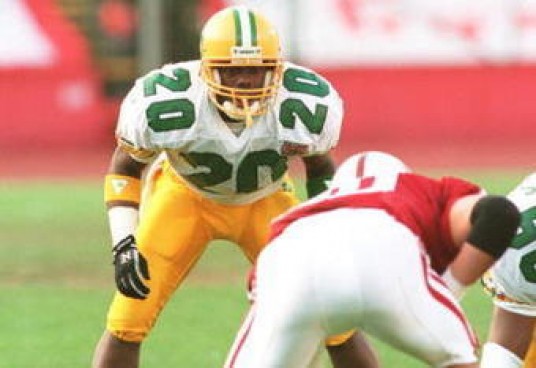
Junior cornerback Kenny Wheaton was the superstar of Oregon's 1996 defense, finishing the season as the team leader in tackles and an All-American
“Guys didn’t buy in to the defense, and I admit I was one of those guys. For the most part 95% of us didn’t buy into it until training camp, especially the veterans as we had been so successful doing things our way, but by then it was too late. There were times I was playing inside nickel, then corner, then safety. I put a lot of that on myself because at that time I was a team leader, it was nothing against coach Stubler, it was because it was something new, nobody understood why we were changing things so much when we had been so good.”
Opening the season in Fresno was an exciting trip for one Oregon player in particular, starting senior quarterback Tony Graziani, who had grown up in Modesto, CA, only about an hour’s drive away. Graziani was in his second year as starting quarterback, an agile lefty with the ability to improvise when plays went sour and possessing a cannon for an arm. Graziani was also on a learning curve, learning a new system under his third offensive coordinator. Many family and friends would be on hand, and the Fresno fans were well aware of the local kid who had left the area to find success up north in Oregon.
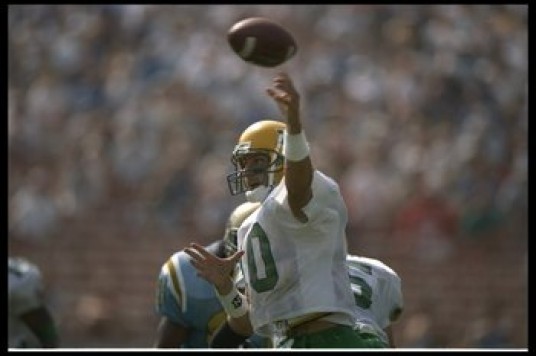
Oregon senior quarterback Tony Graziani was great at making plays with both his arm and his feet
“There was a lot of pressure on me to go to Fresno State, I took a bunch of heat from the locals when I chose Oregon,” Tony Graziani remembers, now retired after a lengthy career in the NFL and Arena League, who stays close to football by doing national radio broadcasts of NFL games. “Trent Dilfer was my host on my recruiting trip there, but I really wanted to get out of the valley and I had a great relationship with Coach (Rich) Brooks and Coach (Mike) Bellotti.”
Fresno State wasn’t unfamiliar with Oregon either, as assistant coach Kelly Skipper had been a high school superstar at Churchill High School in Eugene, OR, in the early 80s before a successful career at Fresno State where he still held several rushing records. Skipper grew up a Duck fan and stayed close to his hometown, visiting often and keeping an eye on the Ducks football team with the 1996 game and the subsequent 1997 rematch back in Eugene on the schedule.
Fresno State featured a powerful running back under Skipper’s tutelage, Michael Pittman, who would go on to a very successful career in the NFL. Pittman could beat a team with his speed, or was powerful enough to run over them. Fresno State had a reputation for blue-collar play, hard-hitting ground & pound style football, a reflection of the hard-working people of the central valley. None represented that philosophy better than Pittman, a combination of punishing size and speed. They had been incredibly successful despite disappointing overall records, being ranked in the top 10 in the nation in total offense five of the past six seasons.
Fresno State runningback Michael Pittman was a terror on defenses in the mid-90s before a long career in the NFL
Oregon senior linebacker Reggie Jordan was one of a handful of holdovers from the glory days of the Gang Green defense that had become famous in 1994, along with several other highly-touted veterans, none better than junior cornerback Kenny Wheaton.
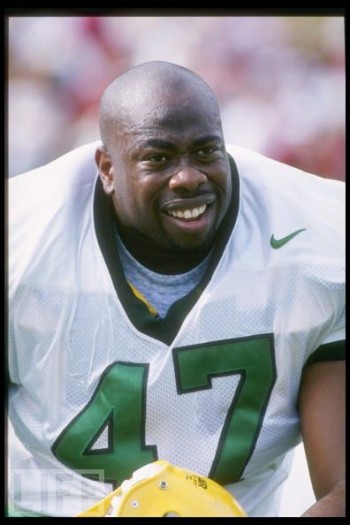
Senior Oregon linebacker Reggie Jordan was a key cog in the 1996 Duck defense
Wheaton had become famous two years prior as a freshman with his iconic pick six interception vs. Washington that spurred the improbable run to the Rose Bowl, but he was much more than just the one interception. Wheaton had finished third on the team in tackles in 1995 as a cornerback and named 2nd team All-American, a great player with a nose for the ball and ability to hit that was rarely seen from the CB position.
“It was great being able to practice against Kenny Wheaton everyday,” said Graziani. “Kenny was one of the most instinctual smart football players I have ever been around, one of the better I ever played with, he was special. I loved going against him, we made each other better, we used to talk so much trash. He knew if he could defend a pass from me or if I could get one past him that we could do it against anybody.”
Oregon’s offense featured a rotating crew of running backs including Kevin Parker, Jerry Brown and JC transfer Saladin McCullough all trying to replace the huge void left by graduated senior Ricky Whittle. Tight end Josh Wilcox epitomized the blue-collar hard-work mentality for the Ducks, while young wide receiver Patrick Johnson was one of the best deep threats in the country, though still somewhat inconsistent while still learning the nuances of the receiver position.
It is often said teams make the most progress between their first and second game, needing a tune-up game to start the season shaking off the rust of the off-season and getting into sync. This certainly applied to both teams as sloppy play defined the early going, but the one thing the game had no shortage of was big hits. In typical style for Oregon-Fresno State matchups that would follow, it wasn’t always pretty, but made up for aesthetics through sheer brutality.
In the opening drive Reggie Jordan made his presence felt early bringing down a Fresno player on a reverse for a 9-yard loss. Fresno State in turn responded with a couple big hits, quickly forcing an Oregon punt.
After the initial punts, Oregon struck the first blow. On Oregon’s second possession Tony Graziani dropped back and threw deep to Patrick Johnson, who had sprinted past the safeties bringing in the ball for an impressive 88-yard touchdown.
“I just tried to throw it as far as I could, I figured if you’re going to go deep you might as well toss it up to the fastest guy in the nation, Patrick Johnson,” said Graziani. “Thankfully I hit him in stride and he had the speed to break away.”
Fresno State answered with several long runs by Pittman, a sign of things to come, but couldn’t capitalize. Things would turn worse for Fresno in the short term, as another long drive into Oregon territory would end abruptly when Kenny Wheaton intercepted a pass along the sideline and returned it 69 yards for a touchdown.
“I pride myself on making plays before the game even starts, from watching film, “ Kenny Wheaton said, now retired after a long career in the NFL and CFL. “As a defensive back I learned from film that if the receiver comes out lined up on the numbers in a certain position that he was running an out pattern, so I knew before the snap he was running an out if they threw my way. I saw it, jumped it, and it was a clear path to the endzone. I had to cut back, couldn’t let the QB tackle me, but it was great to make a play like that for the team.”
Oregon was rolling 14-0, but there was reason to be concerned…Oregon’s secondary seemed more than up to the task, but this odd edge defensive scheme was having zero luck stopping Fresno State’s run game as Michael Pittman was chewing up big chunks of yards with every carry. If Fresno focused on running between the tackles and quit throwing towards Kenny Wheaton, they could potentially dominate this game.
It seemed to be playing right into Fresno State’s gameplan for the Ducks defensive line to line up a yard off the ball, for a team that liked to run right at a defense between the tackles it was a gift to give the Fresno offensive line momentum running downhill. After five carries Pittman was already over 40 yards, and the Bulldogs seemed more than content to slow down the game grinding it out 4-5 yards a pop. Oregon’s defense had the speed to roam sideline-to-sideline, but a shortage of healthy defensive linemen made for big run holes for Pittman and co.
Early in the 2nd quarter a deep play-action pass beat Kenny Wheaton to the corner, setting up Fresno State near the goal line, leading to an easy touchdown run by Michael Pittman.
While Oregon was leading thanks to two big plays, things were not clicking. The defense was having trouble against the run, and Oregon’s receivers were having a bad case of the drops. The running back-by-committee from Oregon was having zero success finding any running lanes. The Ducks offense was off the field almost as quickly as it got on, and the Oregon defense was quickly tiring in the Fresno heat.
Perhaps it was first game jitters, perhaps it was playing close to home in front of friends and family, or maybe it was the relentless pass rush, but Graziani and the rest of the Duck offense was nowhere to be found.
“We had a new offensive coordinator, it was Coach (Dirk) Koetter’s first game,” Graziani recalls.
“We were trying to get on the same page with him, but we had a lot of drops throughout the game, and every time it felt like we were finally getting on a roll we would shoot ourselves in the foot.”
However, Fresno State looked impatient, unwilling to grind out the game on the ground. They got pass happy, testing Oregon’s secondary deep with the safeties playing up near the line to stop Pittman. A dropped second interception by Kenny Wheaton on a deep pass where the ball was knocked out of his hands by Oregon cornerback Eric Edwards was quickly redeemed when Wheaton intercepted a pass on the following play, returning it 20 yards before eventually being brought down. With his second interception, Wheaton was momentarily the leading receiver in the game and also led in total yards, a bizarre anomaly for a cornerback.
“I guess they decided that they were going to go after me,” Kenny Wheaton remembers. “Their big wide receiver Brian Roberson made some comments in the newspapers before the game that he didn’t think I was that good and was coming after me. I took it personal, I was a 2nd team All-American the year before, I thought it was disrespectful. I came into that game with a chip on my shoulder and the mindset that you’re not gonna get it on my side.”
Fresno State’s offense had been known for having a potent offense in previous years, so perhaps it was not completely unexpected that Fresno would move the ball, but the way that the Bulldogs so easily ran at will against this supposedly innovative new defensive scheme was alarming. It was clear that the edge defense was completely ineffective at slowing down Fresno’s ground assault.
FSU liked to play traditional 3-yards-and-a-cloud-of-dust smashmouth football, but Oregon was giving them 3 yards before the 3-yards-and-a-cloud-of-dust. Fresno followed one long drive with another slowly moving the chains with one physical runs predominantly with Pittman. While Oregon had managed early to gouge Fresno with two big scoring plays, the Bulldogs were the exact opposite, 4-5 yards at a time content to slowly pound Oregon’s defense into submission methodically trekking down the field.
Yet while Oregon’s defense would bend badly in the middle of the field, they made life difficult whenever Fresno State got into scoring range. Oregon safety Brandon McLemore almost brought in an interception in the endzone but couldn’t hold onto it, the defense clearly fatigued as a Fresno drive progressed onto its 13th play from scrimmage. The next play the defense was again opportunistic, or maybe just lucky, as linebacker Caleb Smith’s leg knocked the ball loose from Pittman causing a fumble, recovered by Oregon at the 1-yard line.
A couple runs up the gut ran out the clock to halftime. Oregon led 14-7, but the momentum was clearly in Fresno State’s favor, Oregon leading solely because of the three forced turnovers and two long plays. The Ducks had been lucky, but at some point the offense would have to do something, Oregon’s defense looked completely gassed from the Fresno heat and lengthy drives.
Halftime offered no rest for the tired Duck defense, as the design of the stadium placed the visitor locker rooms so far away from the tunnel that the team has to sprint to reach it to quickly review the half and go over adjustments, then sprint back to return within the allotted time. For a team fatigued after long FSU drives and sweating in the Fresno heat, this was just cruel. No rest would come for the defense for quite some time.
The 2nd half began with Fresno State once again getting the ball, but the Bulldogs became impatient and pass happy. A Fresno fumble by their QB on a scramble was incorrectly called down, what should have been Fresno State’s fourth turnover of the day, and the Bulldogs immediately took advantage on a long pass completion to WR Brian Roberson where cornerback Eric Edwards got turned around, setting up FSU in the redzone.
A series of runs led to a short touchdown, despite numerous long drives that had ended with turnovers or stalls, Fresno State finally had tied the score at 14-14.
Fresno State was absolutely dominating the line of scrimmage on both sides of the ball. After the way the previous season had ended with a whimper in an embarrassing loss to Colorado in the Cotton Bowl, it looked like the tough times would likely continue. Nothing for Oregon was working except when Fresno foolishly chose to throw the ball in Wheaton’s direction. The defense couldn’t figure out how to play in this new edge defense, the offense couldn’t connect on any throws or create run lanes. It could be a long season ahead. Great individual efforts, particularly by Reggie Jordan, Kenny Wheaton, and Ryan Klaasen (who already had 16 tackles in the game by the third quarter) couldn’t carry the team by themselves.
The 3rd quarter continued where the 2nd quarter left off, long methodical drives by Fresno State and 3-and-outs for Oregon. The Ducks were extraordinarily fortunate for the score to be tied, but unless the offense started moving the ball that would be only temporary. There were broken tackles, big run lanes; all the signs of a tired defense unable to stop Fresno’s attack. By the mid-3rd quarter Fresno State had out-rushed Oregon 173-23 and held a 17-14 lead, but if not for the three turnovers this one might well be a blowout.
Finally, Oregon’s offense came alive. In what came to be his signature play throughout his career, tight end Blake Spence ran a seam route past the linebackers finding open space in the middle of the field for a 26-yard gain.
A few plays later a flea flicker resulted in a 32-yard touchdown pass to Damon Griffin. Again, the big play was coming through keeping Oregon in the game, but Fresno State continued to be the far more impressive team. Oregon had scored on 32 and 88-yard pass plays and a 69-yard pick-six, beyond that nothing had worked.
“On the flea flicker, we just wanted to get back on the scoreboard,” said Graziani. “We knew we had to get back on the scoreboard. The defense had been grumbling in the first half with the amount they had to play, unfortunately that drive was so quick they didn’t get much rest.”
A bruising run by Michael Pittman finished off yet another long 16-play drive to retake the lead 24-21, a play that also injured Oregon safety Brandon McLemore in a wicked collision at the goal line. Oregon’s defense was running on fumes, and the offense had done nothing to give them a chance to rest. The broadcast team Todd McKim and Ken Woody could only marvel at the dominance, “I can’t remember the last time Oregon’s defense gave up so much yardage on the ground,” said McKim, bewildered.
By the mid-4th quarter Oregon had run for only 13 yards in the 2nd half, but Graziani managed to make a play with his feet, buying time rolling out and throwing against his body to find wide receiver Jibri Hodge for a first down.
Oregon was down, but not out. Turnovers and lucky plays had kept them in it, but there was no quit in the Ducks. Oregon had brought five tailbacks on the travel roster, but had all but abandoned all aspects of the run game to Fresno State’s tough defense, it was an all-out pass attack by the Ducks to just keeping hanging on. Desperate to give the defense some rest knowing Fresno State could continue to run at will, Oregon went for it on a 4th & 4, but the pass intended for tight end Josh Wilcox was knocked away.
Then, something changed, Oregon awoke from their fatigued slumber. Fresno State had bled the clock with a 3-point lead, but a big play by LB Reggie Jordan forced a 4th down. The defense had finally made a stop.
The subsequent punt pinned Oregon at the 1-yard line, needing to go the length of the field to win with little time left on the clock. The task ahead was daunting, and while the defense sat on the sidelines sucking oxygen the offense knew it was now or never.
Oregon had done very little all day, plagued with dropped passes and the inability to slow Fresno’s rushing attack. The Ducks were 1 for-8 on converting 3rd downs in the game, but on 3rd down when a play absolutely had to be made, somehow quarterback Tony Graziani found a way. Breaking nearly every rule there is about playing quarterback, Graziani rolled out in the endzone buying time with his feet, running out of real estate pinning himself in the corner of the endzone he then threw across his body to the opposite side of the field connecting with running back Kevin Parker for a first down.
“I just remember it being third down and I had to make a play,” said Graziani. “I could always do that well, when a play broke containment I could get out of the pocket and make plays with my feet. I was very fortunate to convert that play, and it really jump-started our offense. It reinvigorated us, woke us up, it was absolutely do or die and somehow we made a play to stay in it. Fresno State head coach Jim Sweeney approached me after the game and said that was the play that lost the game for them, and that if I had decided to be a Bulldog the game would have been a blowout, I appreciated that.”
Oregon had escaped from their own endzone, but still had a long way to go to steal this victory away from this Bulldog team that had vastly outplayed Oregon.
Graziani then threw a short dump off pass to fullback Eric Winn who rumbled his way upfield for a 15 yard gain.
Oregon then caught Fresno off-guard with a draw to Jerry Brown, who ran for a first down and got out of bounds to stop the clock.
Now at midfield, a deep pass to wide receiver Damon Griffin had Oregon on the edge of field goal range.
After a couple incompletions on 3rd & 10 Griffin again made a big play, catching a pass over the middle and taking a huge hit while diving to just barely get the first down.
Oregon had driven almost the length of the field, now set up on the 10-yard line with less than a minute left in the game. A touchdown would win it, a field goal would likely send the game to this crazy new college overtime scenario that nobody had ever experienced before.
Then came one of the strangest referee calls ever that almost gave the game back to Fresno State. Tony Graziani dropped back to throw, but a pass rusher was in his face. In a panic Graziani threw towards fullback Eric Winn, who was knocked down by a defender as Graziani was simultaneously knocked to the ground. A good 10-15 seconds passed until a flag was thrown.
At first it seemed obvious to be either roughing the passer or pass interference against Fresno State for the hits sustained by both Graziani and Winn. But when the referee indicated intentional grounding, for a pass that nearly hit the receiver, the Oregon sideline exploded. Graziani and Kevin Parker pleaded with the referee, then ran to the next official and stated their case to them. Then the next official. Then the next official. How could they call intentional grounding in this situation, so close to the goal line, with almost no time left, when the pass almost hit the intended receiver?
Their pleas didn’t work, intentional grounding remained the call, and Oregon was now backed up to the 25 on 3rd down with almost no time left.
“It was just a horrible call,” Graziani remembers. “I mean I understand that the refs are human too. It was a really heated exchange because of the situation and time left, here was a Pac-10 team that had been to two new years day bowls in a row playing at a WAC school, I’m not gonna say the refs were trying to give the game to Fresno, but it was just a horrible call.”
With one chance left to try to win it, Graziani threw a beautiful pass on the move to the back of the endzone to true freshman wide receiver Tony Hartley, the first pass thrown his way in his career, but he dropped it despite the ball hitting him squarely in the hands behind the coverage. Hartley would go on to break nearly every receiving record at Oregon during his career, but it was an embarrassing way to start.
“Tony felt horrible about that,” Graziani recalls. “Obviously to drive all the way down and then for that to happen, I felt bad for Tony just for the fact that I knew how much he cared, but at least we had learned that we could drive on them so we felt good about overtime.”
The Ducks had improbably driven nearly the length of the field to steal the game away from Fresno State in their house, but a bad call and another bad drop had left them just short. With mere seconds remaining, Joshua Smith hit a 38-yard field goal, tying the game. Fresno State chose to run out the remaining clock, and the very first overtime game in college football history was about to begin.
There was a lengthy delay before the coin toss for overtime occurred, as each team huddled (as did the referees) to go over the new overtime rules, while the P.A. system went into it in great detail for the crowd. It had been explained and practiced in training camp, but to do it in a game for the first time was something different. Eventually after several minutes the coin toss occurred, with Oregon winning the flip and taking the ball second. This is common strategy today, but at the time nobody was quite sure how the overtime scenario would play out.
“Coach Bellotti had actually done a really good job of preparing the offense for overtime,” said Graziani. “He went over the rules, and we dedicated an entire practice in fall camp to overtime, so we had an idea of how it worked and what we wanted to do, but still nobody was exactly sure how it would work.”
The one great benefit about the delay was that Oregon’s defense was finally able to get a breather. It had been a long game for the Ducks defense, punished all night playing against a vicious running game and the offense going 3-and-out for much of it, the final drive Oregon put together to tie it was their first chance to rest since the opening kickoff. The distance to the Bulldog Stadium visitor locker rooms provided no relief at halftime. The long Oregon drive at the end and delay before the start of overtime was just what the Oregon defense needed to catch their breath and recoup for one final big effort. Not everyone was exactly clear on the overtime rules, but they knew if they could get a stop that the Ducks would probably win.
“It was explained and talked about in camp, but overtime was something none of us had ever been in,” said Wheaton. “Until you experience it there’s still some uncertainty. It was a shock, first time ever going into overtime, it was confusing from the start. I didn’t quite know what was going on, only thing I remember was that each team got the ball. There was no real strategy other than try to stop them. Fortunately the long drive and break before the start of overtime was a chance to rest. I’m not gonna lie, I was really hurting out there. It was a long game for our defense, first time I ever had to use oxygen on the sideline. During that break the veterans stepped up and said ‘they can’t score, stop them and we win.’ We may not have known exactly what the rules were, but we knew if we could just stop them once we would win.”
They would need every ounce of effort remaining in those fuel tanks running on fumes, legs feeling like jell-o. Fresno State took the ball first in overtime and immediately went back to what they did best, pounding Michael Pittman up the middle for a six yard gain. The next play it was Pittman again, but linebacker Peter Sirmon stepped into the hole and dropped him for just a yard. This set up a 3rd and 3, Oregon’s defense concerned with just one thing, stopping Fresno at all costs.
Fresno threw a pass putting the ball in their best receiver’s hands, Brian Roberson, but Sirmon again came up with a huge hit stopping him just short of the first down.
Not wanting to press their luck, Fresno State chose to take the easy field goal. Oregon had to now match it, or they could win with a touchdown…it didn’t take long to decide the outcome.
On Oregon’s first play Tony Graziani faked a handoff to Jerry Brown then dropped way back to avoid the pass rush, releasing a pass just before getting clobbered to the corner of the endzone to tight end Josh Wilcox, who had found a gap in the zone coverage. Wilcox reeled it in and snuck into the corner for a 25-yard touchdown. Ballgame over.
“It was a waggle to Josh (Wilcox),” Graziani remembers. “The safety came up on the play-action fake, and I was able to throw a good ball and he caught it, it was pretty surreal. I got hit pretty good at the end of it, I stayed on the ground for awhile, part exhaustion part jubilation part exuberance part relief.”
Oregon had somehow hung in there all game getting steamrolled play after play, but with the heroics of Kenny Wheaton and the late drive to tie it followed by the touchdown pass to Wilcox, Oregon had stepped into Bulldog Stadium and stolen an assured victory right out from under the Bulldogs. Not just any win, the first college football overtime win in history, 30-27, nothing like it had ever been seen before. Many Duck players were simply too exhausted to celebrate much, just happy to escape with a win.
“The game took a lot out of us,” said Graziani. “The emotions, the fatigue, the heat, we were just relieved and couldn’t wait to get out of there.”
Graziani had thrown 19 for 32 for 316 yards and 3 touchdowns, voted the player of the game. But the stats were only part of the story, despite a miserable performance leaving the defense hanging for 58 minutes of the game, Tony had rallied the troops and somehow willed the Ducks to get the job done when somebody absolutely needed to make a play. To top it all off, he had perservered in front of friends and family, and one teammate made sure that the Graziani family remembered this night forever.
“When Josh caught the touchdown, he kept the ball,” Graziani recalls. “My mom had been diagnosed with cancer and was going through treatment, they interviewed her before the game and she had this crazy wig on because all her hair had fallen out. Josh hung onto that ball all the way back to the showers, and as soon as he got out he presented the game-winning ball to my mom, painted with the score. I still have that ball, it means a lot to me.”
Kenny Wheaton played a lot of games over his long career in college, the NFL, and CFL, but this game stands out to him as well. “It’s in the top three of being the most exhausting games I ever played in. I was cramping up and sucking oxygen in the first half of that game, I’d never had that happen before. I don’t think there was ever a game where I played more snaps than that night. I was absolutely exhausted, I was just about finished in the first half, it was great we didn’t have to go out there again because we were beat.
It was a big win, it was sweet, but there was also a real bitterness there because we had struggled. I remember telling my parents ‘we need to change something quick, we didn’t stop the run.’ If you don’t stop the run your chance of winning is slim to none. From a personal side I had a good game, I didn’t believe for a second coming into that season that I would get a lot of balls thrown my way but I ended up with two interceptions. From a team point of view, I was proud that we fought and so many young guys stepped up and played hard. They could have hung it up, but when it came down to it they made the plays needed to win. That game embodies what Oregon football is all about. We had a bunch of guys that had chips on their shoulder and they were going to fight to the end. We didn’t quit. It wasn’t pretty, but it was a win. We had learned from the 1994 season to be stubborn, don’t quit, we didn’t know any better but to win.”
The game was the perfect representation for the 1996 season. It was a game where Oregon was still learning, adapting to new coaches and systems, not quite clicking, yet somehow hanging tough refusing to quit and finding a way to win. Grit and toughness overcame faults in scheme or overall talent for the system.
“We were a team that just refused to lose,” Graziani recalls. “We had a will to win, we were talented back then but not always as good as everybody else out there, but somehow we’d find a way to make a play when it was needed and get the victory.”
The Ducks would win their next two games, before going on a 5-game losing streak including another overtime game, after Tony Graziani suffered an injury that kept him out for much of his senior year. Halfway through the season the edge defensive scheme implemented by Rich Stubler was scrapped, and the Ducks returned to the standard defensive approach that had worked so well in 1994 & 1995, but it was too late. After spending all of spring practice and fall camp and the first few games trying to learn this new defense, to then scrap it and return to what had been done before was too much change and adjustment for the players to handle, and the defense suffered despite a phenomenal season from Kenny Wheaton. As a cornerback Wheaton would lead the team in tackles that year, something almost unheard of from a CB.
Still, there was no quit, and the Ducks rallied to win their last three games, including a dismantling of Oregon State in Corvallis, OR, 49-13, scoring at least 40 points in their last three games upon the return of Graziani. At 6-5 the Ducks did not get a bowl invite, one of only two years under Head Coach Mike Bellotti’s 13-year tenure that the Ducks would not participate in postseason play.
As with every year there would be attrition, as Tony Graziani, Reggie Jordan, and other seniors left, while Kenny Wheaton decided to become the first Oregon Duck player in school history to depart early for the NFL.
Defensive Coordinator Rich Stubler and his experimental edge defense would be shown the door. Yet the lessons learned from 1996, the toughness and never-say-die attitude would carry over into future seasons, and the offensive explosion witnessed over the final three games extended into the 1997 and 1998 seasons as the Ducks transitioned from being one of the top defensive teams in the country in the Brooks-era into one the top offenses in the nation.
There would be more overtime games as well, including the very next season an overtime rematch against Fresno State that again saw Oregon emerge victorious in thrilling fashion, 43-40. Two years later a triple overtime thriller in 1999 vs. USC would be a night never to be forgotten in Autzen Stadium history, followed by an unbelievable 2000 double overtime win vs. ASU, and a double overtime victory at Arizona in 2009 most notable among Oregon’s future overtime games. Oregon rarely if ever lost games in overtime, somehow finding a way to rally when it counted most, just like that one hot night in Fresno when the overtime rules were first tested and an exhausted team simply refused to lose.
The first overtime in college football history in its entirety can be seen below:
-Kenny Wheaton lives in Dallas, TX and Phoenix, AZ, and operates the Kenny Wheaton Foundation, helping underprivileged youth in Oregon.
-Tony Graziani is retired from football after a 15 year career that spanned the NFL and Arena League. He resides in Palm Desert, CA with his family and works in real estate with TD Desert Properties, while also participating in national radio broadcasts of NFL games during the football season.
Subscribe to:
Posts (Atom)